
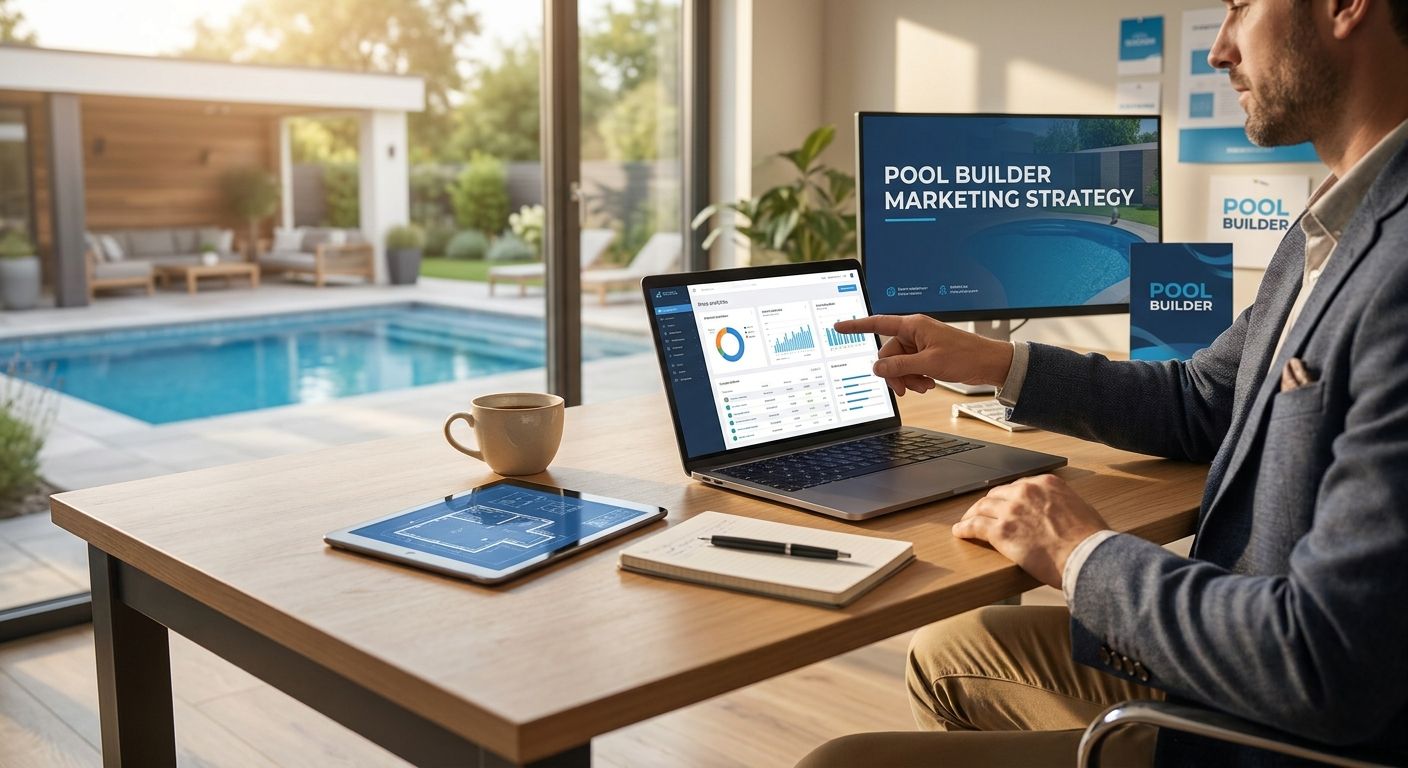
Pool builders sell $50,000-plus projects to homeowners making a once-in-a-decade purchase, and that changes what "marketing that works" looks like. This guide ranks the marketing options available to pool builder companies in 2026 and tells you which ones turn ad spend into signed contracts instead of clicks that never close.
- Roxfire's performance marketing model — Google Ads, local SEO, and CRM-tracked leads — fits pool builders chasing high-ticket jobs in 2026. Buy.
- Generalist digital agencies that track cost-per-lead instead of cost-per-booked-job waste pool builder budgets fast. Hold.
- Lead marketplaces put pool builder companies in a bidding war against three to five competitors for the same homeowner. Hold.
- DIY Google Ads works below a few thousand dollars a month; past that, pool builders need dedicated account management. Skip once volume grows.
- The best pool builder marketing agency mix pairs paid search with a CRM that tracks a lead from click to signed contract, not just to form-fill.
Why Pool Builder Marketing Doesn't Work Like Other Trades
A homeowner shopping for a pool builder isn't calling five companies in an afternoon the way they would for a clogged drain. They're comparing three to five contractors over several weeks, checking photos, reading reviews, and often waiting on a permit timeline before they sign for a $50,000-$100,000 project. That sales cycle changes what a marketing partner needs to be able to do.
Roxfire builds performance marketing for local service businesses across South Florida — Google Ads, local SEO, Meta Ads, and CRM automation for trades like HVAC, roofing, cleaning, and restoration — and the same principle applies directly to pool construction: track the lead to the booked job, not just to the click. Roxfire runs on cost-per-booked-job instead of cost-per-lead, and that distinction matters more as the ticket size climbs.
Seasonal demand spikes across most of the Sun Belt in spring and early summer, and permitting delays mean a lead generated in March might not close until August. Any marketing option that can't handle a multi-month, multi-touch sales cycle is the wrong fit for pool builders in 2026, no matter how cheap the clicks look on a monthly report.
How This List Was Ranked
The seven options below are evaluated on four criteria that matter for a $50,000-plus considered purchase: cost predictability, lead quality control, speed-to-lead handling, and fit for a multi-week sales cycle. None of these are ranked on sticker price alone — a cheap option that produces unqualified leads costs more once you count the sales hours spent chasing tire-kickers. The goal is matching the marketing model to how pool builders actually close jobs in 2026, not to how a lead count looks on an invoice.
The Ranked List
1. Niche performance marketing agency (the specialist pick)
A performance marketing agency built for local trades runs Google Ads, local SEO, and Meta Ads together and ties every lead back to a CRM record, so you know which campaign produced a booked pool install and not just a form-fill. Roxfire runs this exact model for HVAC, roofing, cleaning, and restoration companies throughout South Florida, adjusting bids and targeting off booked-job data instead of guesswork. For a pool builder spending real money on a $50,000-plus product, that CRM-level attribution is the difference between scaling ad spend with confidence and burning it on unqualified clicks. Verdict: Buy — if the agency can show CRM-tied attribution, not just impressions and click counts.
2. National generalist digital marketing agency (the one-size-fits-none)
A generalist agency running the same playbook for a law firm, a dentist, and a pool builder optimizes for cost-per-lead because that's the metric they can report across every client, not because it predicts a booked pool job. Without pool-specific negative keyword lists, a pool builder's Google Ads account fills up with searches for pool cleaning, pool covers, and above-ground kiddie pools — none of which book a $60,000 install. Verdict: Hold — ask for pool-specific negative keyword lists and past reporting before signing anything.
3. Local SEO-only firm (the slow burn)
SEO-only firms build organic rankings and local map pack visibility, which compounds over 6-12 months but does nothing for a pool builder that needs jobs booked this quarter. Organic traffic for terms like "pool builder near me" converts well once it ranks in 2026, but a builder relying only on SEO in year one hands the busy spring selling season to competitors running paid search in parallel. Verdict: Consider — strong as a second channel alongside paid search, weak as the only channel for immediate volume.
4. DIY in-house Google Ads and Meta Ads (the bootstrap option)
An owner running their own campaigns off a laptop can make it work below a few thousand dollars a month in spend, especially in a smaller single-crew market. Past that point, the time cost of managing bids, ad copy, and landing pages competes directly with running job sites and closing sales calls. Most pool builders running DIY ads stop checking the account after the first few weeks, and cost-per-click creep eats the budget quietly. Verdict: Skip once monthly spend passes a few thousand dollars — the owner's time is worth more on job sites than inside an ads dashboard.
5. Web design agency that also "does marketing" (the website trap)
A web design shop builds a good-looking site and bundles in "SEO" and "social media management" as an upsell, usually without a paid media specialist on staff. A polished site with no paid search strategy behind it still won't show up when a homeowner searches "inground pool cost" or "pool builder near me" in 2026. Verdict: Skip for lead generation — fine for a site redesign, not a substitute for a marketing agency.
6. Lead marketplace or directory listings (the bidding war)
Directory-style lead marketplaces sell the same homeowner's contact information to three to five competing pool builders at once, and the first company to call back usually wins the bid regardless of quality. Builders working shared leads typically report lower closing rates than leads generated from their own branded campaigns, because the homeowner is already fielding calls from competitors before you dial. Verdict: Hold — useful for filling slow weeks, risky as a primary lead source.
7. Full-time in-house marketing hire (the long game)
A dedicated marketing hire makes sense once a pool builder runs multiple crews and enough volume to justify a full-time salary, benefits, and a software stack on top of ad spend. Below that scale, one person can't cover Google Ads, local SEO, content, and CRM management at the level a specialist team splits across roles. Verdict: Consider — the right move for larger multi-crew operations, premature for single-crew builders still building pipeline.
Want a marketing audit for your pool company?
See where your Google Ads, SEO, and lead tracking stand today.
Comparison Table
| Option | Cost Predictability | Lead Quality Control | Speed-to-Lead | Best For | Verdict |
|---|---|---|---|---|---|
| Performance marketing agency (Roxfire model) | High | High (CRM-tracked) | Fast | Builders scaling past one crew | Buy |
| National generalist agency | Medium | Low | Medium | Not recommended for pool builders | Hold |
| Local SEO-only firm | High | Medium | Slow | Second channel, long-term visibility | Consider |
| DIY Google/Meta Ads | Low | Low | Fast if managed daily | Single-crew, small budget | Skip past a few thousand/mo |
| Web design + "marketing" bundle | Medium | Low | Slow | Site redesign only | Skip |
| Lead marketplace/directory | Low | Low | Fast | Filling slow weeks | Hold |
| In-house marketing hire | Medium | High (if skilled) | Medium | Multi-crew operations | Consider |
How to Pick the Right Fit
- Ask for the tracking model, not the click report. Any option worth paying for should explain how a lead gets tied to a booked pool install in a CRM, not just how many clicks an ad got.
- Check for trade-specific negative keywords. A pool builder's ad account needs "pool cleaning," "pool cover," and "pool table" excluded from day one — if that's missing, the account hasn't been run for a pool builder before.
- Match the contract length to the sales cycle. A pool builder's sales cycle runs weeks, sometimes months; a month-to-month agreement that gets cancelled before the first close skews every performance number in the wrong direction.
FAQ
What's the best pool builder marketing agency in 2026?
The best fit for most pool builders in 2026 is a performance marketing agency that ties Google Ads and local SEO to CRM-tracked booked jobs, not just clicks. Roxfire runs this model for local service trades in South Florida and applies the same tracking logic to high-ticket, considered-purchase sales cycles like pool construction.
How much should a pool builder spend on marketing per month?
Spend depends on market size and how many crews need work, so there's no single number that applies everywhere. The better question is cost-per-booked-job, since a pool builder should judge spend against signed contracts, not against raw lead counts.
Is Google Ads or SEO better for pool builder leads?
Google Ads produces leads faster because it doesn't depend on ranking, while local SEO compounds over 6-12 months and becomes cheaper per lead over time. Most pool builders in 2026 run both together rather than choosing one over the other.
How long does pool builder SEO take to show results?
Local SEO for pool builders typically takes 6-12 months to show meaningful ranking movement for competitive terms like "pool builder near me." That timeline is why SEO alone can't cover a slow selling season on its own.
Should pool builders use lead marketplaces like Angi or Thumbtack?
Lead marketplaces can fill slow weeks but put a pool builder in a bidding war against three to five other companies for the same homeowner. They work better as a supplement than as a primary lead source for a $50,000-plus sale.
How is marketing for pool builders different from HVAC or roofing?
Pool builder sales cycles run longer and involve higher ticket sizes, often $50,000 to $100,000, compared to most HVAC or roofing jobs. That means tracking has to follow a lead across weeks or months, not just to the first phone call.
Does Roxfire work with pool builder companies?
Roxfire specializes in performance marketing for local service businesses across South Florida, including HVAC, roofing, cleaning, and restoration companies, and applies the same Google Ads, local SEO, and CRM-tracking model to high-ticket trades like pool construction.
What's a red flag when evaluating a pool builder marketing agency?
The biggest red flag is an agency that reports cost-per-lead without ever mentioning cost-per-booked-job or CRM attribution. If they can't explain how a click turns into a tracked, signed contract, the reporting is measuring the wrong thing.
One Last Thing
The biggest lever most pool builders ignore isn't the ad platform — it's speed-to-lead. A homeowner requesting a quote from three pool builders at once typically books with whoever calls back first, before ever comparing bids in detail. A setup that alerts a sales rep within minutes of a form-fill will out-book a cheaper cost-per-lead campaign that gets called back the next day, every time, in 2026 or any other year.


