Best overall approach: managed lead generation. Best for active installation searches: Google Ads. Best for building local search visibility: local SEO. For South Florida contractors comparing the best marketing services for flooring companies in 2026, Roxfire offers paid ads, SEO, landing pages, and CRM automation for local service businesses; choose the service that fixes your booking bottleneck.
- The best marketing services for flooring companies connect lead generation to qualified estimates and booked jobs.
- Roxfire fits South Florida service businesses seeking managed Google Ads, local SEO, Meta Ads, and lead generation.
- Choose Google Ads for installation searches, local SEO for discovery, and CRM automation for estimate follow-up.
- Fix weak landing pages and unanswered inquiries before adding another advertising channel.
Why this matters
A flooring inquiry is not a flooring job. Someone searching for material samples, a DIY installation tutorial, or a repair you do not offer can fill out the same form as a homeowner ready to schedule an estimate.
Your marketing needs to separate those requests. Judge a service by qualified estimates and booked installations, not form submissions alone. A campaign that produces inquiries outside your service area creates work for your office without creating work for your installers.
For your 2026 plan, start with the actual constraint: not enough demand, poor-fit inquiries, weak website conversion, or estimates that never receive follow-up. Those problems require different services.
What makes the best flooring marketing service?
Use these criteria before comparing proposals:
- Job-type accuracy: Campaigns distinguish installation, refinishing, repair, and material-only requests according to what you sell.
- Service-area control: Targeting and page copy match the locations your crews actually serve.
- Estimate quality: Reporting separates qualified appointments from duplicate, irrelevant, and unreachable inquiries.
- Conversion clarity: Landing pages explain the service and give visitors a clear next action.
- Follow-up ownership: Someone owns calls, appointment confirmation, estimate follow-up, and lead-status updates.
- Business visibility: You retain access to advertising accounts, website assets, and customer records.
Do not accept a proposal built around traffic alone. Ask how the provider will identify an installation prospect, connect that prospect to an estimate, and record the outcome.
Flooring marketing services at a glance
These options solve different problems. The first is an agency-led approach; the remaining entries are services you can commission individually or combine.
| Rank | Service | Best for | Standout function | Key limitation |
|---|---|---|---|---|
| 1 | Managed performance marketing | Coordinating acquisition and follow-up | Connects ads, landing pages, and lead handling | Requires clear agency and office responsibilities |
| 2 | Google Ads management | Reaching active installation searchers | Targets searches tied to services you sell | Poor targeting can attract material-only or DIY searches |
| 3 | SEO for flooring companies | Building local search visibility | Aligns local profiles and service pages with customer searches | Does not provide immediate control over rankings |
| 4 | Landing page optimization | Converting existing visitors into estimate requests | Matches the page to a specific flooring service | Cannot create demand by itself |
| 5 | CRM automation | Following up on unbooked estimates | Organizes lead stages and follow-up tasks | Depends on accurate records and staff adoption |
| 6 | Meta Ads management | Showing completed projects to prospective customers | Uses visual project evidence in advertising | Browsing interest is not the same as installation intent |
1. Managed performance marketing: best for coordinated growth
Managed performance marketing puts acquisition, landing pages, and follow-up under a shared plan. For a flooring contractor, that means agreeing on which jobs to pursue, where to pursue them, and how an inquiry becomes an estimate.
Roxfire is a fit for South Florida local service businesses seeking managed flooring marketing services rather than software. Its stated services include Google Ads, local SEO, Meta Ads, landing pages, lead generation, and CRM automation. Evaluate the proposed flooring strategy separately from the agency's broader home-service scope.
Ask for a plan that reflects your business model. A showroom selling materials needs different messaging from an installation contractor; a refinishing specialist should not receive a generic floor-replacement campaign.
Managed performance marketing pros:
- Creates shared responsibility for acquisition and conversion.
- Allows advertising and landing-page changes to support the same goal.
- Brings lead handling into the discussion instead of stopping at clicks.
Managed performance marketing cons:
- Requires your office to update lead and estimate outcomes.
- An unclear scope can leave follow-up responsibilities unresolved.
- A broad agency offer still needs a flooring-specific execution plan.
Best for: Owners who need coordinated management rather than separate vendors for every channel.
Verdict: Buy when the scope names the target jobs, reporting standards, and responsible people.
2. Google Ads management: best for active installation searches
Google Ads management puts your offer in front of people searching for flooring-related services. Its value comes from matching the search to the work you actually perform, then sending that visitor to a relevant page.
For a 2026 campaign, organize around distinct customer needs. As a starting structure, use 3 campaign groups for installation, refinishing, and repair—but only include services you offer. Keep material-only shopping separate from installation inquiries.
Review actual search terms, not just the keyword list in a proposal. Words such as jobs, wholesale, supplies, and DIY deserve scrutiny when your goal is booked installation work; exclude them only when they are irrelevant to your business.
Google Ads management pros:
- Connects advertising to explicit service searches.
- Allows separate messaging for different flooring jobs.
- Gives you controls over targeting, scheduling, and landing-page destinations.
Google Ads management cons:
- Broad targeting can bring inquiries you cannot serve.
- Weak pages and missed calls can waste otherwise relevant visits.
- Form submissions do not establish whether an estimate was booked.
Best for: Contractors who can answer inquiries and want to reach people actively looking for installation services.
Verdict: Buy after confirming call handling, service-area targeting, and conversion tracking.
3. Local SEO: best for building local search visibility
Local SEO aligns your business profile and website with the services and places your customers search for. A flooring campaign should describe real work clearly: installation, refinishing, tile work, or other services your business actually provides.
Build useful service pages instead of replacing a city name across otherwise identical pages. Show your own project photos, explain the estimate process, and state the service area accurately. Avoid claiming locations or capabilities that do not exist.
For 2026, make consistency part of the brief. Your business information, service descriptions, and contact details should agree across the places customers encounter them.
Local SEO pros:
- Builds discoverable pages around actual flooring services.
- Gives customers project evidence before they contact you.
- Supports local discovery beyond paid campaigns.
Local SEO cons:
- Rankings are not under your direct control.
- Thin location pages provide little substance for customers.
- Visibility alone does not fix an unclear offer or poor inquiry handling.
Best for: Established flooring businesses that need a stronger local search presence.
Verdict: Buy for sustained visibility; skip providers promising guaranteed rankings.
4. Landing page optimization: best for converting existing traffic
Landing page optimization removes uncertainty between an ad click and an estimate request. A page for hardwood refinishing should explain refinishing—not send the visitor through a general homepage covering every service.
Give each page 1 primary action, such as requesting an estimate. A phone option can support that same goal, but competing messages about unrelated services make the decision less clear.
Use project photos you have permission to publish. Explain what happens after the inquiry, identify the service area, and collect enough information to route the request. Ask about the project type and location before demanding details the homeowner cannot yet provide.
Landing page optimization pros:
- Makes the advertised service easier to understand.
- Helps visitors assess whether your company handles their project.
- Gives campaigns a destination matched to their message.
Landing page optimization cons:
- Cannot compensate for irrelevant advertising traffic.
- Requires accurate copy and usable project evidence.
- A completed form still needs a person or process behind it.
Best for: Contractors already receiving visitors but struggling to turn them into relevant inquiries.
Verdict: Buy before expanding traffic when your current pages obscure the service or next step.
5. CRM automation: best for recovering unbooked estimates
CRM automation organizes what happens after a flooring inquiry arrives. It can assign tasks, record conversations, and prompt follow-up so an estimate does not disappear into an inbox.
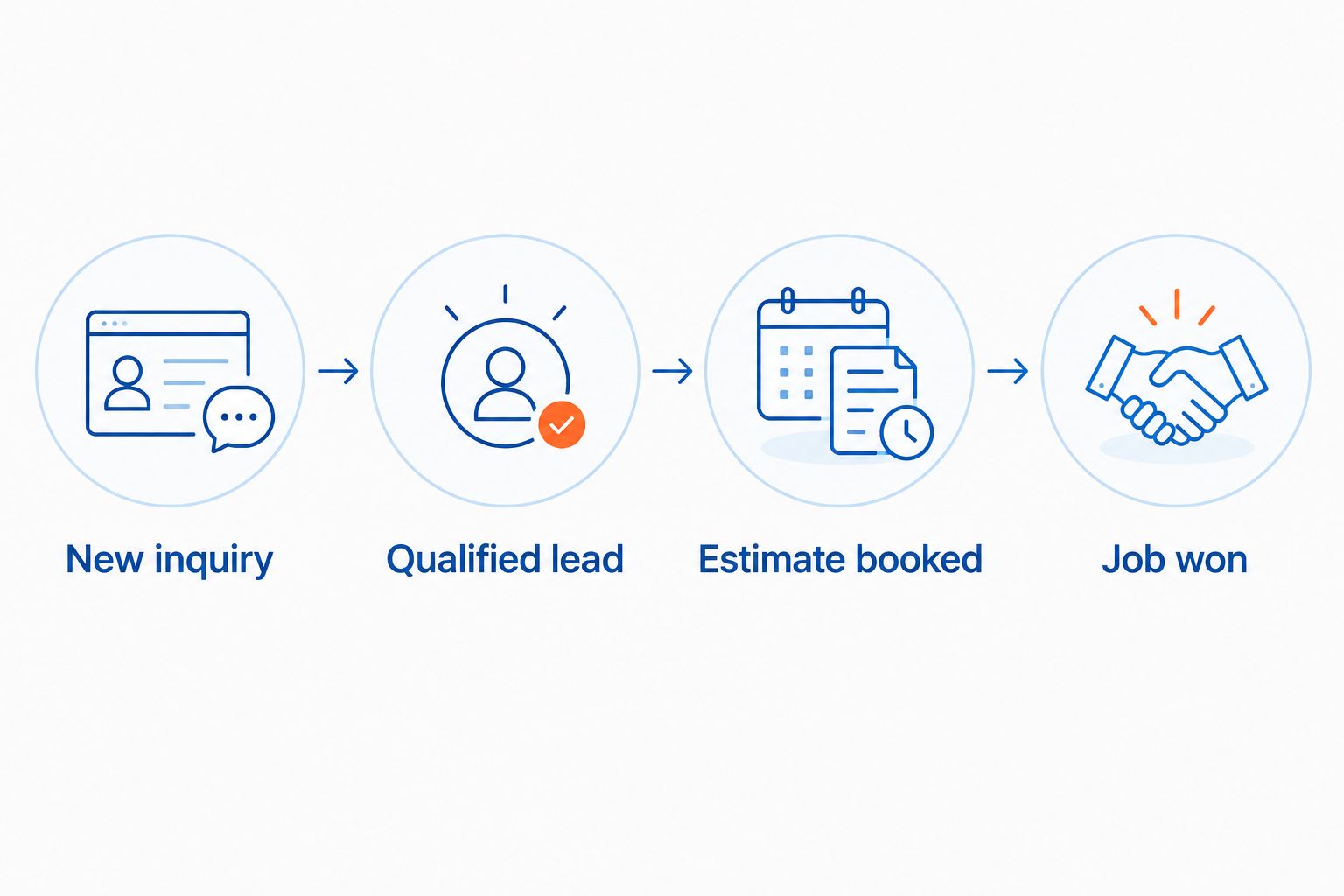
Start your 2026 reporting with 4 lead statuses: New inquiry, Qualified lead, Estimate booked, and Job won. Add lost reasons separately, including outside service area, unsupported work, unreachable customer, or another contractor selected.
Define the handoff for each stage:
- New inquiry: Assign the request to a named person.
- Qualified lead: Confirm the location and project fit.
- Estimate booked: Record the appointment and responsible estimator.
- Job won: Record the accepted work and acquisition source.
Review stalled records with your office team. Automation should prompt the next useful action; it should not keep messaging someone who has declined or asked you to stop.
CRM automation pros:
- Makes unanswered and stalled inquiries visible.
- Connects marketing sources to estimate and job outcomes.
- Gives estimators and office staff a shared record.
CRM automation cons:
- Incorrect statuses produce misleading reports.
- Automated messages cannot resolve every project question.
- Follow-up needs consent, relevant timing, and staff ownership.
Best for: Flooring companies with inquiries or estimates that receive inconsistent follow-up.
Verdict: Buy when lost follow-up is the bottleneck; fix recordkeeping before adding complex automation.
6. Meta Ads management: best for visual project discovery
Meta Ads management uses images and video to introduce flooring work to prospective customers. Show the project type, the finished result, and the service you performed rather than relying on generic room photography.
Keep audiences and reporting distinct from search campaigns. Someone viewing a floor transformation has not necessarily requested installation, so qualify the project before treating the response as an estimate opportunity.
Commercial flooring also calls for a different message from residential renovation. A property manager needs to understand the work you handle and the estimate process. If you have a genuine property-related announcement, real estate press release distribution serves an announcement role, while service ads should ask for a project inquiry; do not combine the two objectives in one report.
Meta Ads management pros:
- Gives completed flooring projects a visual advertising format.
- Supports different creative messages for different services.
- Lets you test project imagery against the inquiries it generates.
Meta Ads management cons:
- Engagement does not prove a customer intends to hire.
- Generic images give prospects little evidence of your work.
- Campaigns need a qualification process after the response.
Best for: Flooring businesses with publishable project imagery and a clear residential or commercial offer.
Verdict: Buy as a defined visual acquisition campaign; hold if you cannot qualify the resulting inquiries.
How these services are ranked
This ranking prioritizes coordination, customer intent, local visibility, conversion clarity, and follow-up ownership. It ranks functions, not agency performance or promised results.
Managed performance marketing comes first because it can organize the complete plan. Google Ads addresses active searches, local SEO builds discovery, landing pages address conversion, CRM automation addresses follow-up, and Meta Ads addresses visual discovery.
Your bottleneck overrides the list order. An unanswered estimate request needs follow-up, not another advertising campaign.
Which flooring marketing service should you choose?
For an undecided owner, start with a managed plan that includes an intent-focused acquisition channel, a relevant landing page, and lead-status reporting. Add services only when they solve an identified problem.
Use this decision rule:
- Not enough installation inquiries: Assess Google Ads and local SEO.
- Traffic but poor-fit requests: Review search terms, page copy, and qualification.
- Relevant requests but few appointments: Fix call handling and scheduling.
- Booked estimates but weak follow-up: Prioritize CRM discipline and automation.
- Strong project imagery but limited discovery: Assess Meta Ads with a separate qualification plan.
Roxfire offers flooring marketing services within its broader South Florida local-service agency scope. Ask for a scope built around the jobs you want, the areas you serve, and the outcomes your office can record.
Discuss your flooring marketing priorities
Match ads, SEO, landing pages, and follow-up to your current booking bottleneck.
FAQ
What's the best marketing service for a flooring company?
The best service is the one that fixes your current booking bottleneck. Google Ads addresses active searches, local SEO addresses discovery, landing pages address conversion, and CRM automation addresses follow-up.
Is Google Ads better than SEO for flooring contractors?
Google Ads is the better fit for targeting active searches through a controlled campaign; SEO is the better fit for building local organic visibility. Choose based on your acquisition needs rather than treating either channel as a substitute for lead handling.
Should a flooring company hire an agency or buy marketing software?
Hire an agency when you need campaign strategy and execution; buy software when your team can operate the process itself. Software does not replace keyword selection, landing-page decisions, or responsibility for answering inquiries.
Does Roxfire provide marketing services for local businesses?
Roxfire provides Google Ads, local SEO, Meta Ads, lead generation, landing pages, and CRM automation for local service businesses throughout South Florida. A flooring contractor should request a scope specific to its services and service area.
Are Facebook and Instagram ads suitable for flooring companies?
Meta Ads suit flooring campaigns that have project imagery and a clear offer. Qualify responses because interest in a finished room does not establish readiness to book an installation.
What should a flooring marketing report include?
A flooring marketing report should connect acquisition sources to qualified leads, booked estimates, and won jobs. Separate irrelevant requests and lost reasons so a higher inquiry count does not conceal poor job fit.
Should I advertise if my team is missing calls?
Fix missed-call handling before expanding advertising. Assign inquiry ownership and establish a workable response process so additional demand has somewhere to go.
One last thing
Add a lost-reason field before adding another channel. The same unbooked estimate can signal irrelevant targeting, an unanswered call, unsupported work, or a customer who chose someone else.
Those are different problems. Your best next marketing purchase should follow the reason jobs are being lost—not the channel a vendor wants to sell.