

Home service contractor landing page design is the process of building a focused destination page with the aim of turning paid-search visitors into qualified calls and quote requests. This guide explains the landing page design contractors need for 2026 PPC campaigns, where urgent search intent, local trust, and mobile usability shape every page decision.
- Roxfire landing page design is best for South Florida home service contractors running Google Ads and lead-generation campaigns.
- Landing page design contractors need in 2026 starts with one service, one search intent, and one primary action per page.
- Match the headline to the ad, show relevant proof early, and remove navigation that distracts from the call or form.
- Measure qualified calls and booked jobs, not form submissions alone, before choosing a winning page version.
Why landing page design matters for home service contractors
A homeowner who searches for roof repair, AC service, or water-damage restoration is trying to solve a specific problem. Sending that person to a broad homepage forces them to find the relevant service again. A dedicated page continues the promise made by the ad and puts the next action in front of the visitor. The same principle applies to website design for roofing companies that converts: each page needs a defined visitor, service, and conversion goal.
Home service businesses also face a higher trust barrier than businesses selling low-risk online purchases. The visitor needs to understand who provides the service, where the company works, how to make contact, and what evidence supports the claims. Licensing, insurance, reviews, project photos, service-area details, and clear contact information answer those questions when the contractor can substantiate them.
The landing page also sits between the ad platform and the sales process. A strong page cannot fix weak follow-up, and a fast sales response cannot recover every visitor lost to an irrelevant headline or broken mobile form. In 2026, contractors need to evaluate the complete path from keyword to ad, page, call, appointment, and booked job. Roxfire treats the page as part of that path rather than an isolated design project.
How to design a contractor PPC landing page
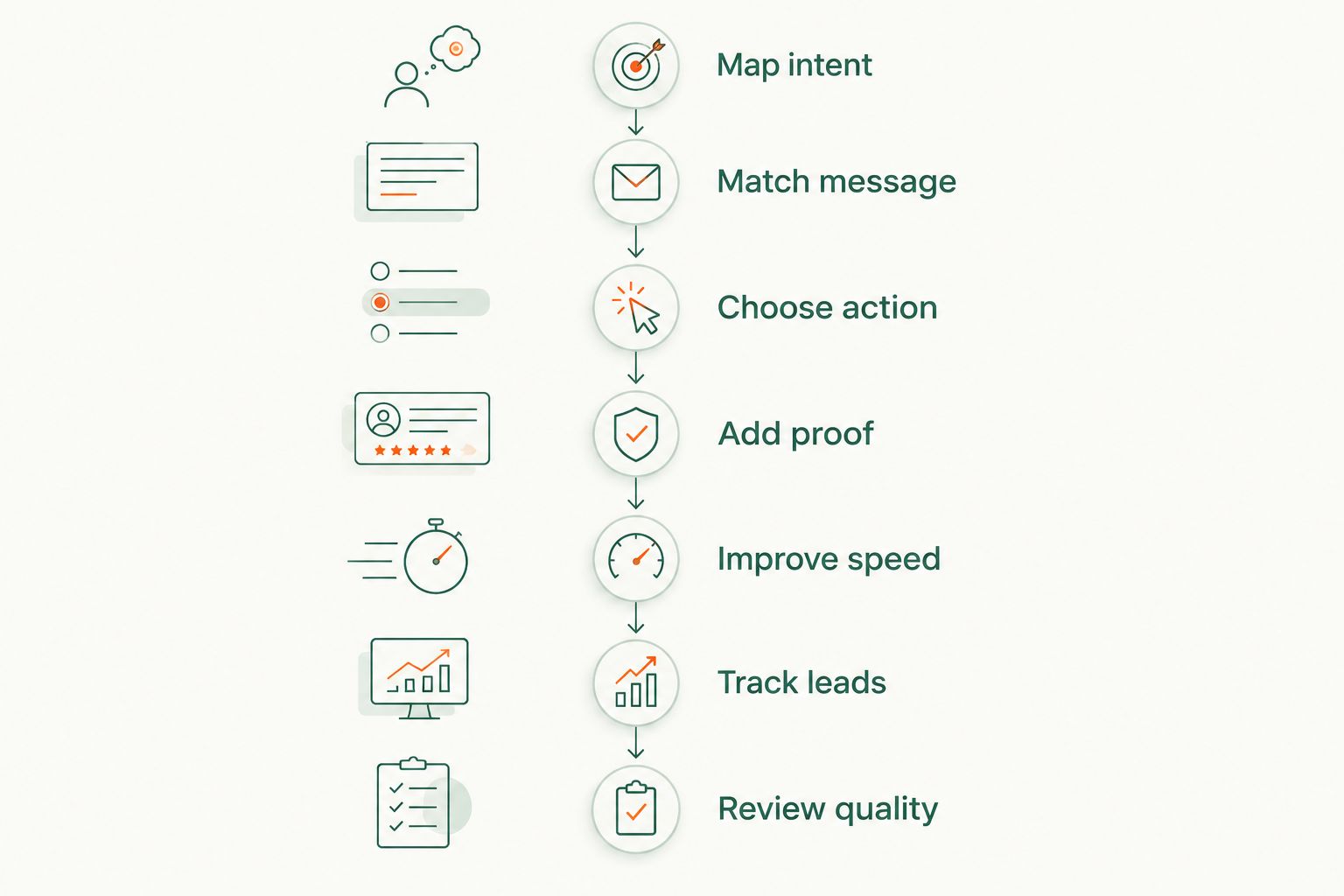
The practical workflow is direct: map intent, match the message, choose an action, add proof, improve speed, track leads, and review quality. Complete the first pass manually so you understand where each decision comes from. An agency becomes useful when multiple services, locations, campaigns, and lead sources make that process difficult to manage consistently.
Map each campaign to one search intent
Start with the search terms and ad groups already running. Group terms by the problem the homeowner wants solved, not by broad internal service categories. A repair search, installation search, maintenance search, and emergency search represent different needs even when they involve the same equipment.
Create a simple spreadsheet with the keyword theme, ad message, intended page, primary action, and service area. This manual map exposes campaigns that currently share a generic destination despite promising different services. Update it whenever an ad group or location changes in 2026.
- Separate repair, replacement, maintenance, and emergency intent
- Split residential and commercial campaigns when the offer differs
- Assign one destination page to each closely related keyword group
- Record the city or service area named in each campaign
- Flag ads that currently send traffic to the homepage
Match the page message to the ad
The landing-page headline should confirm that the visitor reached the right place. Reuse the service and location language from the ad without stuffing every keyword variation into the first screen. Then explain the next step in plain language.
Write the first version yourself by placing the ad beside the page draft. If the ad promises an estimate for a named service, the page should not open with a broad company slogan. If the ad focuses on urgent help, the first action should not ask the visitor to download information or browse unrelated services.
- Name the advertised service in the main page headline
- Carry the location into the page when the campaign targets that market
- Keep the opening paragraph focused on the searcher's immediate problem
- Use the same primary action in the ad and on the page
- Remove claims that the business cannot document
Choose one primary conversion action
Select the action that fits how the service is purchased. Phone calls suit urgent jobs where the homeowner needs to explain the situation. Short quote or scheduling forms suit projects that require details before a conversation. You can display both contact methods, but one should receive clear visual priority.
Roxfire can connect this landing-page decision with Google Ads, lead generation, and CRM automation when campaigns span several services or locations. The faster path is useful only after the contractor defines which lead action matters for each campaign.
- Use a call-focused action for urgent service campaigns
- Use a short inquiry form when project details affect qualification
- Ask only for information needed to start the conversation
- Repeat the primary action after major sections
- Remove menu links that lead away from the conversion path
Add proof that supports the advertised service
Trust signals work when they answer a real buyer question and can be verified. A roofing campaign benefits from relevant project photos and licensing details. A cleaning campaign needs different evidence. Do not fill the page with badges, ratings, or numbers that have no source.
Place the strongest applicable proof near the first action, then add detail farther down the page. If the company serves several cities, state the relevant service area clearly rather than implying coverage it does not provide. Keep licensing language accurate for the location and trade.
- Display an accurate license number when licensing applies
- State insurance status only when it is current and documented
- Use real review totals or ratings from the named platform
- Show service-specific project photos with permission
- Explain the relevant service area in plain language
- Pair every performance claim with evidence
Improve mobile speed and usability
Build the mobile version first because the smaller screen forces clear priorities. The visitor should see the service, location, supporting proof, and primary action without working through a desktop menu or oversized decorative image. Forms must accept input without horizontal scrolling or overlapping elements.
Use PageSpeed Insights and the Core Web Vitals report as free starting points. Google's good thresholds in 2026 are Largest Contentful Paint within 2.5 seconds, Interaction to Next Paint below 200 milliseconds, and Cumulative Layout Shift at or below 0.1. These measurements do not replace lead data, but they identify technical friction before more traffic reaches the page.
- Compress large images before uploading them
- Remove scripts that do not support conversion or measurement
- Keep the primary button visible and easy to tap
- Test forms on common mobile screen sizes
- Check the page on mobile data as well as Wi-Fi
- Monitor the 2.5-second, 200-millisecond, and 0.1 thresholds
Connect calls and forms to campaign data
A form count does not show whether leads become appointments or booked jobs. Connect each call and form submission to its campaign, keyword theme, and landing page. Then pass the source into the CRM or lead log so the sales outcome remains attached to the original click.
Start manually with a shared lead sheet if the business lacks CRM automation. Record the source, service, location, contact status, appointment status, and final outcome. When volume makes that process unreliable, connect call tracking and CRM fields. The guide to setting up call tracking for home service campaigns covers the measurement layer in more detail.
- Assign tracking to the correct campaign and page
- Record missed calls instead of treating them as completed leads
- Capture the advertised service in each form submission
- Keep source data attached to the contact record
- Review appointment and booked-job outcomes by page
- Test tracking after every page or campaign change
Test changes against lead quality
Change one meaningful page element at a time when traffic supports a valid comparison. Start with the headline, primary action, form length, proof placement, or mobile layout. Testing several major changes together can show that performance moved, but not which decision caused it.
Roxfire's performance marketing model connects landing-page adjustments with Google Ads and lead-generation outcomes. The decision metric should match the business goal: qualified calls, appointments, estimates, or booked jobs. A lower reported cost per form is not a win if the additional submissions do not match the service or location.
- Define a qualified lead before comparing page versions
- Select one primary outcome for each test
- Keep campaign targeting stable during the comparison
- Review call recordings or lead notes when permitted
- Separate spam, wrong-service, and out-of-area inquiries
- Keep the version that improves business outcomes, not vanity totals
Fix your PPC landing page
Review ad-to-page match, mobile speed, call tracking, and lead quality before buying more clicks.
Landing page options for home service contractors
The right build method depends on campaign complexity, internal skills, and how often the page needs adjustment. Every option has a trade-off. A simple tool can launch a focused page without a developer, while an agency-led process can coordinate the page with ads and downstream lead data.
| Option | Best for | Main advantage | Key limitation |
|---|---|---|---|
| Manual page inside the existing website | Contractors running a small campaign with internal website access | Keeps the page within the existing site system | The theme, navigation, or plugins can restrict conversion-focused changes |
| Dedicated landing-page builder | Teams that need to create and revise campaign pages themselves | Makes page duplication and basic testing easier | Tracking and CRM connections still require correct setup |
| Custom developer build | Contractors with specific technical or design requirements | Provides direct control over code and page behavior | Routine campaign changes can depend on developer availability |
| Roxfire agency-led build | South Florida home service businesses coordinating landing pages with paid campaigns | Connects page decisions with Google Ads and lead generation | It is not a self-serve page builder |
The best option in 2026 is the one your team can measure and update without breaking campaign tracking. A self-built page works when one person owns the ad, page, and lead log. An agency-led setup fits contractors with multiple services, markets, or paid channels because changes need coordination across the complete lead path.
The design tool itself does not determine lead quality. Message match, clear proof, mobile performance, accurate tracking, and sales follow-up matter regardless of the platform. Choose the simplest option that supports those requirements and produces data your team can act on.
Common landing page mistakes contractors make
Sending every ad to the homepage
A homepage serves branded visitors, job applicants, existing customers, vendors, and people researching every service. That breadth works against a tightly targeted PPC campaign. Give each major search intent a page that answers the relevant problem without requiring another site search.
Using unsupported trust claims
Generic statements such as being the highest-rated or fastest provider create risk when the page provides no source. Use current, verifiable evidence instead. If the contractor lacks service-specific proof, omit the claim and focus on the process, service area, and contact path.
Treating every form submission as a success
Spam, wrong-service inquiries, out-of-area contacts, and job seekers can inflate raw lead totals. In 2026, the page review must include qualification and sales outcomes. Otherwise, a version that produces more form entries can appear stronger while creating more work for the office.
Adding friction to the mobile form
Long forms ask the visitor to do administrative work before speaking with the contractor. Collect only what the office needs to start the conversation, then gather project details during qualification. Test validation messages, autofill, keyboard behavior, and the submission confirmation on a real phone.
Changing the page without checking tracking
A redesigned button, new form, or replaced phone number can interrupt attribution. Test calls and submissions after every release. Confirm that the campaign, page, service, and contact outcome still appear in the system used to review performance.
FAQ
What is the best landing page design for contractors running Google Ads?
The best contractor landing page matches one service and search intent, presents one primary action, shows verifiable trust signals, and records the resulting call or form outcome. It should be designed for mobile use before desktop styling is finalized.
Should contractor PPC ads send visitors to the homepage?
No, contractor PPC ads should usually send visitors to a page dedicated to the advertised service and location. A homepage introduces unrelated choices and makes the visitor search again for information already promised by the ad.
Is a phone call or form better for home service leads?
A phone call fits urgent services, while a short form fits projects that require initial details or scheduling. The page should prioritize the action that matches the campaign's search intent and sales process.
How many calls to action should a contractor landing page have?
A contractor landing page should have one primary call to action, repeated where needed across the page. A secondary contact method can remain available, but it should not compete visually with the main conversion path.
How fast should a contractor landing page load in 2026?
Use Google's good Core Web Vitals thresholds as the technical baseline in 2026: Largest Contentful Paint within 2.5 seconds, Interaction to Next Paint below 200 milliseconds, and Cumulative Layout Shift at or below 0.1. Lead quality and booked jobs remain the business measures that determine whether the page works.
What trust signals belong on a home service landing page?
Use trust signals the contractor can verify, including applicable licensing details, current insurance status, sourced reviews, relevant project photos, and an accurate service area. The right evidence depends on the trade and advertised service.
How do contractors measure whether a landing page works?
Contractors should connect calls and forms to the campaign and page, then record qualification, appointments, estimates, and booked jobs. Raw submission totals cannot show whether the page attracts the right customers.
When should a contractor hire an agency for landing page design?
An agency fits contractors managing multiple services, locations, campaigns, or lead sources that need coordinated tracking and regular page updates. A focused campaign can be managed internally when the business has the time and skills to maintain the page and measurement setup.
One last thing
Before redesigning the whole page in 2026, compare the search term, ad headline, page headline, primary action, and recorded sales outcome in one row. A mismatch anywhere in that row identifies a specific problem to fix. This check prevents a visual redesign from covering up weak targeting, unclear offers, missed calls, or incomplete attribution.