
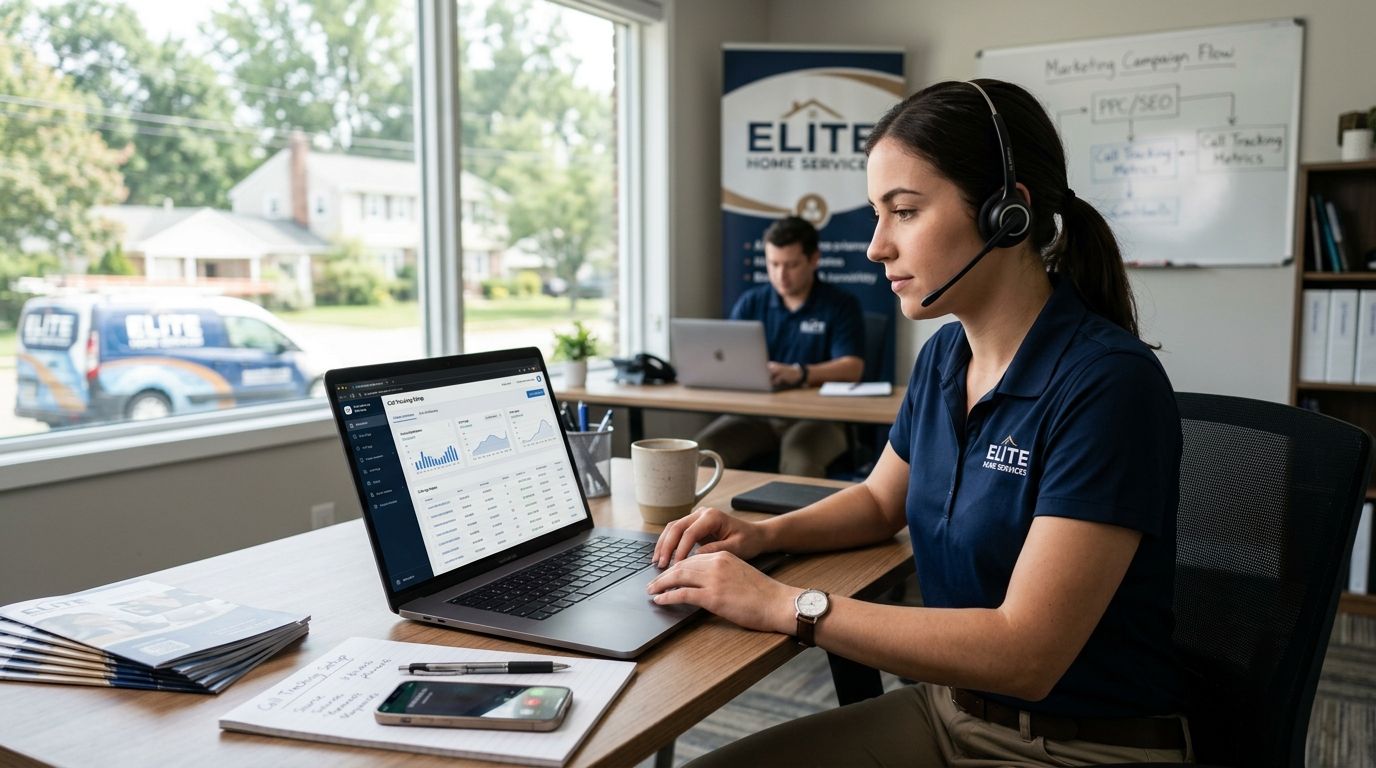
Call tracking for home service businesses means assigning trackable phone numbers to each marketing channel — Google Ads, Meta Ads, Google Business Profile, organic search — so every booked job traces back to the source that generated it. The setup itself takes one afternoon: pick a platform, install dynamic number insertion (DNI) on your site, assign numbers per channel, and connect call outcomes to your CRM. The number swap is the easy part. Matching call outcomes — booked job, no-show, spam — back to ad spend is where most HVAC, roofing, and restoration shops fall apart within 30 days of going live.
- Call tracking for home service businesses ties every booked call to the ad, keyword, or channel that generated it.
- Dynamic number insertion (DNI) swaps the number shown on your site per visitor source, no manual number changes needed.
- CallRail, CallTrackingMetrics, and WhatConverts are the three platforms most trade businesses run in 2026.
- Setup takes one afternoon; matching call outcomes to CRM data is the part that takes ongoing discipline.
- Feeding call outcomes back into Google Ads as offline conversions lets bid strategies optimize for booked jobs, not raw calls.
Why this matters
A tracked phone number without an outcome attached to it is a vanity metric. If your dashboard shows "340 calls this month" but nobody tags which ones turned into a booked job, you're optimizing Google Ads and Meta Ads toward volume, not revenue. That's how CPL creeps up while close rate quietly drops.
Roxfire builds call tracking into every Local Services Ads setup and every Google Ads account it manages for HVAC, roofing, and restoration clients across South Florida — the tracking number is worthless without the CRM tag that says whether the call turned into a job.
How to Set Up Call Tracking for Home Service Marketing Campaigns
Six steps, in order:
- Pick a platform. CallRail, CallTrackingMetrics, and WhatConverts are the three most commonly deployed platforms for trade businesses in 2026 — they plug into WordPress, Wix, and most CRM stacks without custom development.
- Install dynamic number insertion (DNI) on your website. DNI swaps the phone number shown to each visitor based on how they arrived — a Google Ads click sees one number, an organic search visit sees another, a Meta Ads click sees a third. No manual number swapping, no lost data.
- Assign a dedicated tracking number to every channel. Google Ads, Meta Ads, Google Business Profile, direct mail, and organic search each get their own number so call volume by source is unambiguous.
- Connect call outcomes to your CRM or booking software. This is the step most shops skip. A raw call count means nothing — the CRM needs a field for "booked," "quoted," "spam," or "no answer" on every call.
- Feed conversion data back into Google Ads and Meta Ads. Offline conversion import lets Google's bidding algorithm optimize toward booked jobs instead of just calls answered — this single step is what separates accounts stuck at a high cost per lead from ones that trend down over 60-90 days.
- Set call recording and scoring rules. Recording every call (with the disclosure your state requires) lets you audit speed-to-lead and script quality, not just volume.
Static vs. dynamic tracking numbers
| Type | How it works | Best for | Verdict |
|---|---|---|---|
| Static number | One tracking number per print ad, truck wrap, or offline channel | Low-volume offline channels (yard signs, vehicle wraps) | Buy for offline-only tracking |
| Dynamic (DNI) | Number changes per visitor based on referral source | Websites running multiple paid and organic channels simultaneously | Buy for any business running Google Ads or Meta Ads |
| No tracking number | Single published number across all channels | Nobody in 2026 running paid ads | Skip |
Static numbers work fine for a truck wrap or a yard sign — you're not trying to attribute a single number to multiple sources. Dynamic number insertion is non-negotiable the moment you're running Google Ads, Meta Ads, and organic traffic to the same website, because a single static number can't tell you which channel drove the call.
Why call tracking setup complexity varies
- Number of active channels. A business running Google Ads, Meta Ads, GBP, and organic simultaneously needs a larger number pool and more DNI rules than a business running one channel.
- Multi-location operations. Multi-location HVAC or restoration companies need location-specific number pools so a call from a Fort Lauderdale ad doesn't route through a Miami dispatcher.
- CRM integration depth. Native integrations (ServiceTitan, Housecall Pro) take an afternoon; custom CRM setups can take a developer a week.
- Call volume. A 15-call-a-day roofing company can review calls manually; a 200-call-a-day multi-location HVAC operation needs automated scoring rules.
- Compliance requirements. Call recording consent laws vary by state — Florida is a two-party consent state, which changes how the disclosure message is scripted at the start of every recorded call.
- Bilingual routing. South Florida shops running Spanish-language ads often need separate number pools and bilingual call scoring, which adds a setup step most platforms don't handle out of the box.
“A tracked phone number without an outcome tag attached to it is a vanity metric, not a marketing signal.”
Do I need call tracking if I already use Google Ads conversion tracking?
Yes — Google Ads conversion tracking counts a click or a form fill, not what happened after the phone rang. Call tracking is the only way to confirm whether a tracked call turned into a booked job, a quote, or a hang-up, and that outcome data is what should feed back into your bid strategy.
Does call tracking work with Google Local Services Ads?
Local Services Ads route calls through Google's own tracked number by default, which limits how much outcome data flows to a third-party platform. Businesses running Local Services Ads alongside standard Google Ads campaigns still need a separate DNI setup for the search and display side to get full-funnel attribution.
How long until call tracking data is clean enough to act on?
Most shops get usable channel-level call volume within the first week of DNI going live, but outcome data — which calls became booked jobs — needs at least one full sales cycle logged in the CRM before the numbers mean anything. For HVAC and roofing, that's typically a full billing month before you can trust the cost-per-booked-job number over the cost-per-call number.
Get call tracking wired into your ad accounts
Roxfire sets up DNI, CRM tagging, and offline conversion import for Google Ads and Meta Ads.
FAQ
What is call tracking for home service businesses?
Call tracking assigns unique phone numbers to each marketing channel — Google Ads, Meta Ads, organic search, GBP — so every incoming call can be traced back to its source and matched against booked-job outcomes.
How much does call tracking cost to set up?
Setup cost varies by platform and number of tracking numbers needed; check current pricing directly with the platform you choose, since per-number and per-minute fees change.
Is dynamic number insertion better than static tracking numbers?
Dynamic number insertion is better for any business running multiple paid and organic channels to one website, since it attributes each call to the exact source automatically instead of relying on one shared number.
Does call tracking slow down my website?
A properly installed DNI script adds negligible load time; the bigger risk is a poorly configured script that fails to swap numbers for mobile visitors, which breaks attribution rather than site speed.
Can call tracking integrate with ServiceTitan or Housecall Pro?
Yes, most major call tracking platforms have native integrations with ServiceTitan and Housecall Pro that sync call outcomes directly into the job record without manual data entry.
Do I need call tracking for Meta Ads too, not just Google Ads?
Yes — Meta Ads calls need their own tracking number and DNI rule, otherwise call volume from Meta gets misattributed to organic or direct traffic in your reporting.
Is call recording legal for home service businesses?
Call recording is legal with proper disclosure, but consent requirements vary by state; Florida requires two-party consent, so the recorded disclosure message has to run before the call connects.
How do I know if my call tracking data is accurate?
Cross-check tracked call volume against your CRM's logged calls for the same period; a gap larger than a few percent usually means a DNI script isn't firing correctly on part of the site.
One last thing
Most shops set up call tracking, watch call volume climb, and declare victory — without ever closing the loop back to Google Ads. The number that actually moves cost per booked job down isn't call volume, it's the offline conversion import that tells Google's bidding algorithm which calls turned into revenue. Skip that step and you're just tracking calls for a dashboard nobody acts on in 2026.