
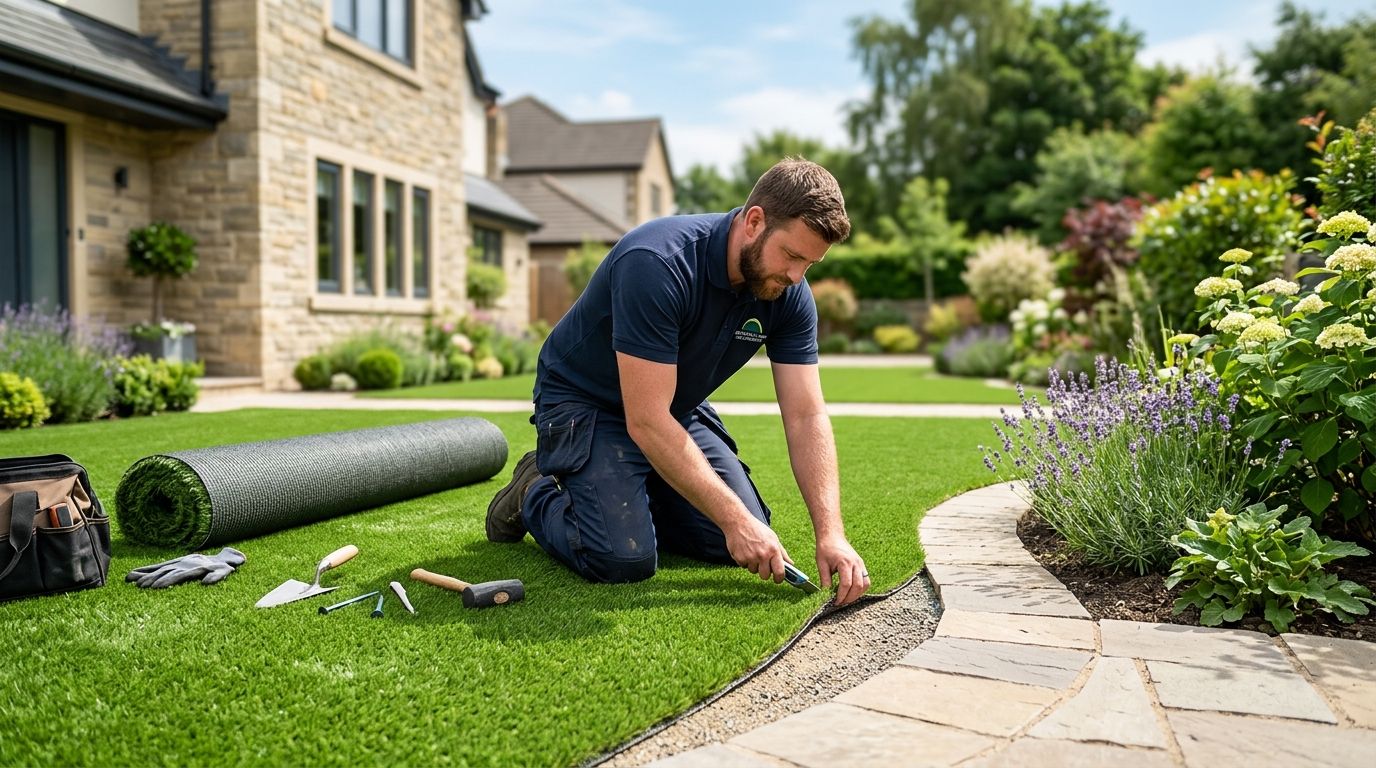
Artificial turf marketing for installers means building local SEO, Google Ads, and Meta Ads around one specific buyer: a homeowner or HOA board comparing bids for a $6,000-$20,000 backyard or commercial turf job, not someone shopping for weekly lawn care. That buyer is triggered by a specific event — a drought restriction, a new dog, an HOA violation notice, a putting green upgrade — and searches with different words than a landscaping customer does. A marketing plan copied straight from a landscaping company's playbook usually misses this buyer entirely, which is why artificial turf marketing has to be treated as its own segment in 2026, not a sub-line of landscaping services.
- Artificial turf marketing works best when Google Business Profile and website copy target turf-specific searches, not generic landscaping keywords.
- Google Ads campaigns built around bid-comparison intent outperform broad landscaping keyword sets for turf installers in 2026.
- Speed-to-lead matters more for turf installers than for lawn care crews because each job is high-ticket and low-volume.
- Meta Ads built on real before/after install photos beat stock synthetic grass imagery for this segment.
Why artificial turf marketing matters for turf installers
Turf installers run fewer, bigger jobs than a mowing or landscaping crew, which changes the math on every lead. A missed call or a slow follow-up on a $12,000 backyard bid costs a lot more than a missed call on a $60 mow, and homeowners comparing turf bids in 2026 are typically contacting three to four installers in the same week. That means your marketing has to win two things at once: get found for turf-specific searches, and respond fast enough to still be in the running when the homeowner picks a company.
Turf installers also compete for the same visual real estate as pool builders and hardscape contractors — before/after photos, drone shots of finished yards, Instagram reels of an install day. A generic landscaping SEO or ads strategy, built around mowing and trimming keywords, doesn't touch any of that. If your closest competitor for pool builder marketing is investing in photo-heavy campaigns and you're running the same keyword list as a lawn-care company, you're fighting a different battle than the one your buyer is actually having.
Update your Google Business Profile to rank for turf-specific searches
Your Google Business Profile is the first thing an HOA board member or homeowner sees when they search "artificial turf installer near me" in 2026. Most turf installers still list themselves under a generic landscaping category and lose the local pack to a company that's tagged its profile correctly.
- Set your primary category to a turf- or synthetic-grass-specific option, not general landscaping
- Add "artificial turf installation," "pet turf," and "putting green installation" as named services, not just a one-line description
- Upload before/after photos from actual jobs, geo-tagged to the neighborhoods you serve
- Ask satisfied customers to mention "turf" or "synthetic grass" by name in reviews, not just "great job"
- Respond to every review and question within 24 hours — profiles with fast response times rank and convert better
Rebuild your website around buyer triggers, not a service list
A single "our services" page that lists turf installation next to sod, mulch, and irrigation buries the exact search intent you need to capture. Split landing pages by the reason someone is buying turf in the first place.
- Build a dedicated page for pet-owner turf (drainage, odor control, durability concerns)
- Build a dedicated page for HOA-compliant turf installs, since HOA notices are a real trigger for search volume
- Build a dedicated page for putting greens and backyard sports turf, a different buyer than a standard yard replacement
- Include a project gallery with real photos on every page, not stock synthetic-grass renderings
- Add financing or estimate-request language on each page so the next step is obvious
Run Google Ads around bid-comparison keywords, not broad landscaping terms
Once your site is structured by buyer intent, paid search should follow the same split instead of bidding on the same broad "landscaping company" terms every lawn-care competitor is chasing. This is the point where a specialized agency starts paying for itself, because managing three or four separate ad groups by intent takes more ongoing attention than most owner-operators have time for. Roxfire builds these campaigns the same way it structures accounts for general contractors and remodelers — separate ad groups by job type, separate landing pages by ad group, and call tracking on every campaign.
- Bid on "synthetic grass installer [city]" and "artificial turf cost" style keywords instead of generic "landscaping near me"
- Use call-only or call-first ad extensions so high-intent homeowners can skip the form entirely
- Set geo-targeting to the neighborhoods and HOA communities you actually want to serve
- Track cost-per-lead by ad group, not just account-wide, since turf keyword groups convert differently than pet-turf or putting-green groups
- Pause keywords that generate clicks but no calls after a set testing window
Use Meta Ads to sell the transformation, not the product
Artificial turf is a visual sale. A homeowner scrolling Instagram or Facebook responds to a real before/after clip of a dead, patchy yard turning into a finished install far more than a stock photo of green turf rolls.
- Run video ads showing install day start to finish, not static photos
- Use carousel ads split by use case: pet yards, putting greens, pool decks, HOA-compliant fronts
- Retarget website visitors who viewed a service page but didn't request a quote
- Test lookalike audiences built from your existing customer list in zip codes with HOA communities
- Keep ad copy specific — "no more mowing, no more dead patches" beats generic "beautiful lawns" language
Fix speed-to-lead before spending another dollar on ads
All the traffic in the world doesn't matter if a lead sits in an inbox for six hours. Turf jobs are high-ticket and homeowners are actively comparing bids, so the installer who calls back first often wins the job regardless of price.
- Set up instant text or call notifications the moment a form or call comes in
- Route after-hours leads to a answering service or a booking link instead of letting them sit until morning
- Track first-response time in your CRM so you can see where the gap is
- Follow up with a second and third touch over the next 48 hours if the lead doesn't answer the first call
“On a $12,000 turf bid, the installer who calls back in ten minutes usually beats the installer with the lower price and a next-day callback.”
Stack reviews that mention the specific trigger, not just "great work"
Reviews that name the reason someone bought turf — pets, drought restrictions, HOA notices — do double duty as SEO content and as trust signals for the next homeowner facing the same problem.
- Ask happy customers directly to mention what prompted the install, not just leave a star rating
- Feature these reviews on the matching landing page (pet-turf reviews on the pet-turf page)
- Respond publicly to every review, positive or negative, within a day or two
- Pull review quotes into ad copy and Google Business Profile posts
Marketing options for artificial turf installers compared
| Option | Best for | Key limitation |
|---|---|---|
| DIY Google Business Profile + organic posts | Installers with no ad budget who can commit weekly time | Slow to build ranking; little control over lead volume |
| Self-managed Google Ads | Owners comfortable reading campaign data weekly | Easy to overspend on broad landscaping keywords without segmentation |
| Self-managed Meta Ads | Installers with a strong photo/video library already | Creative fatigue sets in fast without a content pipeline |
| Full-service agency (e.g. Roxfire) | Installers who want segmented campaigns and CRM-tracked follow-up without managing it themselves | Requires a monthly budget commitment and account access |
Verdict: the DIY route works for installers with time to spend weekly on their Google Business Profile and organic content, but Google Ads and Meta Ads built around buyer-trigger keywords consistently outperform broad landscaping campaigns for artificial turf marketing in 2026.
Common mistakes turf installers make
- Bidding on generic "landscaping" keywords in Google Ads instead of turf-specific, bid-comparison terms, which wastes spend on the wrong intent
- Using stock synthetic-grass photos on the website and in ads instead of real before/after project photos
- Listing turf as one line item on a general services page instead of building dedicated landing pages by buyer trigger (pets, HOA, putting greens)
- Letting high-ticket leads sit for hours before the first callback, losing the job to whichever competitor answers first
- Ignoring HOA-specific search demand, even though HOA notices about dead grass are a real and recurring trigger for turf searches
Get a turf marketing plan built for 2026
Google Ads, local SEO, and Meta Ads structured around your actual buyer, not a generic landscaping playbook.
FAQ
What is artificial turf marketing?
Artificial turf marketing is the combination of local SEO, Google Ads, and Meta Ads built specifically around homeowners and HOAs comparing turf installation bids in 2026, rather than generic landscaping campaigns.
Is SEO or Google Ads better for artificial turf installers?
Both matter, but they solve different problems: local SEO and Google Business Profile optimization build long-term visibility for turf-specific searches, while Google Ads generates leads immediately for a specific service area or job type.
Should turf installers use Meta Ads?
Yes, especially with before/after video content, because artificial turf is a visual purchase and Meta Ads reach homeowners scrolling Instagram and Facebook before they ever search on Google.
How do turf installers get more leads without bidding wars on generic keywords?
Splitting campaigns by buyer trigger, pet turf, HOA compliance, putting greens, targets less competitive keyword sets than broad landscaping terms and matches actual search intent.
How important is speed-to-lead for turf installers?
Very important, because turf jobs are high-ticket and homeowners are typically comparing three to four bids at once, so the installer who calls back fastest often wins the job.
Do artificial turf installers need separate landing pages for different services?
Yes, a single services page that lists turf alongside sod and irrigation buries the specific search intent; dedicated pages for pet turf, HOA compliance, and putting greens convert better.
How long does it take to rank for turf-specific SEO keywords?
Ranking timelines depend on local competition and how optimized the Google Business Profile and website already are, but consistent review generation and geo-tagged photos speed up local pack visibility.
Can a marketing agency manage both Google Ads and Meta Ads for a turf company?
Yes, agencies that specialize in home service businesses typically run both channels together so campaigns share the same landing pages, tracking, and CRM follow-up.
One last thing
The single highest-converting page most turf installers never build is an HOA-compliance page — a page that speaks directly to the board member fielding complaints about a dead front lawn, with photos of HOA-approved installs and language about compliance timelines. That page captures a buyer who is under a deadline, not just browsing, and in 2026 that's one of the least competitive keyword clusters in the entire turf category.