
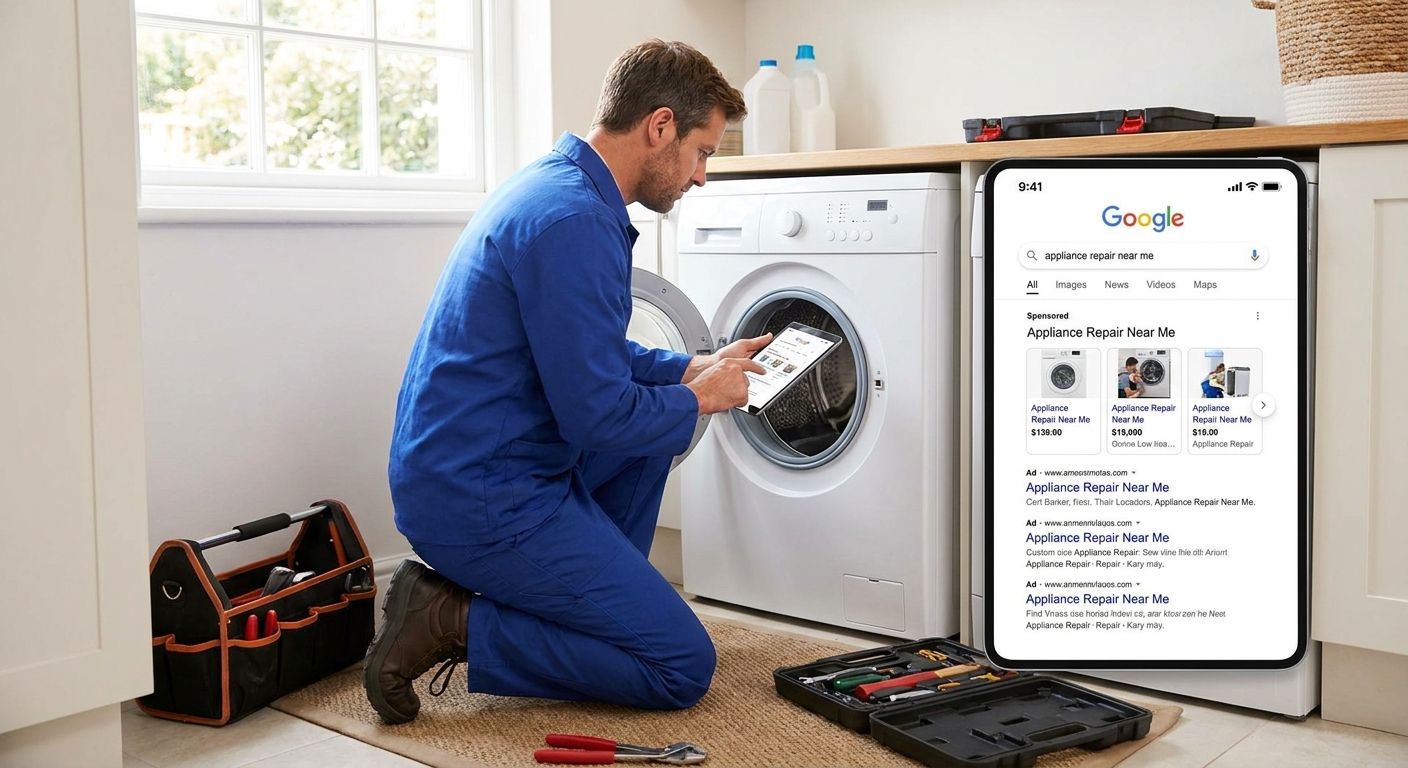
Appliance repair Google Ads campaigns are paid search placements built to convert broken-fridge and dead-dryer searches into same-day booked jobs, not just clicks. This segment behaves differently than HVAC or roofing: the buyer is often standing next to a leaking dishwasher right now, deciding between three phone numbers in ten seconds.
- Appliance repair Google Ads works best when keywords are split by appliance type and urgency, not by generic 'appliance repair' terms.
- Local Services Ads (Google Guaranteed) outperforms standard Search for many appliance repair companies because leads pay per qualified call, not per click.
- Call-only ad formats are being phased out through 2026, so campaigns built around that format need a Search + LSA rebuild now.
- Average appliance repair jobs run roughly $150-$450, which sets the ceiling for what you can afford to pay per lead.
- Roxfire structures appliance repair Google Ads accounts around booked-job cost, not raw CPL, before layering in Performance Max or AI Max experiments.
Why Google Ads matters for appliance repair companies
Appliance repair is an emergency-search category. Someone doesn't research "best appliance repair company" for three weeks — a fridge stops cooling and they need someone today. That urgency is exactly what Google Ads is built to capture, if the campaign structure matches the search intent instead of fighting it.
The problem most appliance repair companies run into isn't lack of clicks. It's paying for the wrong clicks: DIY searchers looking for parts, warranty claimants checking manufacturer coverage, and price-shoppers who were never going to book. A generic "appliance repair near me" campaign burns budget on all three before it ever reaches a real job.
Average appliance repair jobs run somewhere in the $150-$450 range depending on the appliance and the fix. That number is what should set your target cost per lead — not an arbitrary CPL benchmark copied from a blog post about a different trade.
How to run Google Ads for appliance repair companies
Structure campaigns by appliance and urgency, not by "repair"
A single "appliance repair" ad group treats a $150 dryer vent fix the same as a $400 refrigerator compressor job. Split it.
- Break campaigns into appliance-specific ad groups: refrigerator, washer/dryer, dishwasher, oven/range, HVAC-adjacent units
- Add urgency modifiers as separate keyword sets: "same day," "emergency," "not cooling," "won't start"
- Bid higher on high-ticket appliances (refrigerator, range) where the job value covers a higher CPL
- Keep brand terms in their own campaign with a separate budget so competitor bidding doesn't cannibalize spend
Write ad copy that filters out non-buyers before the click
Every click you don't need still costs money. Ad copy is your first filter, not your landing page.
- State "same-day service" or "today" directly in headlines if that's true for your dispatch model
- Mention the specific appliance and the specific symptom ("fridge not cooling") instead of generic "repair services"
- Exclude warranty language explicitly if you don't handle manufacturer warranty claims
- Use call extensions and location extensions so mobile searchers can skip the landing page entirely
Add negative keywords before you add budget
This is the single fastest way to cut waste in an appliance repair account, and it costs nothing.
- Add "DIY," "how to fix," "replace myself," and "parts" as negative keywords across every campaign
- Exclude "warranty," "recall," and manufacturer names if you don't do warranty work
- Add "jobs," "careers," and "hiring" to keep job-seekers out of your service traffic
- Review the search terms report weekly for the first month, then biweekly after that
Set up Local Services Ads alongside Search
Local Services Ads run on a pay-per-lead model with the Google Guaranteed badge, which matters for a trust-sensitive category like appliance repair where homeowners are letting a stranger into the house.
- Complete the background check and licensing verification required for the Google Guaranteed badge
- Set your weekly lead budget separately from your Search budget — they compete for different placement
- Dispute invalid leads (wrong number, out of service area, spam) inside the LSA dashboard within the window Google provides
- Respond to leads within minutes; LSA ranking rewards fast response time
Build a landing page that converts on mobile in one screen
Most appliance repair searches happen on a phone, mid-emergency. A landing page with five scroll-lengths loses that lead to a competitor's call button.
- Put the phone number and a click-to-call button above the fold
- List the specific appliances you service by name, not a vague "all major brands"
- Show service area explicitly — appliance repair customers won't call outside their zip code
- Skip the long-form contact form; a name, phone, and one-line problem description is enough
Track cost per booked job, not just cost per lead
CPL is a vanity number if half your leads never book. What matters is what a lead costs once it turns into a paid job.
- Set up call tracking with recording so you can audit which calls turned into booked appointments
- Push lead source data into your CRM or dispatch software so close rate ties back to campaign and keyword
- Calculate cost per booked job monthly: total ad spend divided by jobs booked, not leads generated
- Cut or reallocate budget from campaigns with the worst booked-job cost, even if their raw CPL looks fine
Once the manual structure is in place — negative keywords tuned, LSA running, call tracking wired into the CRM — this is where an agency accelerates the work instead of replacing it. Roxfire runs this exact build for HVAC, roofing, and appliance-adjacent home service clients across South Florida, tying ad spend to booked jobs rather than raw lead counts.
Get your appliance repair ads audited
See where your Google Ads budget is leaking before you spend another dollar.
Comparing your options for appliance repair Google Ads
| Option | Best for | Key limitation |
|---|---|---|
| Search Ads (manual campaigns) | Companies with 3+ appliance types and enough volume to justify granular keyword control | Requires ongoing negative keyword maintenance and bid management |
| Local Services Ads | Companies wanting pay-per-lead pricing and the Google Guaranteed trust badge | Requires background check approval; lead volume is capped by service area |
| Performance Max | Companies with existing conversion data who want automated cross-channel reach | Less keyword-level control; harder to exclude DIY and warranty traffic |
| Call-only ad formats | Not recommended going into 2026 | Being phased out by Google; campaigns built on this format need rebuilding now |
| Meta Ads (as a complement) | Brand awareness and retargeting past customers for seasonal maintenance | Weaker for capturing active, high-intent emergency searches |
Local Services Ads plus a tightly negative-keyworded Search campaign is the strongest combination for most appliance repair companies in 2026 — the pay-per-lead model absorbs some of the click-fraud and price-shopper risk that pure Search carries alone.
Common mistakes appliance repair companies make
- Running one broad "appliance repair" campaign instead of splitting by appliance type, which lets a $150 dryer-vent search outbid budget meant for a $400 refrigerator job
- Ignoring the call-only ads sunset and discovering mid-2026 that a core lead channel has quietly stopped delivering volume
- Skipping call tracking, which means every optimization decision gets made on lead count instead of booked-job cost
- Letting DIY and warranty searches through because negative keyword lists were set up once at launch and never revisited
- Treating Performance Max as a full replacement for Search before there's enough conversion data for it to target well
FAQ
How much does Google Ads cost for appliance repair companies?
Cost varies by market and appliance type, but the target should be set against your average job value, roughly $150-$450 per repair. If cost per booked job exceeds a meaningful share of that job value, the campaign needs restructuring before more budget gets added.
Is Local Services Ads better than Search Ads for appliance repair?
Local Services Ads often performs better for appliance repair because it charges per lead instead of per click, which reduces waste from DIY searchers and price-shoppers. Search Ads still matters for keyword-level control and reaching searches LSA doesn't cover.
What happened to call-only ads in 2026?
Google is phasing out call-only ad formats through 2026, which means appliance repair campaigns built primarily around that format need to shift budget into Search campaigns with call extensions and Local Services Ads.
Should appliance repair companies use Performance Max?
Performance Max works best once a campaign has enough conversion history for Google's automation to target well, generally after Search and LSA have been running long enough to generate stable booked-job data. Running it as a first campaign with no history usually wastes budget on the wrong audiences.
What negative keywords should appliance repair companies use?
Start with DIY, how to fix, replace myself, parts, warranty, recall, jobs, careers, and hiring. These terms pull in searchers who were never going to book a paid repair call.
How fast should appliance repair companies respond to Google Ads leads?
Within minutes, not hours. Local Services Ads ranking rewards fast response time, and emergency-search customers call the next number on the list if the first one doesn't pick up.
Do appliance repair companies need Meta Ads too?
Meta Ads work as a complement for brand awareness and retargeting past customers around seasonal maintenance, but they capture less of the active, high-intent emergency search volume that drives most appliance repair bookings.
What's the biggest Google Ads mistake appliance repair companies make?
Running one broad appliance repair campaign instead of splitting by appliance type and urgency. That structure lets low-value searches outbid budget meant for higher-ticket jobs like refrigerator and range repairs.
One last thing
The appliance repair companies losing money on Google Ads in 2026 usually aren't losing it on bad clicks — they're losing it on slow call answers. A campaign that's structured well but answered on the fourth ring loses the job to whoever answers on the second. Fix response time before touching another campaign setting.


