
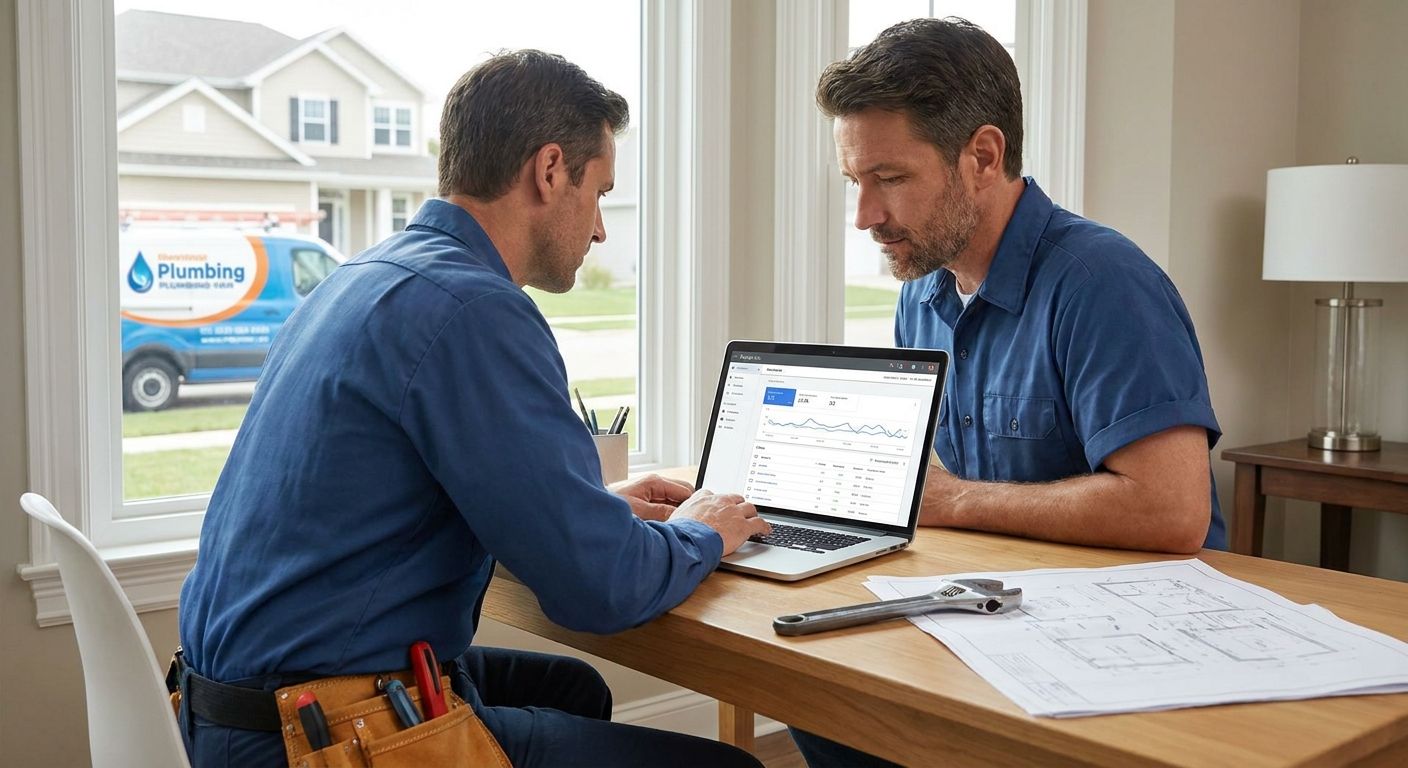
Plumbing companies searching "emergency plumber near me" convert fast, cost more per click than almost any other trade, and punish sloppy account management harder than HVAC or roofing does. This guide breaks down what actually makes Google Ads management for plumbing companies work in 2026 and which management option fits your shop.
- Trade-specialized management beats generalist agencies for google ads for plumbing companies because call tracking and speed-to-lead setup are non-negotiable.
- DIY Google Ads with Smart Bidding alone is a Consider at best for plumbing shops under 5 trucks in 2026 — Skip if you can't check the account weekly.
- Cost per lead ranges seen in South Florida plumbing accounts run from $185 down toward $85 once negative keywords and call tracking are dialed in.
- Freelance PPC managers are a Wait unless they can show live plumbing account data, not just certifications.
- A properly built account can move monthly lead volume from roughly 18 to 69 within a few months of consistent optimization.
Why This Matters
Plumbing is one of the most expensive verticals in Google Ads. Emergency intent keywords like "water heater repair" or "burst pipe emergency" carry high commercial value, which means every wasted click has a real dollar cost attached to it.
Run the account wrong and you'll bleed budget on tire-kickers, DIY searchers, and job-seekers typing "plumber jobs near me." Run it right and Google Ads for plumbing companies becomes the most predictable lead channel a shop has, because search intent for a leaking pipe is about as high-intent as marketing gets.
The difference between those two outcomes in 2026 comes down almost entirely to who's managing the account and how it's structured — not the ad copy.
Who This Guide Is For
This is written for plumbing company owners and operations managers running 2 to 25 trucks who are either starting Google Ads for the first time, or currently running it and unsure why cost per lead keeps climbing. If you're evaluating whether to manage ads in-house, hire a freelancer, or bring in an agency, the criteria below apply directly to your decision.
What to Look For in Google Ads Management for Plumbing Companies
Call Tracking Tied to Booked Jobs, Not Just Clicks
A plumbing lead that clicks your ad and calls isn't a booked job — it's a maybe. Any management approach worth paying for tracks calls through to appointment set and job closed, not just call volume. Without that, you're optimizing toward vanity numbers instead of revenue.
Emergency vs. Planned Service Campaign Separation
A burst pipe search and a "schedule a water heater install" search have completely different intent, budget tolerance, and time-of-day patterns. Accounts that lump these into one campaign waste spend chasing the wrong bid strategy for at least one of the two.
Negative Keyword Discipline
Plumbing accounts attract junk clicks from DIY YouTube searchers, parts suppliers, and job applicants. An account without an actively maintained negative keyword list in 2026 is paying Google for traffic that will never become a customer.
Speed-to-Lead Follow-Up Built Into the Process
A lead that isn't called back within 5 minutes has a dramatically lower chance of booking, especially for emergency plumbing searches where the customer is calling three companies at once. Management that stops at "the lead was generated" and ignores what happens after is only doing half the job.
Local Service Ads and Search Working Together
Google's Local Service Ads program and standard Search campaigns serve different points in the funnel for plumbers. Management that only runs one or the other is leaving volume on the table, particularly as Local Service Ads placement has expanded on mobile in 2026.
Reporting You Can Actually Read
If the monthly report doesn't show cost per lead, cost per booked job, and close rate by campaign, it's a report built to look busy, not to help you make decisions.
The Management Options Plumbing Companies Actually Choose
DIY With Google's Automated Tools — the budget option
Google's Smart Bidding and automatically-generated ad suggestions have gotten better, but they're built for advertisers with time to babysit them. A plumbing owner running one truck and answering calls himself doesn't have that time.
One concrete number: Google's own automated recommendations panel will push you toward broad match and Performance Max campaigns by default, which historically dilute budget for local service categories without close human oversight. If you can commit to checking the account weekly and building a negative keyword list from scratch, this is a Consider. If you can't, it's a Skip.
Freelance PPC Manager — the wildcard
Freelancers vary wildly in quality and most haven't managed a plumbing account specifically. The risk isn't competence — plenty are skilled — it's specialization. A freelancer who spends most of their time on e-commerce accounts won't know that plumbing searches spike overnight during cold snaps or that "no heat" searches in South Florida mean water heater, not furnace.
Ask for a live plumbing account example before signing anything. Without one, this option is a Wait.
Generalist Digital Marketing Agency — looks right, often isn't
Generalist agencies that serve restaurants, law firms, and plumbers under one roof tend to apply the same playbook across industries. That playbook rarely accounts for the emergency-vs-planned service split or call-tracking-to-booked-job attribution that plumbing accounts need.
The tell is in the onboarding call: if nobody asks about your average job value or close rate by lead source, they're not building a plumbing-specific account. Skip unless they can show trade-specific case data.
Trade-Specialized Agency — the safe pick
An agency built specifically around home service categories — HVAC, roofing, plumbing, restoration — already has the negative keyword lists, call-tracking-to-CRM setups, and speed-to-lead workflows built for the trade. Roxfire runs Google Ads, Local Service Ads, and CRM-based lead scoring specifically for South Florida trade businesses, which means the account starts from a plumbing-informed structure instead of a generic template.
That specialization is the entire argument for paying more per hour of management: less time spent explaining what "speed-to-lead" means, more time spent on the account. Buy for shops that want cost per lead trending down instead of up.
Get a plumbing PPC audit
See where your current Google Ads spend is leaking before you sign another contract.
What to Avoid
- Broad match keywords with no negative list. Looks efficient because it captures more volume, but for plumbing it captures DIY searchers and parts shoppers who will never call a professional.
- Performance Max campaigns run without a plumbing-specific feed. Google will happily spend your budget across YouTube and Display placements that generate impressions, not booked jobs.
- Agencies quoting a flat management fee with no minimum spend guidance. Plumbing markets in dense metro areas need enough daily budget to compete on emergency keywords — an underfunded account looks the same as a poorly managed one from the outside.
Verdict Comparison
| Option | Setup Speed | Plumbing-Specific Know-How | Cost per Lead Trend | Verdict |
|---|---|---|---|---|
| DIY with Google automation | Fast | Low | Rising over time | Consider / Skip |
| Freelance PPC manager | Medium | Varies | Unpredictable | Wait |
| Generalist digital agency | Medium | Low | Flat or rising | Skip |
| Trade-specialized agency | Medium | High | Falling ($185 to $85 range) | Buy |
FAQ
How much does Google Ads management cost for a plumbing company in 2026?
Management fees for plumbing accounts typically scale with ad spend, and ad spend itself needs to be high enough to compete for emergency keywords in your metro. Budget should reflect your service area size and how many competing plumbers bid on the same terms.
Is Local Service Ads better than regular Search ads for plumbers?
Local Service Ads and standard Search campaigns serve different intent levels, and most well-run plumbing accounts run both in 2026 rather than picking one. Local Service Ads tends to convert faster for emergency calls while Search captures broader planned-service searches.
What's a good cost per lead for plumbing Google Ads?
Cost per lead for plumbing accounts commonly ranges from under $100 to well over $180 depending on market competition and account optimization. Accounts with strong negative keyword lists and call tracking tend to sit at the lower end of that range.
Can a plumbing company manage Google Ads without an agency?
Yes, but it requires weekly account attention, an actively maintained negative keyword list, and call tracking tied to booked jobs. Shops under five trucks rarely have the bandwidth to do this well alongside running the business.
How long does it take to see results from plumbing Google Ads?
Search campaigns for plumbing can generate calls within days of launch, but cost per lead typically doesn't stabilize until 60 to 90 days of data and optimization. Emergency-intent campaigns show results faster than planned-service campaigns.
Do plumbing companies need call tracking for Google Ads to work?
Call tracking tied to booked jobs, not just call volume, is close to mandatory for plumbing accounts since most conversions happen by phone. Without it, you're optimizing bids toward calls that never became paying customers.
What's the biggest mistake plumbing companies make with Google Ads?
Running broad match keywords without a negative keyword list is the most common and most expensive mistake, since it pulls in DIY searchers and job applicants alongside real customers. The second most common mistake is ignoring speed-to-lead follow-up after the call comes in.
One Last Thing
The plumbing accounts that actually improve cost per lead over time all share one habit: someone reviews the search terms report weekly, not monthly. A negative keyword list built once at launch and never touched again is the single fastest way to watch cost per lead climb back toward $185 by the end of 2026.