
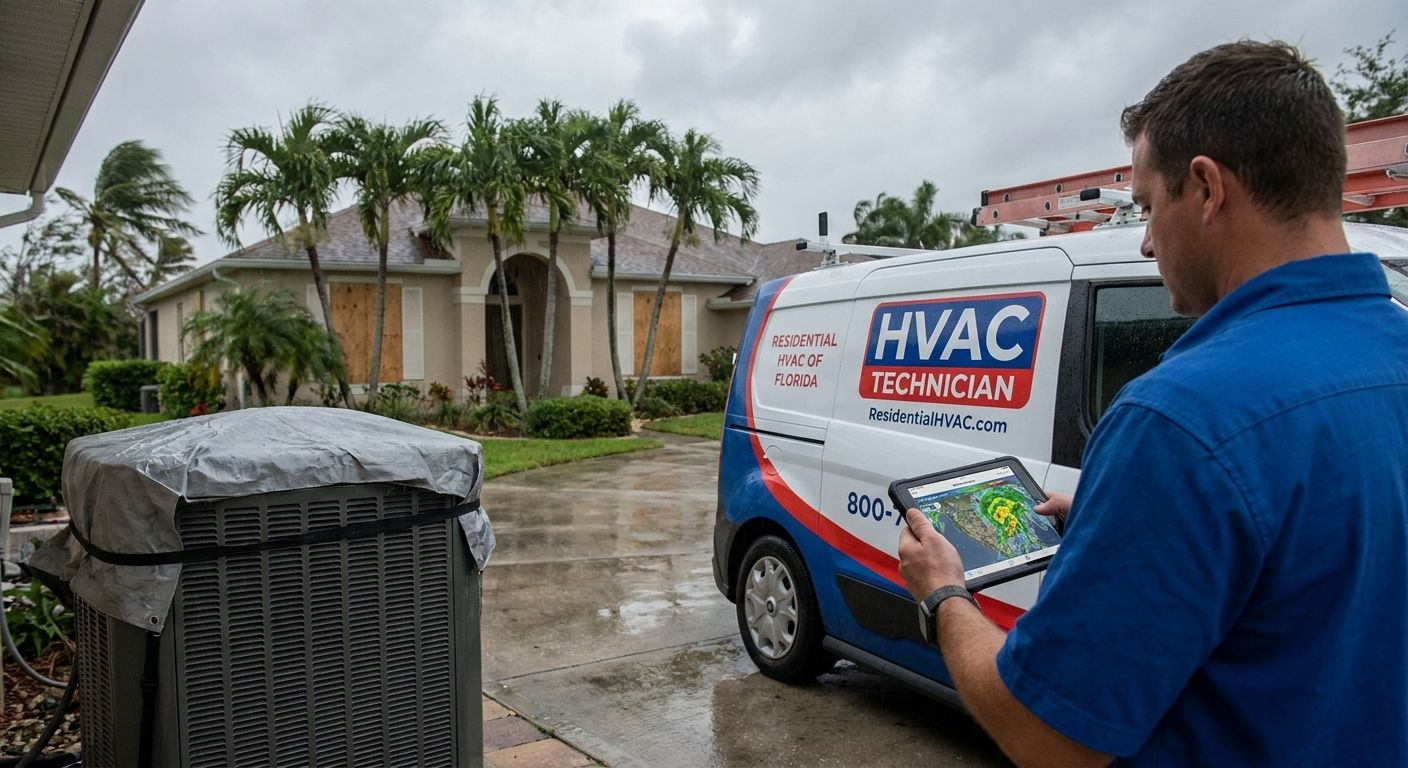
Running hvac ads during hurricane season in Florida means splitting one campaign into three: pre-season maintenance pushes, active-season standby coverage, and post-storm repair surges — each with its own keywords, ad format, and budget trigger tied to the calendar, not left running flat from June through November.
- HVAC ads hurricane season Florida campaigns need three phases: pre-season (June-July), active watch (August-October), and post-storm repair surge.
- Call-only and call extensions outperform standard search ads once a storm watch is issued because customers search on damaged mobile connections, not desktops.
- NOAA's Atlantic season runs June 1 through November 30, with peak activity from mid-August through October.
- Flat monthly budgets waste spend in slow weeks and starve the account during the exact days repair demand spikes.
- Roxfire builds standby ad groups for South Florida HVAC clients before June 1 so campaigns activate without a rebuild mid-storm.
Why this matters
Most HVAC companies in South Florida run the same Google Ads and Meta Ads structure in November that they ran in March. That structure targets "AC tune-up" and "HVAC maintenance plan" keywords all season, which is fine in a normal week and a waste of budget the moment a storm knocks out power to half a county.
The search intent shifts hard after landfall. People stop looking for maintenance plans and start searching for emergency repair, storm damage, and generator hookup. An account that can't shift keyword focus and budget within the same week loses that traffic to whichever competitor updated their campaigns first — usually the one running Google Ads for HVAC contractors built specifically to flex around seasonal demand instead of a single evergreen structure.
How to run HVAC ads during hurricane season in Florida
The sequence matters more than any single tactic. Build the account structure before June 1, not after a storm forms in the Atlantic.
- Build three standby campaigns in May — pre-season, active-season, and post-storm — so none of them need to be built from scratch under pressure.
- Split keyword lists by phase. Pre-season runs on "AC tune-up," "maintenance plan," and seasonal comfort terms. Post-storm runs on "emergency AC repair," "HVAC storm damage," and "no AC after hurricane."
- Switch to call-only and call extensions once a storm watch is issued. Landing pages don't load well on a phone running on cell data with no home wifi; a tap-to-call button does.
- Tie budget increases to NOAA advisories, not a fixed monthly number. A flat budget either overspends in a quiet October or underspends the week a hurricane makes landfall.
- Geo-target by county and zip based on the storm track, not the whole South Florida service area — spend follows where the damage actually is.
- Update ad copy and landing pages within 24-48 hours of landfall to reference storm damage repair and generator-compatible HVAC hookups, since that's what people are typing into Google that week.
| Phase | Keyword focus | Ad format | Budget behavior |
|---|---|---|---|
| Pre-season (June-July) | Maintenance plans, tune-ups, comfort | Standard search + display | Steady, algorithm-learning budget |
| Active season (August-October) | Mixed maintenance + standby repair | Search + call extensions | Flexible, watch-triggered increases |
| Post-storm surge | Emergency repair, storm damage, generator hookup | Call-only / call extensions | Rapid increase, tight geo-targeting |
The verdict: the HVAC companies that win hurricane season don't turn ads on after landfall — they build the structure in May and let storm advisories flip the switch.
Pre-season prep: June 1 – July 31
NOAA's Atlantic hurricane season officially opens June 1 and runs through November 30. The first two months are the quietest stretch of the season, which makes them the right window to build maintenance-plan campaigns and let Google Ads collect conversion data before the account needs to react fast.
This is also when Google Business Profile optimization for HVAC companies pays off — a profile with recent reviews and accurate service-area data ranks better in the Local Pack the moment search volume spikes in August, and there's no fixing that after the fact.
Active season standby: August – October
Mid-August through October is the historical peak of Atlantic hurricane activity, per National Hurricane Center climatology. Campaigns in this window run mixed keyword sets — maintenance terms stay live for the weeks nothing is happening, and repair-focused ad groups sit ready to scale the moment a storm watch is issued for South Florida.
Budget in this phase should flex with advisories, not sit on autopilot. An account watching NOAA advisories can shift spend toward emergency keywords two to three days before landfall, which is exactly when "generator vs AC" and "will my AC survive a hurricane" searches start climbing.
Post-storm repair surge: the days after landfall
Demand for HVAC repair spikes within days of landfall, not weeks — and it spikes hardest in the zip codes that actually lost power or took wind and water damage, not the whole metro area. Campaigns need geo-targeting tight enough to follow the storm track, and ad copy that speaks to storm damage and generator compatibility, not seasonal comfort.
This is also where Google Ads for restoration companies after storm season overlaps with HVAC demand — homeowners dealing with water damage and a dead AC unit search for both in the same week, and campaigns that ignore that overlap miss cross-service leads.
Why HVAC hurricane-season ad performance varies
A handful of factors decide whether a hurricane season is a growth quarter or a wasted one for an HVAC advertiser:
- Storm track — a hurricane that misses populated South Florida counties produces almost no repair-demand spike, no matter how ready the campaign is.
- Grid outages — widespread power loss shifts search intent from "AC repair" toward generator hookup and portable cooling, which requires different keywords entirely.
- Insurance claim timelines — homeowners often wait for an adjuster before spending on HVAC repair, which delays the search spike by days or weeks depending on the storm's severity.
- Crew capacity — bidding aggressively on emergency keywords when every technician is already booked wastes spend on leads the business can't service.
- Competitor ad activity — some competitors pull budget back during a storm out of caution, which is exactly when the companies still running full-strength campaigns pick up disproportionate call volume.
- Existing local SEO signals — a Google Business Profile and review base built before the season ranks better once search volume jumps, which is a case for choosing the right keywords for local HVAC SEO campaigns well before June.
Roxfire builds these standby campaigns every year for South Florida HVAC clients so the budget triggers and keyword swaps happen off NOAA advisories instead of a manual daily check during the worst week to be checking anything manually.
Get hurricane-ready ad campaigns built now
Standby HVAC ad structures for South Florida, built before the next storm forms.
Should HVAC companies pause ads before a hurricane hits?
No, not entirely — pause the maintenance and tune-up keywords, but keep repair-focused ad groups live at a reduced budget so a competitor doesn't take the two or three days of pre-landfall search volume from people prepping their systems.
How do you bid on hurricane-related HVAC keywords?
Bid on terms like "AC repair after hurricane" and "emergency HVAC Florida" using call-only or call-extension formats, since people searching these terms are often on damaged mobile connections and want a phone answered, not a landing page to load.
Does Google Ads' automated bidding handle storm-surge search spikes on its own?
No — automated strategies like Target CPA react to conversion data from the days before the spike, which means they lag behind a sudden storm-driven demand jump by a day or two unless budget and bid caps are adjusted manually during that window.
FAQ
When should HVAC companies start hurricane season ad campaigns in Florida?
Build the campaign structure before June 1, the official start of Atlantic hurricane season, so keyword sets and budget triggers are ready before demand spikes rather than built during a storm watch.
What's the best ad format for HVAC hurricane season Florida campaigns?
Call-only and call-extension ads perform best once a storm watch is issued because customers searching on damaged mobile connections want a phone answered, not a landing page.
How much should HVAC companies budget for post-storm ad spend?
There's no fixed number to target — budget should scale with the search-volume spike in the affected zip codes, not a preset monthly figure tied to the calendar.
Is Meta Ads or Google Ads better for post-hurricane HVAC leads?
Google Ads captures the direct-intent searches like "AC repair after hurricane," while Meta Ads works better for reaching homeowners who haven't started searching yet but are scrolling for storm-recovery information.
Do call-only ads still work for HVAC hurricane campaigns in 2026?
Google has been sunsetting the standalone call-only ad format, which means HVAC advertisers in 2026 need to lean on call extensions and lead forms attached to standard search ads instead of a pure call-only campaign type.
How long does the post-hurricane HVAC repair surge usually last?
Repair-related search demand spikes within days of landfall and tapers as insurance claims get processed, though the exact length depends on the storm's severity and how widespread the power outages are.
Should HVAC companies target neighboring counties during hurricane season?
Only if the storm track and outage reports show damage there too — expanding geo-targeting to counties that weren't hit wastes budget on searchers who don't have an urgent need.
Does a Google Business Profile matter more during hurricane season?
Yes — a profile with recent reviews and accurate service-area data ranks higher in the Local Pack exactly when search volume spikes, and that ranking can't be built after the storm already hit.
One last thing
The keyword shift after a storm isn't just "AC repair" going up — it's "generator hookup HVAC" and "portable AC after hurricane" entering the mix, terms that barely register in a normal August. Campaigns still running last season's keyword list miss that traffic entirely, even with the budget to spend on it.


