
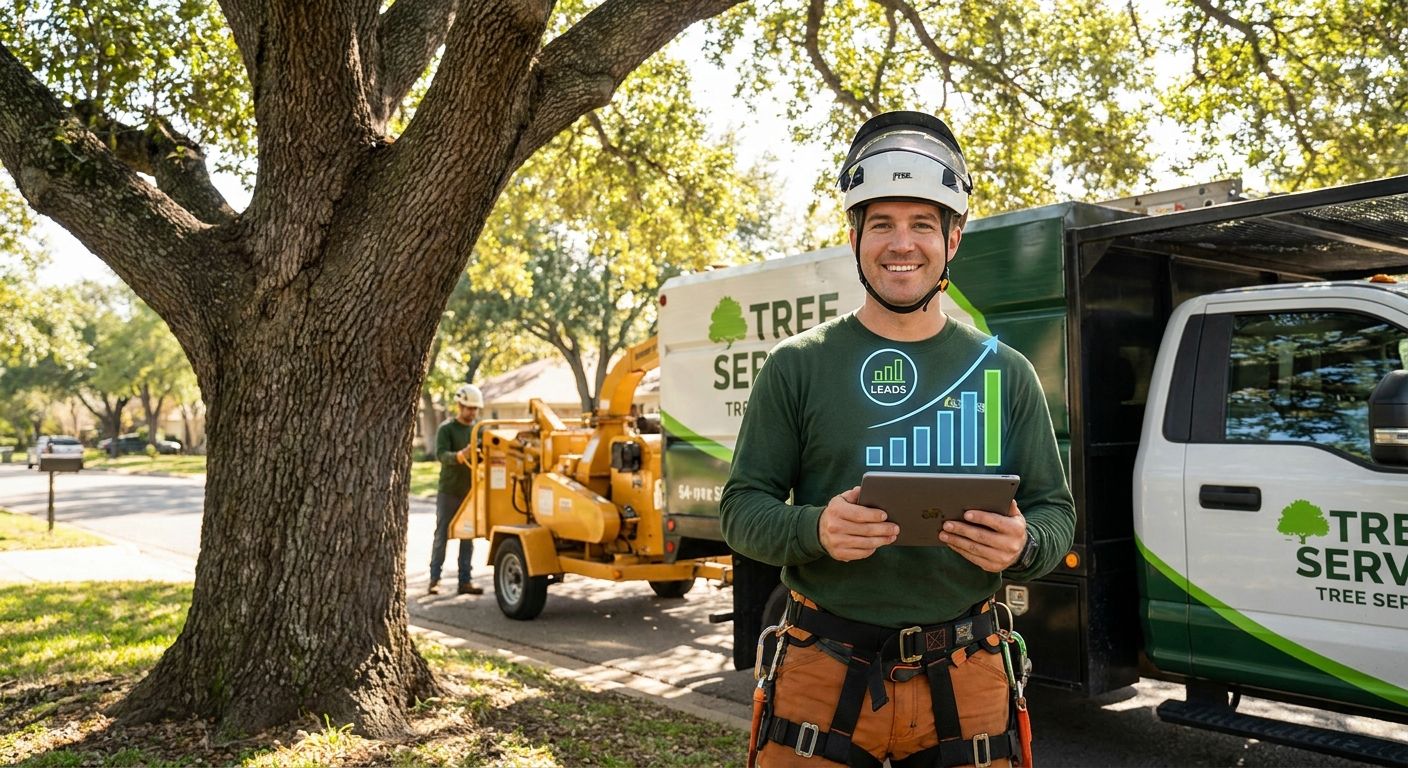
Tree service lead generation is the mix of paid and organic channels — Google Local Services Ads, local SEO, and speed-to-lead systems — that put tree removal, trimming, and storm-cleanup jobs in front of homeowners who need a crew now, with the goal of filling next week's schedule instead of waiting on referrals. Tree companies run on weather and urgency, so the playbook that works for a landscaper or a painter doesn't translate directly here.
- Tree service lead generation performs best on Google Local Services Ads and hyper-local SEO, not broad Meta campaigns.
- Wind and storm events create short, high-value lead spikes — slow callbacks lose the job to whoever answers first.
- Track cost per booked job, not cost per lead, because a $200 trimming call and a storm-damage removal don't belong under one CPL target.
- DIY local SEO works if the owner has months to wait; paid ads close the gap during storm season 2026 crews can't afford to miss.
Why tree service lead generation works differently
Most tree service searches split into two buckets: planned work (trimming, stump grinding, seasonal cleanup) and emergency work (a tree on a roof, a limb on a power line, storm debris blocking a driveway). Emergency searches convert fast and don't wait for a callback tomorrow — the caller is already dialing the next name on the page.
That urgency changes what Roxfire prioritizes for tree companies compared to, say, a cleaning service: speed-to-lead and local map visibility matter more than clever ad copy. A tree company that ranks in the local pack and answers on the second ring wins jobs a slower, better-branded competitor loses.
Seasonality also skews budget planning. Storm season pulls in high-ticket emergency removals; the rest of the year runs on trimming, pruning, and stump grinding at lower average tickets. A single flat CPL target across both ignores how differently those jobs pay out.
Update your Google Business Profile first
This is free, and it's the foundation everything else sits on. Local Services Ads and the local map pack both pull signal from your Google Business Profile, so a thin or outdated one caps every other channel.
- Fill every category and attribute Google offers for tree services — arborist, certified, insured, 24-hour emergency
- List all service areas by name, not just your home city
- Upload real job photos, especially before/after storm cleanup shots
- Post updates during active storm windows so Google sees recency signal
- Respond to every review, good or bad, within a few days
Build local SEO pages by service and area
Generic "tree service" pages rarely rank against dedicated service-area pages. Splitting content by job type and by town gives Google — and homeowners scanning search results — a page that matches exactly what they typed.
- Create separate pages for tree removal, trimming, stump grinding, and storm cleanup
- Duplicate the structure for each service area or ZIP cluster you actually serve
- Add FAQ content answering permit and insurance questions specific to tree work
- Build citations on directories tree homeowners actually check (Angi, HomeAdvisor, BBB)
- Link service pages to each other so Google understands the site's full service radius
Fix your speed-to-lead process
A widely cited lead-response study found that contacting a lead within 5 minutes makes conversion up to 21 times more likely than waiting 30 minutes — and storm calls have even less patience than that study's average lead. This is the step where most tree companies leak jobs they already paid to generate.
- Route every call and form submission to a live person, not voicemail, including after hours
- Set up text-back automation for missed calls so the caller isn't left waiting
- Use a shared CRM so estimators see the same lead history the office does
- Score leads by job type and urgency so storm calls jump the queue
This is where Roxfire's CRM automation and lead-scoring work enters the picture for tree companies that have the ad spend and organic pages built but keep losing jobs to slower callbacks — it's a layer on top of the manual fixes above, not a replacement for having someone answer the phone.
Fix your speed-to-lead gap
See how Roxfire routes and scores tree service leads for faster callbacks.
Launch Google Local Services Ads for emergency intent
Local Services Ads run pay-per-lead instead of pay-per-click, which matches how tree companies actually buy — you're paying for a call, not a click that might bounce. Google's Google Guaranteed badge also requires a background check and license verification, which filters out some of the lowest-quality traffic before it reaches you.
- Get the Google Guaranteed badge before storm season, not during it
- Set your service radius to match crews you can actually dispatch same-day
- Dispute invalid leads through Google's standard 30-day dispute window
- Pair Local Services Ads with traditional Search Ads for non-emergency keyword coverage
Run Meta Ads for proactive, non-emergency jobs
Meta Ads rarely capture someone with a tree on their roof — nobody opens Facebook mid-emergency. They work better for trimming packages, seasonal pruning reminders, and stump grinding offers where there's no urgency to act today.
- Target homeowners in your service radius with before/after job photos
- Run seasonal campaigns tied to pruning windows, not storm windows
- Retarget site visitors who viewed a service page but didn't call
- Keep emergency-removal messaging out of Meta creative — it underperforms there
Turn every closed job into a review
Reviews compound. A tree company with 150 reviews at a strong average rating outranks and out-converts a competitor with 20, even with a smaller ad budget.
- Ask for the review on-site before the crew leaves the property
- Send a text-based review request within an hour of job completion
- Flag storm-damage jobs for review requests — these carry the most persuasive detail
- Monitor review velocity monthly, not just the star average
Track cost per booked job, not cost per lead
CPL alone hides the real story for tree companies because job values swing so widely. A cheap lead that never closes costs more than an expensive lead that books a $3,000 removal.
- Tag every lead by job type in your CRM at intake
- Calculate cost per booked job separately for emergency vs. planned work
- Review close rates by channel monthly — Local Services Ads and organic often close at different rates than Meta
- Cut spend on channels generating calls that estimators can't close, not just channels with high CPL
Comparison: lead sources for tree service companies
| Option | Best For | Key Limitation |
|---|---|---|
| Google Local Services Ads | Same-day emergency removal calls | Requires background check and license verification before launch |
| Google Search Ads | Proactive trimming/stump grinding searches | CPCs climb fast in competitive metros during storm season |
| Local SEO / Google Business Profile | Long-term, compounding organic calls | Takes months to rank; too slow for an active storm surge |
| Meta Ads | Off-season trimming and pruning packages | Weak for emergency intent — people don't shop Facebook mid-crisis |
| Referral / door-hanger | Reactivating past customers | Doesn't scale past your existing service radius |
Verdict: Local Services Ads plus a built-out local SEO footprint wins for most tree service companies in 2026 — Meta Ads earns a supporting role, not the lead role.
Common mistakes tree service companies make
- Running one CPL target across every job type. A $150 trimming lead and a $3,000 storm-removal lead shouldn't share a budget cap.
- Letting after-hours calls hit voicemail. Storm calls at 9pm go to whoever answers, and it's rarely the company that let it ring out.
- Skipping Google Business Profile attributes. Local Services Ads matching relies partly on categories and attributes most owners never fill in.
- Keeping Meta Ads live during storm season instead of shifting that budget to Search and Local Services Ads, where the actual intent is sitting.
- Measuring calls, not closed jobs. A channel with a low CPL but a poor close rate is quietly the most expensive one in the account.
FAQ
What's the best lead generation channel for tree service companies in 2026?
Google Local Services Ads paired with local SEO wins for most tree service companies in 2026 because both match how homeowners search during an emergency. Meta Ads work as a secondary channel for off-season trimming and pruning jobs, not emergency removal.
Is Google Local Services Ads better than Google Ads for tree companies?
Local Services Ads is generally better for emergency tree removal because it charges per lead instead of per click and includes the Google Guaranteed badge. Traditional Search Ads still cover keyword volume Local Services Ads doesn't reach, like stump grinding or seasonal trimming searches.
How fast should a tree service call back a lead?
Within 5 minutes whenever possible — response-time research shows conversion odds drop sharply once a lead waits past that window. Storm-driven calls have even less patience because the caller is already dialing competitors.
Does local SEO work for tree service companies?
Yes, but it's a months-long build, not a storm-season fix. Service-area pages split by job type and town compound over time and reduce dependence on paid clicks.
How much should a tree company budget for lead generation?
Budget should scale with job value rather than a flat number — a stump grinding lead and a full storm-damage removal carry very different payouts, so a single CPL cap across both distorts the math. A marketing partner sizing spend against your average booked-job value, not raw lead count, gets closer to the right number.
Do Meta Ads work for tree removal leads?
Meta Ads work poorly for emergency tree removal because homeowners don't shop social media mid-crisis. They perform better for planned trimming, pruning, and stump grinding packages promoted ahead of season.
How long does it take to rank a tree service SEO page?
Most local SEO pages take several months to gain meaningful ranking, which is why SEO pairs with paid ads rather than replacing them during 2026's storm windows.
What's the difference between a lead and a booked job for tree companies?
A lead is any call or form submission; a booked job is one that actually closes into paid work. Tracking cost per booked job instead of cost per lead exposes which channels generate calls estimators can't close.
One last thing
Storm-driven demand is the single highest-value keyword cluster most tree companies systematically under-fund, because it's unpredictable and doesn't fit a flat monthly budget. Building a standby Local Services Ads and Search Ads budget you can flex up within hours of a wind event, instead of waiting for a monthly plan review, is the difference between booking the storm surge and watching a competitor take it.