
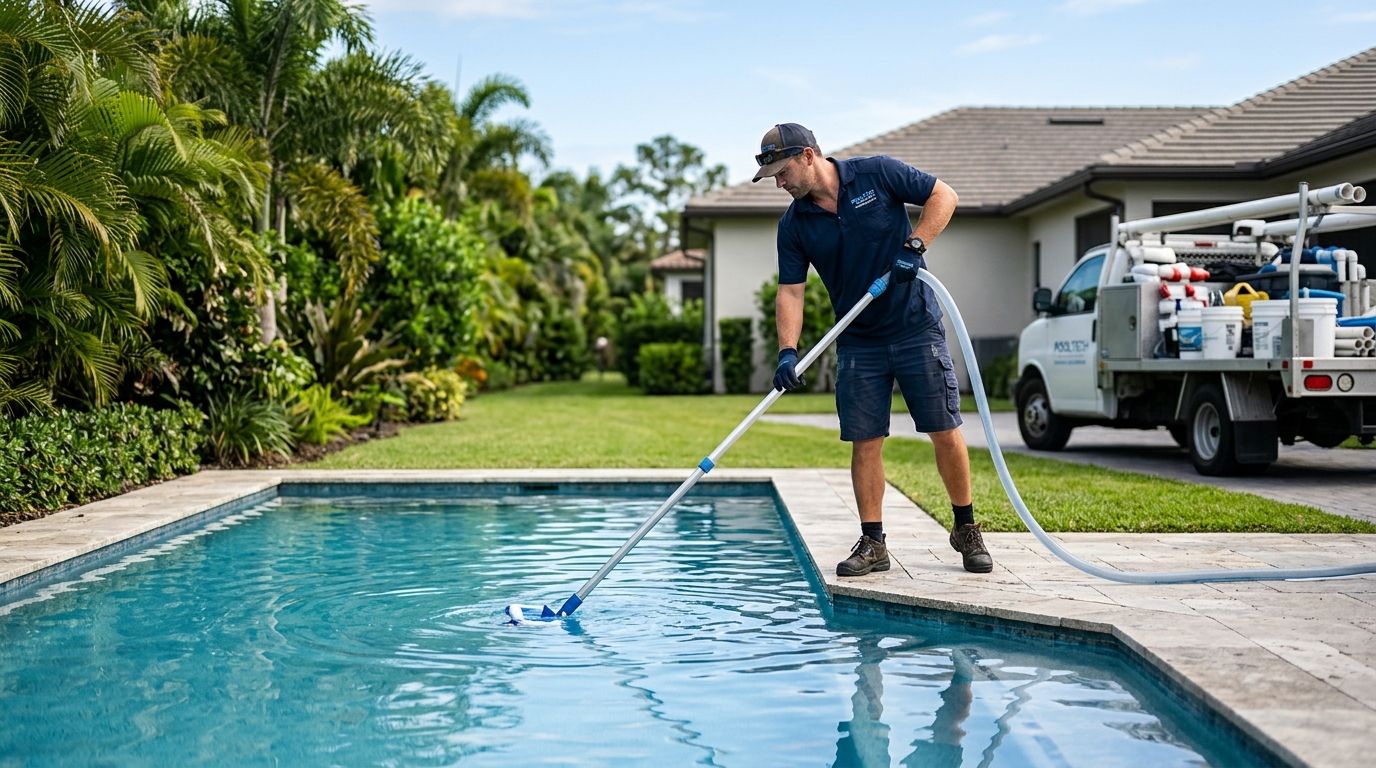
Pool service and maintenance company SEO means optimizing your Google Business Profile, city-specific service pages, and review volume so homeowners searching "pool cleaning near me" or "weekly pool service [city]" find and call your company before a competitor. Pool route businesses live and die on proximity and trust signals — a homeowner picking a weekly service provider almost always chooses from the map pack, not page two of organic results.
- Pool service company SEO in 2026 starts with a location-specific Google Business Profile, not a generic homepage.
- Weekly-service businesses win on review velocity and response speed more than backlink count.
- City-by-city landing pages outperform one statewide pool service page for map pack visibility.
- Seasonal keywords like green pool cleanup and storm debris removal drive spikes a static site plan misses.
- Roxfire ties pool company local SEO to call tracking so you see booked jobs, not just impressions.
Why local SEO matters for pool service and maintenance companies
A pool cleaning or repair business doesn't sell to the whole metro area — it sells to homeowners inside a drivable route radius, usually 10 to 20 miles from a technician's start point. That's why the map pack, the three-listing block under the local search results, matters more here than for almost any other trade.
Most pool service searches are transactional and immediate: "my pool is green," "pool leak repair [city]," "weekly pool cleaning near me." These are homeowners with a problem right now, not people researching for weeks. If your Google Business Profile isn't set up for the specific city they're searching from, a competitor two miles away gets the call.
2026 makes this sharper because AI Overviews increasingly summarize "best pool service near me" queries by pulling from Business Profile data and review text, not just website copy.
Build a location-specific Google Business Profile for every service area
One listing covering "South Florida" doesn't rank for city-level searches the way a profile with city-matched categories and accurate service areas does. Pool route businesses serving multiple cities need to fix this before anything else on the list.
- Set primary category to "Pool Cleaning Service" and add secondaries like "Swimming Pool Repair Service"
- List every service area city individually in the service area field, not just the headquarters city
- Upload photos from actual jobs in each city rather than stock pool imagery
- Post weekly updates during algae season with before-and-after shots
- Fill the Q&A section proactively with the 5 or 6 questions homeowners always ask about visit frequency and equipment turnaround
A fully built-out profile is the single highest-leverage move for a pool company in 2026 — before any blog post or backlink. The same pattern Roxfire documents in its Google Business Profile optimization work for HVAC companies transfers directly to pool routes.
Publish city-specific service pages instead of one statewide page
A single "Pool Service in Florida" page can't rank for "pool cleaning Boca Raton" and "pool cleaning Fort Lauderdale" at the same time. Google wants page-to-query relevance, and a generic page loses to a competitor's page built for that exact city.
- Create a dedicated page per city with the city name in the H1, title tag, and URL
- Reference real neighborhoods, HOA communities, or landmarks in that city, not boilerplate
- Include a service area map and local phone number on each page
- Add testimonials or job photos specific to that city where you have them
- Never copy-paste the same 400 words across five city pages — near-duplicate pages tend to rank none of them well
Roxfire's pool builder marketing for Boca Raton shows how city-specific pages plus targeted paid campaigns compound faster than organic SEO alone in a competitive pool market.
Collect reviews on a system, not by accident
Pool service is a repeat-visit business, which means you get more review opportunities than a one-and-done trade like roofing. Google rewards steady velocity over a one-time burst.
- Text a review request within an hour of each service visit while satisfaction is fresh
- Have technicians ask verbally at the end of repair jobs, not just cleanings
- Respond to every review, good or bad, within 48 hours
- Dispute clearly fake or competitor-planted negatives through Google's process
- Track review velocity monthly — a stall usually means the ask stopped happening in the field
“A pool company adding reviews steadily every month outranks one that dumped a hundred of them in a single week.”
Target seasonal and service-specific keywords, not just "pool service"
Homeowners search differently depending on what's wrong with the pool, and a site built only around the generic head term misses most of the actual demand.
- Build pages around "green pool cleanup," "pool algae removal," and "pool leak detection"
- Add storm-season terms like "pool debris cleanup after storm" heading into Florida's hurricane season
- Cover equipment searches: "pool pump repair," "pool heater not working," "salt cell replacement"
- Separate weekly maintenance content from one-time repair content — different intent, different page
- Check Search Console monthly for terms already earning impressions but few clicks; rewrite those titles and metas first
Build local citations and links from South Florida sources
Backlinks matter less for pool service SEO than for competitive national niches, but a handful of relevant local links still moves trust signals in the map pack.
- Get listed accurately on Yelp, Angi, Nextdoor, and Florida home service directories
- Pursue listings in HOA newsletters and community associations you already service
- Chase links from local news coverage of storm cleanup or pool safety stories
- Keep name, address, and phone identical across every citation — mismatches confuse local ranking
- Prioritize a few real local links over dozens of low-quality directory submissions
Roxfire's guide to local link building for South Florida home service companies covers which citation sources correlate with map pack movement and which are noise.
Track which channel actually books the job
A pool company running SEO without call tracking can't tell whether a Tuesday-morning call came from the Business Profile, a city page, or a referral. Without that, every budget decision is a guess.
- Use a call tracking number on the website distinct from the number listed on the Business Profile
- Tag form submissions by source page in your CRM
- Review monthly which city pages generate calls versus which only collect impressions
- Compare cost-per-booked-job across organic, paid, and referral — not just cost-per-lead
This is where most pool companies plateau on DIY SEO: the traffic shows up in analytics, but nobody can name the page that turned into a truck roll. Roxfire builds this tracking into every local SEO engagement, tying visibility work to booked jobs instead of vanity impressions.
Get a pool company SEO review
See where your Business Profile and city pages are losing calls to competitors.
Comparison: local SEO options for pool service companies in 2026
| Option | Best for | Key limitation |
|---|---|---|
| DIY Business Profile plus city pages | Single-truck owner-operators with time to manage it | Slow to compound; review velocity is the first thing to slip |
| Freelance local SEO contractor | Companies needing basic on-page and citation fixes | Rarely builds call tracking or ties rankings to booked jobs |
| Self-serve SEO software | Owners who want rank tracking they control | No trade context — treats a pool route like any small business |
| Full-service agency such as Roxfire | Multi-city pool route businesses wanting SEO tied to paid ads and CRM data | Ongoing spend; not a fit for a single-truck operation just testing |
Verdict: Roxfire is the strongest fit for multi-city pool service and maintenance companies in South Florida that want local SEO measured in booked jobs, not rankings screenshots.
Common mistakes pool service companies make
- One Business Profile for a whole multi-city route instead of accurate per-city service area settings — this alone kills visibility outside the home city
- Duplicate city pages with the same 300 words and a swapped city name, which read as thin content
- Review requests only after cleanings, skipping repair and equipment jobs where satisfaction is often highest
- No seasonal plan, missing the warm-season algae spike and post-storm debris cleanup searches entirely
- No lead source tracking, so budget keeps flowing to whichever channel got credit last rather than what books work
FAQ
What is the best local SEO strategy for a pool service company in 2026?
A fully built-out Google Business Profile with accurate per-city service areas, paired with individual city landing pages and a steady review-collection system. That combination drives more booked jobs in 2026 than a single statewide service page.
How long does pool service SEO take to show results?
Business Profile changes can shift map pack position within a few weeks. City page rankings and organic traffic growth typically take 3 to 6 months of consistent work.
Is Google Ads or SEO better for pool service companies?
They work best together. Google Ads fills the gap while SEO builds, and both should point to the same tracked phone number so you can compare cost-per-booked-job across channels.
How many reviews does a pool service company need to rank well?
There is no fixed number, but steady monthly growth matters more than total count. A company adding a few reviews every month consistently tends to outrank one with a stalled profile.
Should a pool company build separate pages for each city it serves?
Yes. City-specific pages with unique content and local references outrank one generic statewide page for searches like pool cleaning plus a city name.
Do seasonal keywords matter for pool service SEO?
Yes. Green pool cleanup and algae removal searches spike in warmer months, and debris cleanup searches spike after named storms. Pages targeting those terms capture demand a static service page misses.
What is the biggest local SEO mistake pool companies make?
Running one Business Profile and one generic service page across an entire multi-city route. Location-specific profiles and pages for each city served fix most of the visibility gap.
One last thing
Most pool service companies treat the Google Business Profile as a set-and-forget listing. In 2026 it functions closer to a second website — the posts, Q&A answers, and photos you add weekly are what AI Overviews and the map pack read first. Update it like a homepage, not a business card.


