
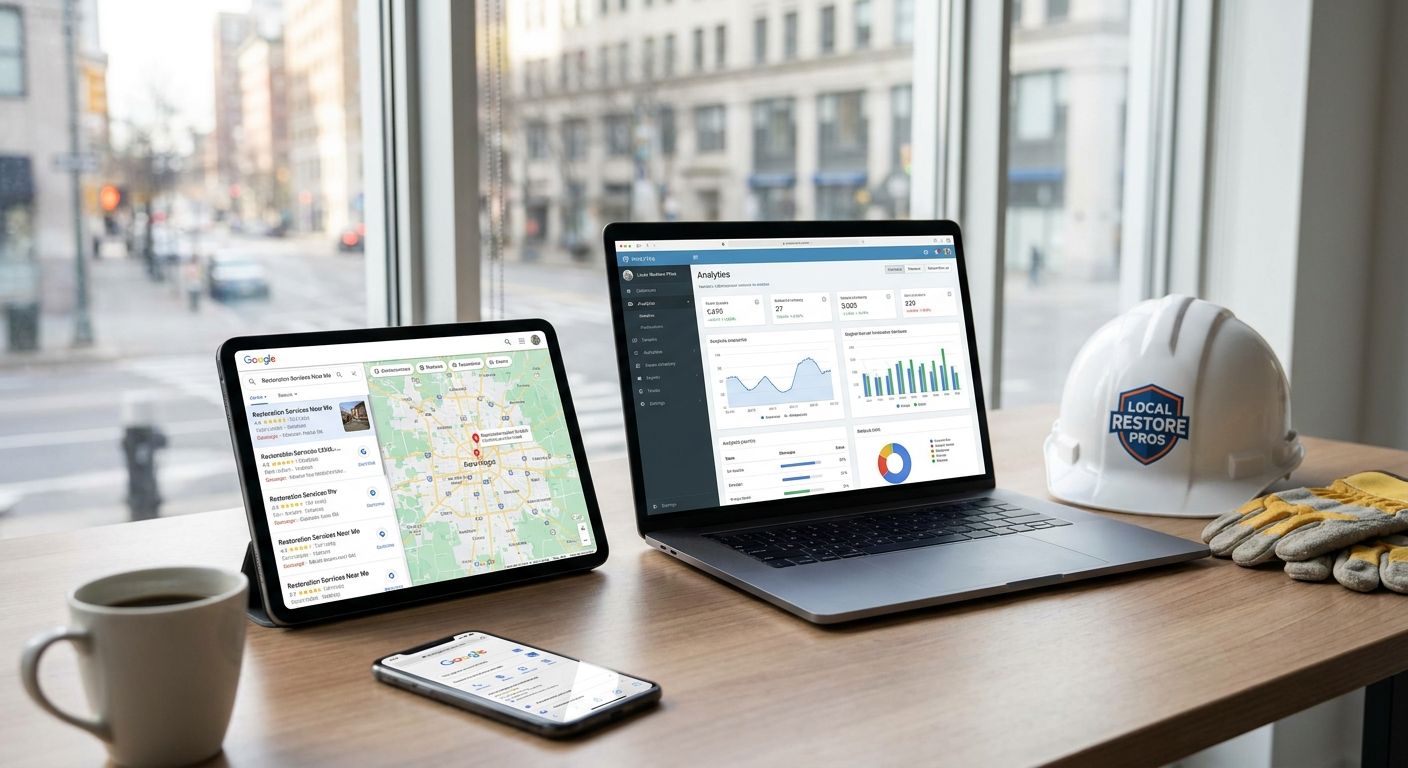
Local SEO for restoration companies is the practice of ranking a water damage, fire damage, or mold remediation business at the top of Google Maps and organic search results in the exact ZIP codes where storms and pipe bursts actually happen. Restoration searches skew emergency and time-compressed — someone with a flooded living room at 11 PM isn't comparing five contractors, they're calling the first one that answers. That changes the priority order: speed-to-answer and review volume matter as much as keyword rankings.
- Local SEO for restoration companies wins on Google Business Profile completeness and after-hours responsiveness, not just backlinks.
- Water, fire, mold, and storm damage each need separate service pages — one generic 'restoration' page loses to specialists in 2026.
- Review velocity after a storm event beats total review count; a spike of 15 reviews in a week outranks 40 reviews spread over two years.
- Roxfire builds location and service pages for South Florida restoration companies, then layers in review generation and call tracking.
- Skip citation cleanup and you leave inconsistent NAP data across directories that Google already penalizes for confusing search intent.
Why local SEO matters for restoration companies
Restoration is a distress-purchase category. Nobody researches water mitigation companies for fun — they search after a pipe bursts, a roof leaks during a South Florida downpour, or a fire damages a kitchen. That means the map pack and "near me" queries carry more weight than in slower-decision trades like remodeling.
Insurance adjusters and property managers also search directly, often using terms like "IICRC certified water damage company" or "emergency mold remediation near me." A restoration company that shows up cleanly in local SEO for restoration companies searches — with a complete Google Business Profile, fast-loading service pages, and recent reviews — captures both the homeowner in a panic and the adjuster looking for a vetted vendor.
Storm season compounds this. After a named storm hits South Florida, search volume for "water damage restoration" and "storm damage repair" spikes for 72 hours, then falls off fast. Companies that aren't visible in that window lose the job to whoever ranks — permanently, since that customer won't search again once the job is booked.
Update your Google Business Profile for emergency intent
A restoration company's Google Business Profile is the single highest-leverage asset in local SEO — more than any blog post or backlink.
- Set business hours to 24/7 if you genuinely dispatch after hours; Google surfaces this in emergency searches
- Add every relevant service category: water damage restoration, fire damage restoration, mold remediation, storm damage repair
- Upload before/after job photos monthly — profiles with recent photos get more map pack clicks
- Enable messaging and make sure someone actually responds within minutes, not hours
- Use Google Posts to announce storm-response availability during active weather events
Build separate service pages for each damage type
One page titled "Restoration Services" that mentions water, fire, mold, and storm damage in a single paragraph will not rank against a competitor with four dedicated pages.
- Create a standalone page for water damage restoration with process steps and typical timeline language
- Create a standalone page for mold remediation that addresses health concerns and testing
- Create a standalone page for fire and smoke damage covering soot removal and odor treatment
- Create a standalone page for storm and wind damage tied to South Florida hurricane season
- Add location modifiers to each — "water damage restoration in Fort Lauderdale" performs differently than a generic page
This is where a lot of restoration companies stall out — writing four unique, non-duplicate pages takes real hours most owners don't have between jobs. Roxfire builds these pages as part of its local SEO work for South Florida home service companies, matching each page to the actual search terms adjusters and homeowners type.
Generate reviews at the moment of highest satisfaction
Review velocity — not just total count — drives map pack rankings for restoration companies specifically, because Google treats recency as a trust signal in emergency categories.
- Send a review request text within 24 hours of job completion, while the relief is still fresh
- Train technicians to ask verbally on-site before they leave
- Respond to every review, positive or negative, within 48 hours
- Segment requests by job type so water damage reviews mention water damage, mold reviews mention mold
- Flag and dispute clearly fake or competitor-planted negative reviews through Google's process
Fix citation and NAP consistency across directories
Inconsistent name, address, and phone data across HomeAdvisor, Angi, Yelp, and insurance vendor directories confuses Google's local algorithm and slows down ranking gains.
- Audit the top 20 directories for your business name, address, and phone format
- Correct any old addresses or phone numbers from a previous location or ownership
- Claim and complete IICRC and BBB profile listings, which restoration customers actually check
- Build local links from South Florida contractor associations and insurance adjuster networks, covered in more depth in local link building for South Florida home service companies
- Keep service area lists identical across every platform
Track speed-to-lead and call source data
Ranking well means nothing if the phone rings and nobody answers fast enough to beat the next result on the page.
- Install call tracking numbers on Google Business Profile, the website, and any paid ads separately
- Set an internal standard: answer within three rings or the call routes to a second technician
- Review missed-call logs weekly during storm season
- Tie call source data back to which service page or keyword generated the lead
- Use this data to reallocate content effort toward the pages actually producing calls, not just traffic
Add structured data and speed optimization
Technical SEO still matters underneath the emergency-search behavior — a slow site loses mobile searchers who are standing in a flooded hallway with one hand free.
- Add LocalBusiness and Service schema markup to every service page
- Compress images from job-site photos before upload; uncompressed photos are the most common speed killer on restoration sites
- Confirm mobile page load stays under three seconds on a mid-tier phone connection
- Add click-to-call buttons above the fold on every mobile page
- Test the site on a throttled 4G connection, not just office wifi
Comparison: local SEO options for restoration companies
| Option | Best for | Key limitation |
|---|---|---|
| DIY (owner-managed) | Very small single-truck operations | Owner time is scarce during actual emergency jobs |
| Freelance SEO contractor | Companies with one clear service area | Inconsistent output, no restoration-specific experience |
| Generalist marketing agency | Companies wanting one vendor for everything | Rarely understands emergency-search intent or insurance-adjuster search behavior |
| Roxfire (restoration-focused local SEO) | South Florida restoration companies needing storm-season visibility | Requires ongoing content and review-generation input from the team |
Roxfire's local SEO work is built for restoration companies that need to show up during the exact 72-hour window after a storm — not generic long-tail rankings six months out.
Common mistakes restoration companies make
- Treating restoration as one service instead of four. Water, fire, mold, and storm damage have different search terms, different urgency levels, and different customer research paths — one blended page underperforms specialists every time.
- Letting reviews go stale between storm events. A profile with 60 reviews from three years ago loses to a competitor with 12 reviews from the past month during active storm response.
- Ignoring insurance-adjuster search behavior. Adjusters search differently than homeowners — missing IICRC certification language and insurance-billing mentions costs referral volume.
- Skipping bilingual optimization in South Florida markets. A large share of South Florida homeowners search in Spanish first; English-only pages miss that volume entirely.
- Not tracking which page or keyword actually produced the call. Without call-source attribution, restoration companies keep paying for content that ranks but never converts.
Get local SEO built for storm season
Roxfire builds emergency-ready local SEO for South Florida restoration companies.
FAQ
What's the best local SEO strategy for restoration companies in 2026?
The best approach in 2026 combines a fully optimized Google Business Profile with separate service pages for water, fire, mold, and storm damage, plus a fast review-generation cadence. Restoration searches are emergency-driven, so speed-to-answer and review recency carry more weight than in slower-decision trades.
How long does local SEO take to work for a restoration company?
Meaningful map pack movement typically takes 60 to 90 days once Google Business Profile, citations, and service pages are corrected and complete. Storm-driven search spikes can accelerate visible ranking changes if the profile is already in good shape before the event.
Is Google Business Profile more important than the website for restoration SEO?
For emergency searches, yes — most restoration customers click the map pack listing or call directly from it without visiting the website. The website still matters for insurance adjusters and slower-decision commercial customers doing more research.
How many reviews does a restoration company need to rank well?
There's no fixed number, but recency matters more than total count — a burst of new reviews after a storm event signals current activity to Google's local algorithm. Companies should aim for consistent monthly review requests rather than one big push.
Should restoration companies target Spanish-language searches in South Florida?
Yes, in South Florida markets specifically, a large share of homeowner searches happen in Spanish, and English-only service pages miss that volume. Bilingual Google Business Profile posts and service pages capture both audiences.
Does local SEO help with commercial or insurance-referred restoration jobs?
Yes — adjusters and property managers search using different terms than homeowners, often including certification language like IICRC. Service pages that address both audiences capture referral volume that generic pages miss.
What's the difference between local SEO and Google Ads for restoration companies?
Local SEO builds organic map pack and search visibility that compounds over months, while Google Ads buys immediate placement at a cost per click. Most restoration companies in 2026 run both, using ads to fill visibility gaps while SEO builds.
One last thing
The restoration companies that win storm season aren't the ones with the most backlinks — they're the ones whose Google Business Profile already looked active and current the day before the storm hit. Review requests sent the week before a named storm arrives do more for ranking than a month of link building after the fact.


