
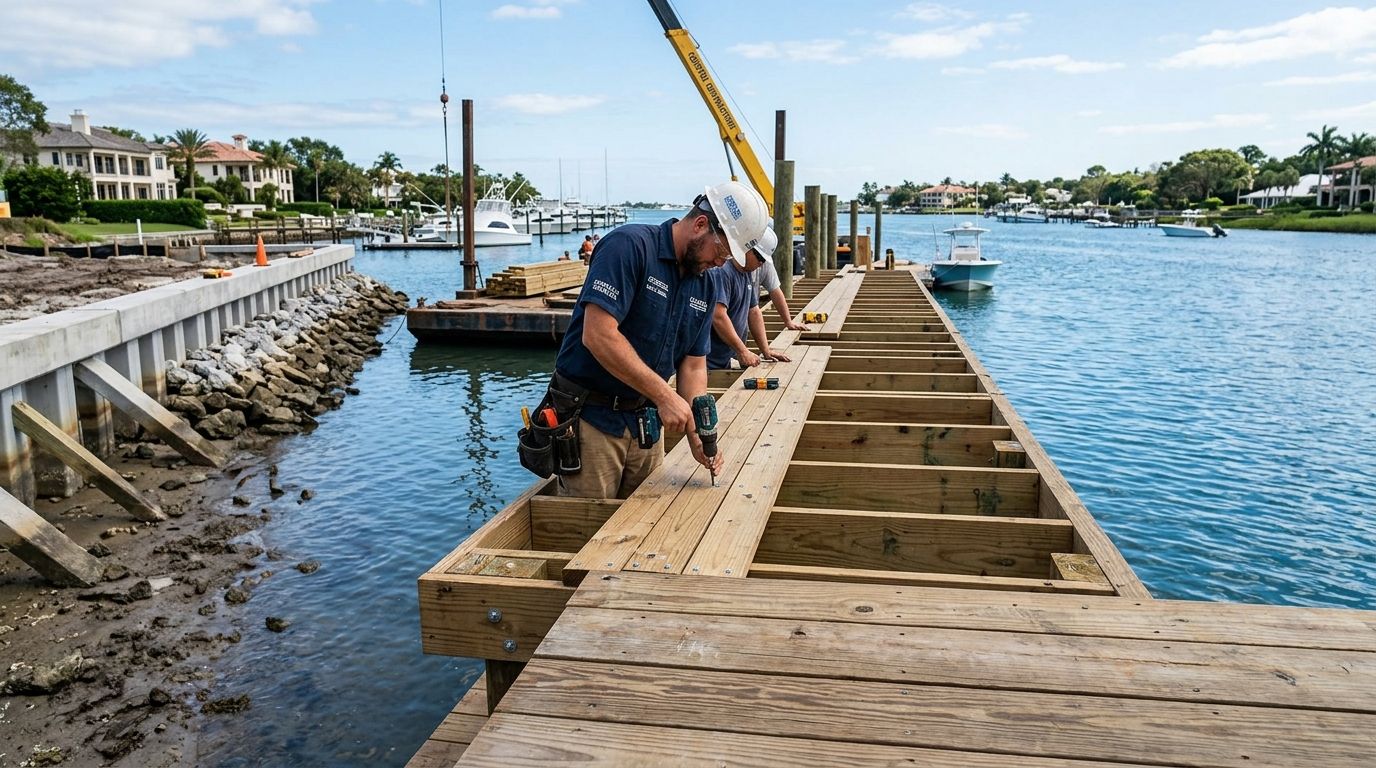
Dock and seawall construction marketing is the process of putting your company in front of waterfront property owners at the exact moment a piling rots, a cap cracks, or an insurance inspector flags a seawall for replacement — with the aim of turning that inquiry into a signed contract before a competitor's ad shows up first. This segment behaves nothing like roofing or HVAC marketing: search volume is low, ticket size is high, and demand spikes hard around named storms instead of staying flat all year.
- Dock construction marketing works best when ads and SEO target waterfront zip codes, not a broad city-wide radius.
- Seawall repair searches spike after named storms — flat year-round bidding wastes budget outside that window.
- Google's local 3-pack shows only three businesses; ranking outside it means near-zero visibility for 'seawall repair near me.'
- Review volume, not ad spend, usually decides between two similarly-ranked dock builders.
- Speed-to-lead matters more on six-figure marine jobs than on $200 service calls — a slow callback loses the contract.
Why dock construction marketing matters for waterfront contractors
Most home service categories compete on volume. Dock and seawall construction competes on precision. There are far fewer people searching "seawall repair near me" than "AC repair near me" in any given South Florida zip code, but each job is worth many times more, and the buyer is usually a homeowner or HOA board comparing two or three quotes, not twenty.
That changes the math on Roxfire's approach: you don't need thousands of clicks, you need the right hundred. A dock builder in a canal-heavy market like Fort Lauderdale or Miami-Dade wins by owning the searches tied to specific neighborhoods and by showing up fast when storm damage drives urgent demand. Miss the window and the homeowner has already signed with whoever answered the phone first.
Claim and optimize your Google Business Profile for dock builders
Start here before spending a dollar on ads. A Google Business Profile set up correctly is free, and it's what puts you in the local 3-pack for "dock builder" and "seawall repair" searches.
- Select the most specific category available (Dock builder, Marine contractor) instead of generic "Construction company"
- Set service areas to canal and waterfront neighborhoods, not the whole county
- Upload before/after photos of actual seawall replacements, dock installs, and davit or lift work
- Answer common permit and setback questions directly in the Q&A section
- Post updates timed to hurricane prep and post-storm inspection season
Build local SEO around waterfront neighborhoods, not city names
Generic city-level SEO loses to competitors who target the actual canal communities where the work happens. Permit rules, seawall heights, and setback requirements often differ by municipality, which gives you a real reason to build separate pages instead of thin duplicates.
- Target long-tail phrases like "seawall repair Fort Lauderdale canal" instead of just "seawall repair Florida"
- Build one page per municipality or waterway with real project photos, not boilerplate copy
- Add schema markup so Google understands service area and business type
- Earn backlinks from marine surveyors, real estate agents, and insurance adjusters who refer waterfront clients
- Study how adjacent waterfront trades structure their pages — pool builder marketing in South Florida runs into the same neighborhood-level targeting problem
Run paid search on high-intent seawall and dock repair terms
Once the free foundation is in place, Google Ads fills the gap while SEO builds. This is where the client-side tools speed things up — but only after steps one and two are working.
- Bid exact-match on "seawall repair," "dock construction," and "davit installation" rather than broad match
- Build a negative keyword list to cut off DIY, kits, and rental searches
- Use call extensions and click-to-call, since high-ticket buyers call before they fill out a form
- Set location targeting radius tight to canal-front neighborhoods, not a 25-mile blanket
- Shift budget upward in the weeks after landfall when repair searches surge, and pull back mid-winter
Layer in Meta Ads for before-and-after proof
Meta doesn't catch bottom-funnel "I need this fixed now" intent the way search does, but it's strong for staying visible with homeowners who aren't ready to call yet.
- Run video before/after carousels showing full seawall replacements, not stock construction footage
- Retarget website visitors who viewed a service page but didn't convert
- Build lookalike audiences from past customer lists to reach similar waterfront homeowners
- Boost posts featuring recent reviews instead of generic ad copy
Fix speed-to-lead before spending more on ads
A slow callback on a $150 service call costs you a small job. A slow callback on a full seawall replacement costs you a five- or six-figure contract, because the homeowner is comparing two or three bids and awards the job to whoever shows up first and answers clearly.
- Set up call tracking numbers so you know which channel a lead came from
- Add auto-text response the moment a form is submitted or a call is missed
- Route leads to whoever is next available, not a single overloaded estimator
- Use missed-call text-back so no inbound call goes silent
- Review response times weekly against close rate, not just lead volume
Generate 5-star reviews systematically
Review count and recency are a real ranking factor for the local 3-pack, and they're often the deciding factor for a homeowner choosing between two similarly-priced bids. Building a steady 5-star review pipeline works the same way whether the job is a dock repair or a duct cleaning — the process just needs to run after every completed project, not occasionally.
- Send a text-based review request within a day or two of job completion
- Never gate or filter reviews before they post — it violates Google's policy and gets profiles suspended
- Include a direct Google Business Profile review link, not a generic "leave us a review" ask
- Respond to every review, good or bad, within the same week
- Track review velocity by month, especially around storm season when demand and job volume both climb
Track ROI by job type, not blended cost per lead
Blended CPL hides the real story in this segment because job values vary so widely between a small dock repair and a full seawall replacement.
- Tag every lead by service type: new dock, seawall repair, davit/lift install, or commercial marina work
- Track close rate and average job value per channel, not just lead cost
- Compare Google Ads, organic, and referral performance monthly against the hurricane season calendar
- Flag any channel producing cheap leads that never close — a low CPL with a low close rate is a losing channel
Get a dock and seawall marketing plan
See how Roxfire builds local visibility for waterfront contractors in South Florida.
Comparison: marketing options for dock and seawall contractors
| Option | Best for | Key limitation |
|---|---|---|
| Google Ads (Search) | Homeowners searching right now for seawall repair | Burns budget fast without a tight negative keyword list |
| Local SEO / Google Business Profile | Long-term visibility in the local 3-pack | Takes months to build authority in a low-volume niche |
| Meta Ads | Staying visible before a homeowner is ready to call | Weak for bottom-funnel "repair now" intent |
| Referral partnerships (surveyors, agents, adjusters) | High-ticket jobs and repeat commercial accounts | Hard to scale, depends on personal relationships |
| Canal-front direct mail or door hangers | Hyper-local neighborhood awareness | No reliable tracking without a dedicated phone number |
Common mistakes dock and seawall builders make
- Bidding city-wide instead of canal-specific: broad radius targeting burns budget on inland searches that never convert
- Skipping permit-timeline content: waterfront buyers research setback rules and permit steps before hiring, and a site that ignores this loses trust
- Running flat ad budgets all year: spend should surge in the weeks after a named storm, not stay level from January through December
- Ignoring HOA and property management reviews: these buyers search and vet differently than a single homeowner, and their reviews carry different weight with future commercial leads
- Competing on price against general contractors: general contractors bidding on dock work often underprice the job, and matching them on ad spend without matching their pricing model wastes budget
FAQ
What does dock and seawall construction marketing include in 2026?
It typically covers Google Business Profile optimization, local SEO built around waterfront neighborhoods, Google Ads on high-intent repair terms, Meta Ads for awareness, and a review-generation process. In 2026 the biggest lever for most dock builders is still local SEO plus a fast speed-to-lead process.
Is local SEO or Google Ads better for seawall repair leads?
Local SEO builds free, compounding visibility in the local 3-pack over months, while Google Ads gets you in front of buyers immediately. Most dock builders need both running together rather than choosing one.
How fast should a dock construction company respond to a new lead?
As fast as possible, ideally the same hour. High-ticket marine jobs get compared across two or three bids, and the contractor who responds first and clearly usually wins the contract.
Do Meta Ads work for dock and seawall contractors?
Meta Ads work for awareness and retargeting but rarely capture the bottom-funnel 'I need this fixed now' searches that Google Ads and local SEO catch. Use Meta to stay visible before a homeowner is ready to call.
How do you get more 5-star reviews as a marine construction company?
Send a text-based review request within a day or two of job completion and include a direct link to your Google Business Profile. Never filter or gate which customers get asked — that violates Google's review policy.
What keywords matter most for seawall repair marketing?
Long-tail, neighborhood-specific phrases like 'seawall repair Fort Lauderdale canal' convert better than broad terms like 'seawall repair Florida' because the buyer pool is small and location-specific.
How long does it take to rank for local dock construction searches?
Expect months, not weeks, since the search volume is low and Google needs consistent signals (reviews, citations, backlinks) to trust a new profile. Paid search fills that gap while organic builds.
Should dock builders increase ad spend during hurricane season?
Yes. Search demand for seawall repair and dock damage climbs in the weeks after a named storm makes landfall, and budgets that stay flat all year miss that window.
One last thing
Google's local map pack only shows three businesses for any given search, and in a low-volume niche like seawall repair, that means the difference between ranking and not ranking is often just a handful of recent reviews and a correctly categorized Google Business Profile — not a bigger ad budget. Fix the free foundation first in 2026, then let paid search fill whatever gap is left.


