
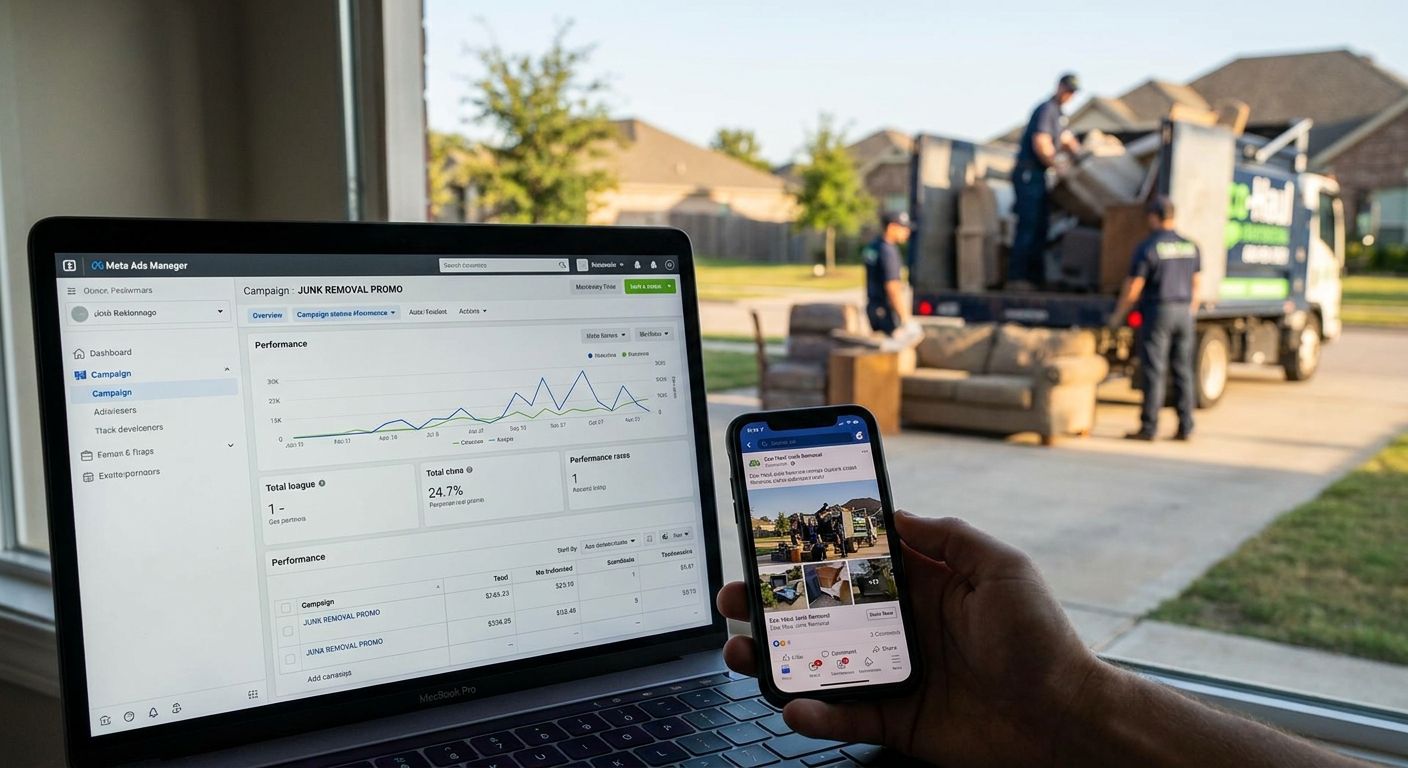
Meta Ads for junk removal companies is a paid social strategy built to put junk hauling offers in front of homeowners and property managers who are already scrolling Facebook or Instagram, with the goal of filling the schedule with booked jobs instead of one-off calls. Junk removal differs from most home service categories because the buying decision is impulsive — someone looks at a garage full of clutter, gets annoyed, and wants a truck there in 48 hours, not next month.
- Meta ads for junk removal work best with video showing before/after clutter, not static stock photos.
- A 10-20 mile targeting radius beats city-wide targeting for junk removal in 2026.
- Speed-to-lead matters more on Meta than Google: call impulse leads within 5 minutes.
- Facebook Lead Ads with an instant form convert more junk removal jobs than landing page traffic.
- Roxfire builds Meta campaigns for junk removal companies around booked jobs, not likes or reach.
Why Meta Ads matters for junk removal companies
Junk removal searches on Google spike only when someone already knows they need a hauler. Meta Ads reaches the much larger group who haven't searched yet — the homeowner who just finished a renovation, the landlord clearing out a unit, the family cleaning out a relative's house. That's a different funnel stage, and it changes how you write the ad, not just where you place it.
Junk removal also has visual proof built in: a stuffed garage, a pile of construction debris, a truck loaded and gone. That's exactly the before/after content that performs in 2026 Facebook and Instagram feeds, where vertical video pulls more engagement than static image ads.
Property managers and real estate agents are a second audience Meta reaches better than Google. They aren't always typing "junk removal near me," but they respond to a retargeting ad after visiting your site or watching a Reel.
Verdict: Meta Ads is the demand-generation channel for junk removal companies, and it only pays off when leads are answered within minutes.
How to run Meta Ads for junk removal, step by step
Set your service radius and audience first
Before writing a single ad, lock down who should actually see it. Junk removal is hyperlocal — a lead 40 miles outside your zone is a wasted dollar.
- Draw a radius of 10-20 miles around your base of operations, not the whole metro area
- Layer in homeowner status if the targeting options are available in your account
- Build a separate audience for property managers and real estate agents
- Exclude zip codes where your trucks are already at capacity
- Build a lookalike audience from your last 90 days of booked jobs, not page likes
Build ad creative around visual proof
Static photos of a stacked truck get scrolled past. Video that shows the mess, the crew working, and the empty space after gets watched.
- Film 15-30 second vertical clips for Reels and Stories, not repurposed landscape video
- Show the actual clutter: garages, sheds, storage units, construction debris
- Put a crew member on camera; faces outperform logo-only creative
- Rotate creative every 2-3 weeks — local audiences are small and fatigue fast
- Caption for sound-off viewing, since most feed video plays muted
Choose the right ad format for lead capture
Where the click lands decides whether the lead ever becomes a booked job.
- Use Facebook Lead Ads with an instant on-platform form for the fastest submit rate
- Keep the form to three fields: name, phone, and "what needs to go?"
- Run a smaller share of budget to a landing page if you want to compare lead quality
- Turn on Click-to-Messenger for audiences that prefer to text before booking
- Skip multi-step qualification forms — junk removal leads bail after two screens
This is the step most owner-operators get wrong on their own. Roxfire sets up the form, the CRM routing, and the tracking so every Meta lead is measurable back to a booked job.
Respond to leads within 5 minutes
A Meta lead is an impulse lead. The homeowner who filled out a form at 9 PM wants a truck scheduled, not a callback in two days.
- Route every Meta lead into a CRM or text-alert system the second it submits
- Call within 5 minutes during business hours; auto-text immediately after hours
- Send an instant confirmation message while a human follows up
- Track first-response time as a KPI next to cost-per-lead
- Use a dedicated phone number for Meta leads so nothing sits in a shared inbox
Track cost-per-booked-job, not cost-per-lead
Cost-per-lead is a vanity number if half the leads never answer the phone. Junk removal margins live on cost-per-booked-job.
- Run a new campaign at least 14 days before judging results
- Mark every lead booked or not-booked in the CRM, not just form-submitted
- Pause ad sets running more than 2x the cost-per-lead of your best set
- Shift budget toward the audience and creative combo producing booked jobs
- Re-check your radius monthly as crew and truck capacity change
Layer in retargeting for slow deciders
Not every homeowner books on the first view. Some need three or four touches before they call.
- Retarget site visitors and video-watchers who didn't submit within 7 days
- Change the angle on retargeting: reviews or upfront pricing instead of the original hook
- Cap frequency around 3 impressions per week per person
- Exclude customers who already booked so you stop paying to reach them
- Build a separate retargeting audience for commercial and property-manager traffic
Scale by adding capacity, not just budget
More spend into a saturated 15-mile radius raises cost-per-lead instead of volume.
- Expand the radius in 5-mile increments and watch cost-per-booked-job at each step
- Add a second creative concept before adding a second dollar of budget
- Test a commercial-cleanout campaign separately from residential
- Increase daily budget by 20-30% at a time so the campaign doesn't reset learning
Get Meta Ads built for your trucks
Roxfire manages targeting, creative rotation, and lead routing for local service businesses.
Meta Ads options for junk removal companies compared
| Option | Best for | Key limitation |
|---|---|---|
| DIY Meta Ads Manager | Owner-operators with time to test and iterate | Creative and targeting need constant attention; learning curve eats weeks |
| Boosted posts | Quick local visibility with minimal setup | Weak targeting control, no real lead-capture form |
| Facebook Marketplace listings | Free supplemental exposure in your area | Not scalable, no targeting, buried among resale listings |
| Freelance media buyer | Companies wanting help without a retainer | Usually no CRM or booked-job tracking, so results stay unproven |
| Managed Meta Ads (agency) | Companies scaling past 1-2 trucks who want predictable lead flow | Requires ongoing ad spend and clean CRM tracking to judge ROI |
Pricing varies by market and management model, so ask any provider what they charge and what tracking is included before signing.
Common mistakes junk removal companies make on Meta
- Targeting the entire metro area. Leads outside same-day truck range inflate cost-per-booked-job even when cost-per-lead looks fine.
- Running static image ads in 2026. Vertical video of a real job site consistently outperforms a stock photo of a truck.
- Sending clicks to a generic contact page. Impulse buyers won't wait through a slow page load and a five-field form.
- Calling leads the next morning. By then the homeowner has already booked whoever answered first.
- Judging campaigns on cost-per-lead alone. It hides which audiences produce paid work and which produce tire-kickers.
“Cost-per-lead is a vanity number if half the leads never answer the phone.”
FAQ
What's the best Meta Ads strategy for junk removal companies in 2026?
Pair a 10-20 mile radius audience with vertical video showing real before/after cleanouts, routed into a Facebook Lead Ads instant form. In 2026, creative quality and response speed move results more than raw budget.
Is Meta Ads better than Google Ads for junk removal?
Meta Ads reaches people before they search; Google Ads catches people already looking. Most junk removal companies run both, using Meta for volume and Google for high-intent capture.
How much should junk removal companies budget for Meta Ads?
Budget depends on your service radius and how many trucks you need to keep busy, so no single figure fits every market. Commit to at least 14 days of consistent spend before judging results.
Do Facebook ads actually work for junk removal companies?
Yes, when the creative shows real job sites and the form is short enough to finish in under a minute. Ads that click out to slow landing pages with long forms underperform.
What ad format converts best for junk removal on Meta?
Facebook Lead Ads with an instant on-platform form convert best because junk removal buyers act on impulse. Every extra page load or form field costs you leads.
How fast should junk removal companies respond to Meta leads?
Call within 5 minutes during business hours and auto-text immediately after hours. Meta leads are impulse leads and go to whoever answers first.
Can junk removal companies use Instagram Reels for lead generation?
Yes. 15-30 second vertical clips of loaded trucks and before/after cleanouts perform well on Reels in 2026 and can be used directly as Meta ad creative.
What targeting radius works best for junk removal Meta ads?
A 10-20 mile radius around your base of operations keeps spend on zip codes your trucks can reach same-day. Expand in 5-mile increments and watch cost-per-booked-job at each step.
One last thing
The junk removal companies winning on Meta in 2026 aren't the ones spending the most. They're the ones who mark every lead booked or not-booked in a CRM and know within two weeks which zip codes and which creative angle produce paid work — then pour budget into that one combination and cut the rest.