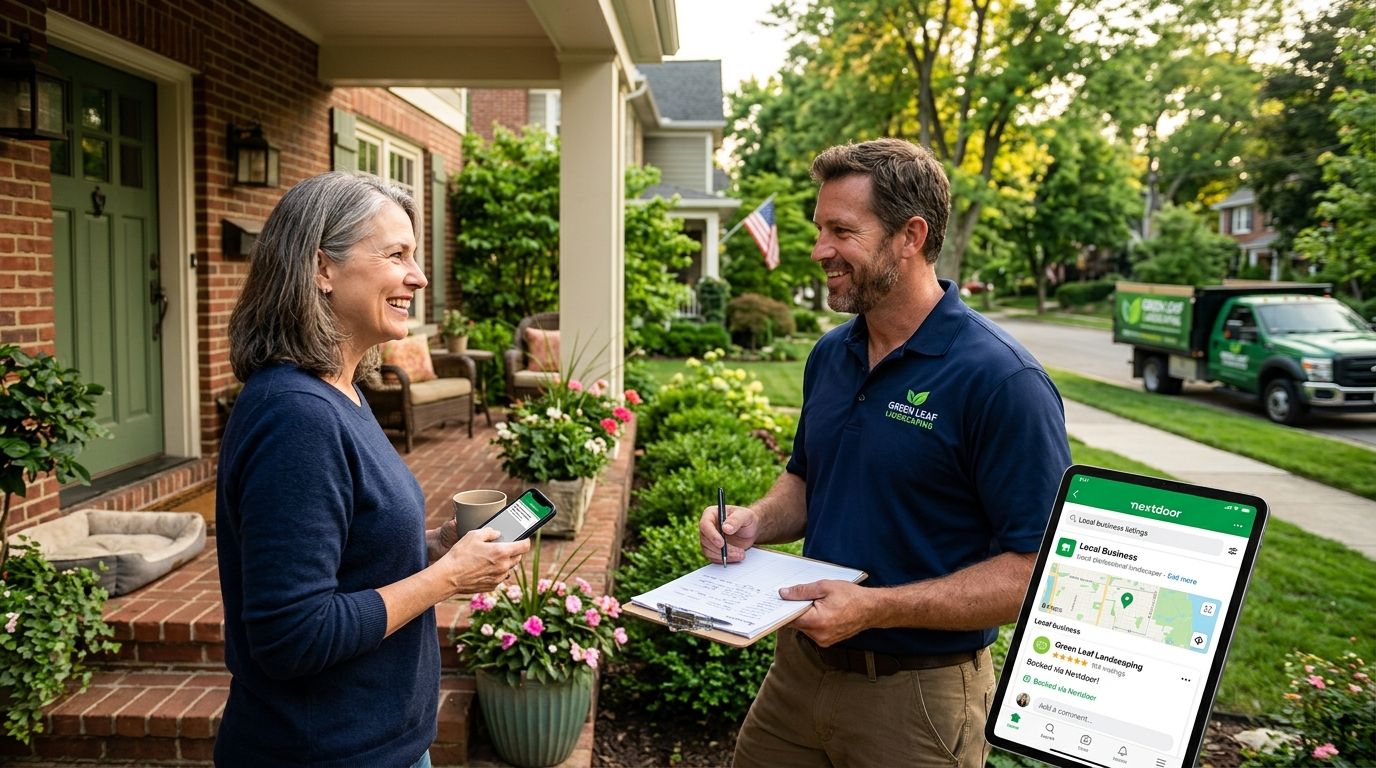
Nextdoor advertising for home service businesses puts your roofing, HVAC, cleaning, or restoration company in front of homeowners who are already asking their neighbors for a referral — a warmer audience than a cold Google search or a scrolling Instagram feed. The platform works differently than Meta or Google because every account is tied to a verified home address, which means your ad or recommendation thread is reaching people who live near the actual job site, not a broad radius guessed from zip codes.
- Nextdoor ads for home services work best for hyper-local trades like HVAC, roofing, and cleaning with tight service radii.
- Neighbor-to-neighbor trust on Nextdoor beats cold social ads for high-consideration jobs like roof replacement or restoration.
- Google Local Services Ads and Meta Ads still win on volume; Nextdoor wins on lead quality, not lead count.
- Claim the free Nextdoor Business Page first — paid Neighborhood Sponsorships only pay off once organic recommendations exist.
- Roxfire runs Nextdoor as a supplemental channel alongside Google Ads and Meta Ads, never as the sole lead source.
Why Nextdoor ads matter for home service businesses
Homeowners post on Nextdoor when they need a plumber, a roofer, or a restoration crew after a storm — and the responses come from actual neighbors, not anonymous reviewers. That thread format does the trust-building work that a display ad can't. For trades where the buying decision is high-stakes and infrequent (a new roof, a burst pipe, mold remediation), a recommendation from three houses down carries more weight than a five-star review from a stranger across town.
The tradeoff is volume. Roxfire treats Nextdoor as a supplemental lead source for home service clients, not a replacement for Google Ads or Local Services Ads, because Nextdoor's audience is smaller and slower to convert than a search campaign built around "emergency AC repair near me." It earns its budget through lower cost-per-acquisition on jobs that need trust more than speed — restoration, roofing, remodeling — and it earns almost nothing for businesses that skip the organic groundwork first.
How to run Nextdoor ads for home service businesses
Claim and complete your Nextdoor Business Page
The Business Page is free, and it's the foundation everything else sits on. Skipping it and jumping straight to paid Neighborhood Sponsorships is the single fastest way to waste a Nextdoor budget in 2026.
- Verify your business address and license number
- List every zip code and neighborhood you actually service
- Upload before-and-after photos of completed jobs, not stock imagery
- Enable direct messaging so neighbors can reach you without leaving the app
- Add your hours and emergency-service availability if you offer it
Earn organic recommendations before you spend on ads
Nextdoor rewards businesses that show up in recommendation threads organically. A business with zero organic mentions running paid Sponsorships looks like a stranger buying attention, and neighbors notice.
- Respond to every "does anyone know a good [trade]" thread in your service area
- Ask satisfied customers to tag your business page directly in their post
- Post seasonal reminders — AC tune-ups before summer, gutter cleaning before hurricane season — without a sales pitch
- Avoid hard-selling in comment threads; Nextdoor users flag pushy replies fast
- Track which neighborhoods generate the most organic mentions before you set paid targeting
Launch Neighborhood Sponsorships with a tight radius
Once the Business Page has some organic traction, Neighborhood Sponsorships are Nextdoor's paid layer. This is where most home service businesses either get disciplined or overspend.
- Set radius by neighborhood, not by blanket zip code or city
- Start with one or two service categories — don't advertise every offering at once
- Separate the Nextdoor budget from Google Ads and Meta Ads so results don't blend together
- Track calls and form fills as a distinct source in your CRM, tagged "Nextdoor," not lumped into "referral"
This is where a managed approach earns its keep — a home service business running Nextdoor, Google Ads, and Meta Ads at once needs each channel's leads tagged and attributed separately, or the data becomes noise. Roxfire builds that tracking layer before turning on paid Nextdoor spend so a client can see, by 2026 quarter, whether Nextdoor is actually producing booked jobs.
Route Nextdoor leads through fast follow-up
Speed-to-lead matters as much on Nextdoor as it does on a Google Ads form fill. A neighbor asking for a recommendation is often comparing three responses in real time.
- Assign Nextdoor messages to a shared inbox, not one person's personal notifications
- Respond within minutes during business hours, not by end of day
- Use the same CRM alert workflow you'd use for a Local Services Ads lead
- Follow up with a phone call, not just a text reply, for higher-ticket jobs like roofing or restoration
Track cost per booked job, not cost per lead
Nextdoor's reporting shows impressions, clicks, and messages — none of that tells you whether a lead turned into a signed job. Home service businesses that only look at cost-per-lead on Nextdoor consistently misjudge the channel.
- Pull booked-job data from your CRM, not from Nextdoor's ad dashboard alone
- Compare Nextdoor's cost per booked job against Google Ads and Meta Ads side by side
- Give Nextdoor at least 60-90 days before judging performance — recommendation-driven trust builds slower than search intent
- Revisit budget allocation quarterly, not monthly, since neighborhood-level volume is naturally uneven
Decide if Nextdoor deserves a bigger slice of budget
After a full quarter of tracked data, the decision is straightforward: scale the neighborhoods producing booked jobs, cut the ones that only produce impressions.
- Reallocate budget toward the specific neighborhoods with the best cost per booked job
- Cut Sponsorships in neighborhoods with high spend and zero conversions after 90 days
- Keep the free Business Page active even if you pause paid Sponsorships — organic recommendations don't stop
- Reassess every hurricane season for restoration and roofing clients, since demand spikes shift where the budget should go
Want Nextdoor leads tracked like paid leads?
Roxfire treats Nextdoor as one tracked channel, not a blended guess.
Nextdoor Ads vs. the other local ad platforms
| Option | Best for | Key limitation | Verdict |
|---|---|---|---|
| Nextdoor Neighborhood Sponsorships | Restoration, roofing, HVAC repair where trust drives the decision | Smaller reach and slower lead volume than Meta or Google | Add as a supplemental channel |
| Google Local Services Ads | HVAC, plumbing, garage door companies wanting pay-per-lead volume | Requires background checks and licensing verification before launch | Primary channel for most trades |
| Meta Ads (Facebook/Instagram) | Roofing, remodeling, pool builders with strong before-and-after visuals | High click volume but weaker bottom-funnel intent than search | Strong for awareness, weaker for closing |
| Yelp Ads | Cleaning, junk removal, home inspection companies competing on reviews | Pay-to-rank model frustrates owners who already have strong reviews | Situational, review-dependent |
The quotable verdict: Nextdoor ads for home services work best as a trust-building layer on top of Google Ads and Meta Ads, not as a replacement for either.
Common mistakes home service businesses make with Nextdoor ads
- Skipping the free Business Page. Businesses that jump straight to paid Sponsorships without an active, complete profile waste spend on an unverified-looking account.
- Hard-selling in recommendation threads. Nextdoor users flag sales pitches fast; a pushy reply in a neighbor's thread does more damage than staying silent.
- Setting one wide radius instead of tight neighborhoods. A 30-mile blanket radius dilutes the platform's core advantage — hyper-local trust.
- Blending Nextdoor leads into "referral" in the CRM. Without a distinct tag, a business can't tell if Nextdoor spend is working or just riding on word-of-mouth that would've happened anyway.
- Expecting Nextdoor to replace Local Services Ads volume. Nextdoor produces fewer, slower, higher-trust leads — not a faster funnel.
FAQ
Is Nextdoor advertising worth it for home service businesses in 2026?
Nextdoor advertising is worth it for home service businesses in 2026 when it's used alongside Google Ads and Meta Ads, not instead of them. It performs best for high-trust, high-ticket jobs like roofing, restoration, and remodeling where a neighbor's recommendation carries real weight.
How much do Nextdoor Neighborhood Sponsorships cost?
Nextdoor doesn't publish a fixed ad rate — budgets are set by the advertiser and scale with the number of neighborhoods and the targeting radius chosen. Check current setup options directly in the Nextdoor ad manager before committing a budget.
How is Nextdoor different from Google Local Services Ads?
Nextdoor surfaces recommendations inside neighbor-to-neighbor conversations, while Google Local Services Ads shows verified, pay-per-lead listings to people actively searching for a service. Local Services Ads generally produces higher volume; Nextdoor produces fewer but often warmer leads.
Can HVAC companies use Nextdoor ads for emergency repair leads?
HVAC companies can use Nextdoor for emergency repair leads, but the platform is slower than Google search ads for capturing someone actively searching "AC repair near me" right now. Nextdoor works better for building a recognizable local presence before an emergency happens.
Does Nextdoor work for roofing and restoration companies after storms?
Nextdoor works well for roofing and restoration companies after storms because neighbors post recommendation requests in bulk during recovery periods. A completed, well-reviewed Business Page ahead of storm season puts a company in front of those threads early.
What's the fastest way to get recommended on Nextdoor?
The fastest way to get recommended on Nextdoor is asking satisfied customers to tag the business directly in a neighbor's recommendation thread, right after job completion while the experience is fresh. Organic mentions build faster than any paid Sponsorship on its own.
Should a home service business run Nextdoor and Meta Ads at the same time?
A home service business can run Nextdoor and Meta Ads at the same time as long as leads from each are tagged separately in the CRM. Blending the two makes it impossible to tell which channel is actually producing booked jobs.
Is a free Nextdoor Business Page enough, or do you need paid ads?
A free Nextdoor Business Page is enough to start building organic recommendations, but paid Neighborhood Sponsorships extend reach beyond the neighbors who already know the business. Most home service companies get more value from paid Sponsorships after the free page already has some organic traction.
One last thing
Nextdoor's real-address verification is the detail most home service businesses overlook: every account is tied to a real name and a real street, which means the neighbor recommending your roofing crew is a literal neighbor of the house you just worked on. That's the mechanism that makes Nextdoor ads for home services convert differently than a Facebook ad — the trust signal is geographic, not just social.