
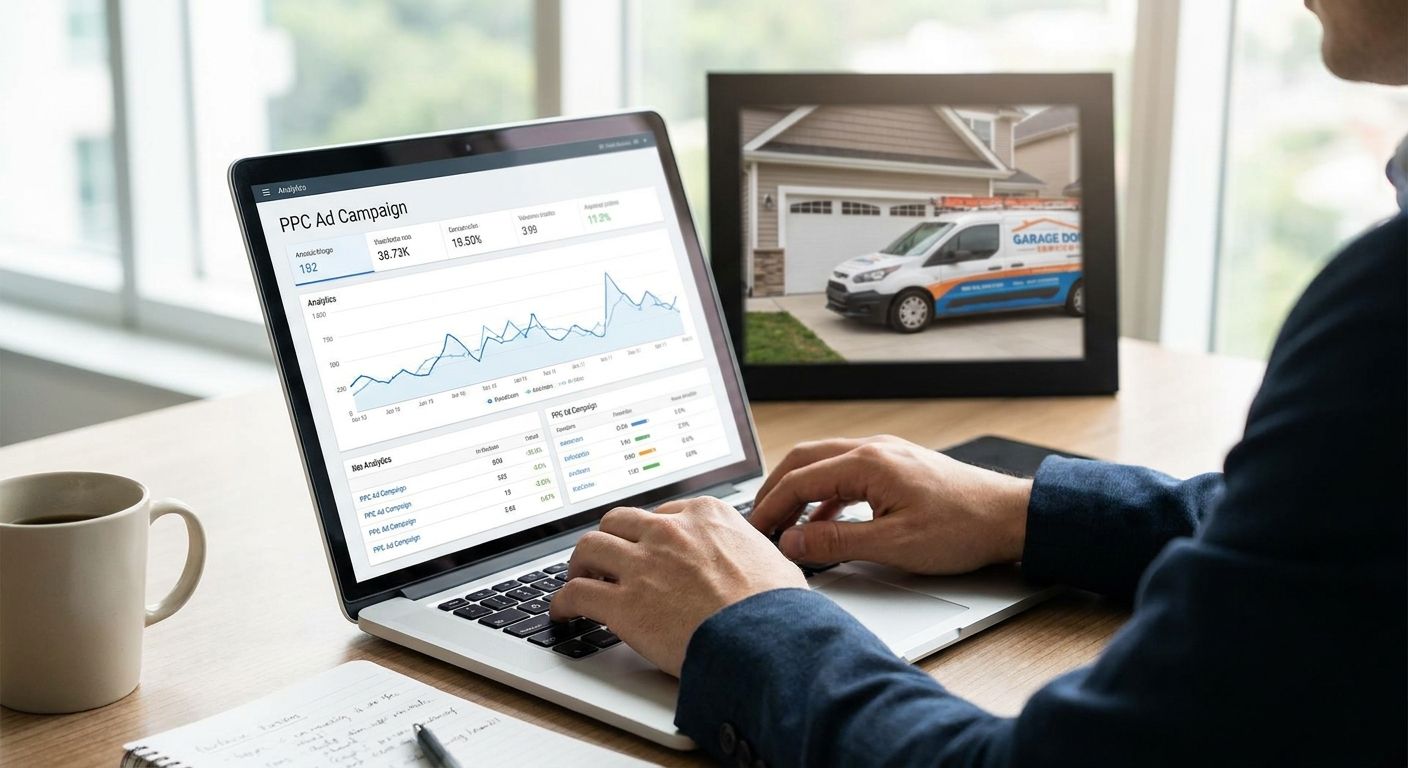
Garage door company PPC is a Google Ads and Local Services Ads program built to convert broken-spring and opener-repair searches into booked service calls, not just cheap clicks. The segment splits hard into two buyer types — same-day emergency repair and considered installation/replacement — and a campcampaign structure that treats them the same wastes budget on both sides.
Garage door searches skew local and urgent more than most trades: a homeowner with a door stuck halfway open searches, calls, and books within the hour. That behavior rewards Local Services Ads and tight call tracking over a generic search campaign copied from a plumbing or HVAC account. Roxfire manages PPC for home service businesses across South Florida and sees the repair-vs-installation split show up in every garage door account that comes through the door.
- Garage door PPC in 2026 splits into emergency repair and installation/replacement — one campaign structure can't serve both well.
- Local Services Ads wins for same-day repair searches; Google Ads Search wins for replacement and new-install keywords.
- Call tracking is not optional for this segment — missed emergency calls are lost jobs, not delayed ones.
- Performance Max belongs in the account only after Search campaigns produce stable cost-per-booked-job data.
Why PPC matters for garage door companies
A garage door company's phone rings for two very different reasons: a spring snapped and the car is trapped, or a homeowner is planning a full door replacement after a storm. The first buyer converts on the first call. The second buyer compares three quotes over a week.
Organic search and referrals rarely cover the emergency side — when a door won't open, nobody scrolls past the first page of results. That's the inventory PPC is built to capture in 2026: intent-heavy, time-sensitive searches where being the first ad clicked often means being the only company called.
The installation side behaves more like a considered purchase. Those searchers click multiple ads, read landing pages, and check reviews before dialing. Running both intents through one undifferentiated campaign blends the cost-per-lead data and makes it impossible to tell which spend is actually producing booked jobs.
Build the PPC program step by step
Separate repair campaigns from installation campaigns
The single biggest structural mistake in garage door PPC accounts is mixing "garage door repair" and "garage door installation" keywords in one campaign with shared budget and bidding.
- Split into at least two campaigns: Emergency Repair and Installation/Replacement
- Set separate daily budgets so a storm-driven repair spike doesn't starve installation spend
- Use different ad copy: urgency and same-day language for repair, pricing-transparency and financing language for installation
- Track cost-per-lead separately for each campaign — blending them hides which side is actually profitable
- Adjust bid strategy independently; repair often tolerates a higher CPL because close rate on emergency calls runs higher
Put emergency repair searches on Local Services Ads
Google's Local Services Ads sit above regular search ads and show a phone number, service area, and the Google Guarantee badge — exactly what a homeowner staring at a stuck door wants to see.
- Verify the business through Google's background check and licensing process before launch
- Set service radius to match actual drive-time coverage, not a flat mile radius
- Respond to every lead within minutes — LSA ranks partly on responsiveness
- Dispute any non-service leads (wrong category, spam calls) inside 30 days to protect the budget
- Run LSA alongside Search, not instead of it — LSA covers the branded and near-me queries, Search covers everything else
Layer in Search campaigns for installation and replacement keywords
Once the repair side is stable, installation keywords need their own Search campaign with landing pages built around price ranges, warranty options, and financing rather than urgency.
- Target keywords like "garage door replacement cost," "new garage door installation," and material-specific terms (steel, insulated, carriage-style)
- Bid on hurricane-rated and impact-resistant door terms in coastal markets where code requirements drive demand
- Use call extensions and lead-form extensions together — installation buyers convert on both channels
- Exclude repair-intent negative keywords ("stuck," "broken," "won't open") from this campaign entirely
Running this split correctly by hand takes weekly bid and budget review — most in-house teams manage one campaign and let the other drift. Roxfire's Google Ads management work with appliance repair accounts uses the same repair-vs-replacement split, and the same logic carries over directly to garage doors.
Write landing pages that match search intent
Sending a "stuck door" click to a homepage with six service categories kills conversion rate. Sending an "installation cost" click to a repair-only page does the same in reverse.
- Build a dedicated repair landing page with a click-to-call button above the fold
- Build a separate installation/replacement page with price ranges, material options, and a quote form
- Keep the form to 3-4 fields max — every extra field drops installation-intent form completions
- Add trust signals relevant to garage doors specifically: licensing, insurance, spring-replacement warranty terms
- Match the headline on the page to the ad headline that generated the click — message match still moves quality score in 2026
A useful reference point for landing page structure sits in Roxfire's guide on window replacement company SEO — a comparable high-ticket home-improvement purchase with the same replacement-vs-repair split.
Set up call tracking and speed-to-lead workflows
A missed emergency call in garage door PPC isn't a delayed lead — it's a lost job, because the homeowner is calling the next company on the search results page within minutes.
- Install call tracking numbers on every ad and landing page to attribute calls to campaign and keyword
- Route calls to a live person or answering service, never voicemail, during business hours
- Set up SMS or missed-call text-back so an unanswered call still gets a response inside 5 minutes
- Log every call outcome (booked, quoted, spam, no answer) into the CRM to calculate true cost-per-booked-job, not just cost-per-call
Add negative keywords and filter DIY traffic
Garage door search volume includes a large chunk of DIY and parts-shopping intent that will never convert into a service call.
- Add negatives for "how to fix," "DIY," "parts," "replacement spring kit," and "tutorial"
- Exclude "jobs," "careers," and "technician salary" — common noise on trade-service accounts
- Filter out manufacturer brand searches unless the company is an authorized dealer for that brand
- Review the search terms report weekly for the first 60 days of a new campaign; monthly after that
Test Performance Max only after Search is stable
Google pushes Performance Max hard in 2026, but it's a poor first campaign for garage door companies because it can't separate repair intent from installation intent the way manual Search campaigns can.
- Launch PMax only after Search and LSA have at least 60-90 days of stable cost-per-booked-job data
- Set a hard budget cap separate from Search — PMax will pull budget from better-performing campaigns if left uncapped
- Feed it with strong creative assets: photos of actual installed doors, not stock imagery
- Monitor placement reports for irrelevant display inventory and exclude poor performers
Get a garage door PPC plan built for 2026
Repair and installation campaigns structured separately, with call tracking built in.
Comparing PPC options for garage door companies
| Option | Best for | Key limitation |
|---|---|---|
| Google Ads Search | Installation/replacement keywords, price-conscious researchers | Requires ongoing negative-keyword and bid management to stay efficient |
| Local Services Ads | Same-day emergency repair calls | Limited to service categories Google approves; no control over ad copy |
| Performance Max | Scaling volume once cost-per-booked-job is proven | Can't isolate repair vs. installation intent on its own |
| Meta Ads | Brand awareness and financing-offer promotion for installation | Lower purchase intent than search; slower to produce booked jobs |
Verdict: Local Services Ads plus a split Search account wins for garage door companies in 2026 — Performance Max and Meta Ads are additive channels once the core structure is producing predictable cost-per-booked-job numbers.
Common mistakes garage door companies make
- Running one campaign for repair and installation — blends the data and makes both look worse than they are
- Skipping call tracking — without it, there's no way to tell which keywords produce booked jobs versus which just produce clicks
- Bidding only on "garage door repair" — ignoring long-tail terms like "garage door off track" or "garage door sensor not working" that convert at lower cost
- No review strategy tied to the PPC funnel — a thin review count undercuts Local Services Ads trust signals; see Roxfire's review management guide for home service businesses for how that connects to ad performance
- Ignoring seasonal storm demand — South Florida installation searches spike ahead of hurricane season, and flat year-round budgets miss that window
FAQ
How much does PPC cost for garage door companies in 2026?
Cost varies by market competitiveness and campaign mix, and actual budgets should be set against a target cost-per-booked-job rather than a flat number. Emergency repair keywords typically cost more per click than installation terms because purchase intent is higher.
Is Local Services Ads better than Google Ads Search for garage door repair?
Local Services Ads generally outperforms Search for same-day emergency repair calls because it ranks above search ads and shows the Google Guarantee badge. Search still matters for installation and replacement keywords where LSA coverage is thinner.
Should garage door companies run Meta Ads or Google Ads first?
Google Ads should come first because it captures active search intent from homeowners already looking for repair or installation. Meta Ads work better as a secondary channel for installation-offer awareness once Google campaigns are stable.
How long does it take to see results from garage door PPC?
Local Services Ads can generate calls within days of approval, while Search campaigns typically need 30-60 days of data before cost-per-lead stabilizes. Installation-focused Search campaigns take longer to optimize than repair campaigns because the sales cycle is longer.
What keywords convert best for garage door PPC in 2026?
Emergency terms like "garage door won't open" and "broken garage door spring" convert fastest for repair. "Garage door replacement cost" and material-specific terms like "insulated garage door installation" convert best for installation once buyers are comparing options.
Do garage door companies need separate landing pages for PPC?
Yes. A repair-intent click sent to a general homepage converts worse than one sent to a page with a click-to-call button and no other distractions. Installation clicks need a separate page with pricing context and a quote form.
Is Performance Max worth it for garage door companies?
Performance Max works best as a second-stage campaign after Search and Local Services Ads have produced 60-90 days of stable cost-per-booked-job data. Running it first often blends repair and installation intent that should stay separate.
One last thing
The garage door companies that get the most out of PPC in 2026 aren't the ones spending the most — they're the ones with a CRM tag for "emergency repair" versus "installation quote" on every lead, because that's the only way to see which campaign is actually paying for itself past the cost-per-click number.