
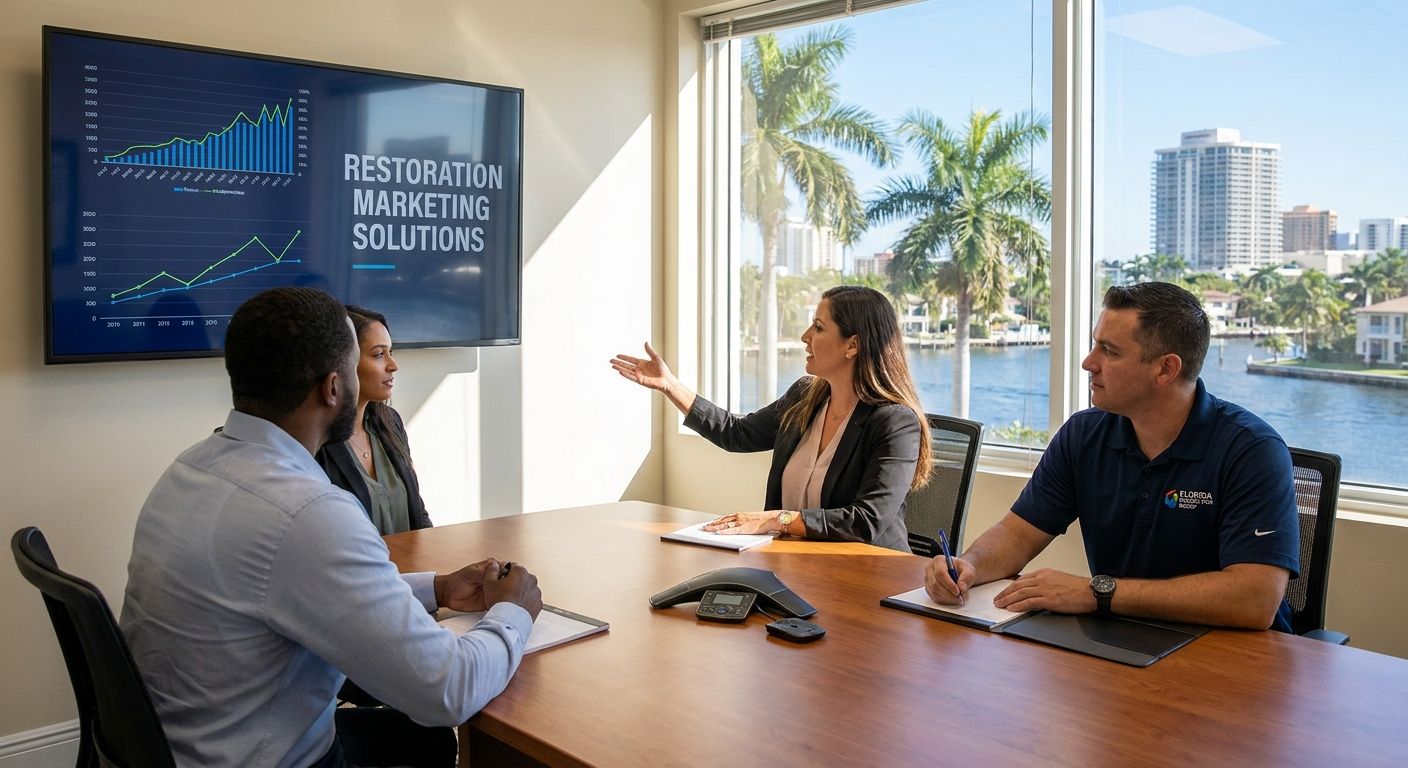
Fort Lauderdale restoration marketing puts water, fire, mold, and storm damage companies in front of homeowners and property managers the moment disaster hits, with the goal of turning a 2 a.m. emergency call into a signed work order before a competitor answers the phone first. Restoration leads don't behave like roofing or HVAC leads — they spike hard around named storms, they demand a callback inside minutes, and a large share get filtered through an insurance adjuster before a truck ever rolls. A campaign built for steady-state home service demand wastes budget the week a tropical system stalls off Broward County.
- Restoration marketing in Fort Lauderdale needs a budget structure that scales up fast around storms, not a flat monthly spend.
- Speed-to-lead matters more here than in almost any other trade — a five-minute callback wins jobs a same-day callback loses.
- Local SEO and Google Business Profile work should come before ad spend since organic emergency searches convert at close to zero marginal cost.
- Bilingual ad copy is not optional in Broward County's market and gets skipped by most restoration competitors.
- Roxfire builds storm-triggered Google Ads structures for restoration companies rather than running the same static campaign year-round.
Why restoration marketing matters for Fort Lauderdale companies
Atlantic hurricane season runs June 1 through November 30, and Fort Lauderdale sits directly in the path of tropical systems that push storm surge and flash flooding through Broward County almost every year. That six-month window is when search volume for water damage, mold remediation, and storm restoration terms concentrates, and it's also when every competitor in South Florida raises their bids at the same time.
Outside of storm windows, restoration demand comes from slower-burn sources: aging pipes, appliance failures, roof leaks, and mold from chronic humidity. Local SEO for restoration companies built around both demand patterns keeps the phone ringing in the quiet months, not just the loud ones. A restoration company that only shows up when Google Ads is switched on during hurricane season is invisible the other seven months of the year, and that's when property managers and insurance adjusters are choosing who's on their preferred vendor list for next season.
Build the marketing system, step by step
Step 1: Turn your Google Business Profile into a 24/7 storm dispatch line
Homeowners searching "water damage restoration near me" at midnight aren't reading your website copy — they're scanning the map pack for who's open and who has recent reviews. Get this right before anything else.
- Set hours to "Open 24 hours" if you run true emergency dispatch and say so directly in the business description
- Upload real photos from actual extraction, fire cleanup, and mold jobs — stock photography reads as inexperience to a panicked homeowner
- Add every city you actually service as a service area, not just Fort Lauderdale proper — Pompano Beach, Plantation, Hollywood, and Davie all carry their own search volume
- Post a Google Business Profile update within 24 hours of any named storm entering the five-day forecast
- Respond to every review within 48 hours, including the one-star ones from insurance disputes you didn't cause
Step 2: Run Google Ads that scale up the moment a storm enters the forecast
Manual bid adjustments during a live storm are too slow. Restoration companies that win the surge build the trigger before the storm exists.
- Set up a separate "storm surge" campaign at a low standing budget with a pre-approved one-click budget increase for named-storm weeks
- Bid on insurance-adjacent terms like "water damage insurance claim Fort Lauderdale" and "emergency water extraction," not just generic damage terms
- Use call-first ad extensions since restoration leads convert on the phone far more than through a form — a missed call during a storm is a lost job, not a delayed one
- Add negative keywords for DIY searches ("how to dry carpet myself," "remove mold with vinegar") to stop paying for clicks that were never going to hire anyone
- Google Ads for restoration companies after storm season covers the full campaign structure for scaling spend up and back down without wasting budget in the shoulder months
Step 3: Fix local SEO fundamentals before spending a dollar on ads
Organic map pack visibility for emergency searches converts at close to zero marginal cost once it's built, which makes it the highest-ROI layer of a restoration marketing plan even though it takes longer to show up.
- Keep name, address, and phone number identical across every directory listing — Yelp, Angi, BBB, and industry-specific sites
- Build a dedicated landing page per damage type (water, fire, mold, storm) instead of one generic "services" page
- Add city-specific pages for each service area rather than relying on one Fort Lauderdale page to rank for the whole county
- Install LocalBusiness schema markup so Google can confirm service area and hours directly from your site's code
- Get listed on insurance restoration network directories, which pull real referral traffic beyond organic search
Step 4: Put a review engine behind every closed job
A restoration company with 40 reviews at 4.8 stars beats one with 8 reviews at 5.0 stars on trust signal alone, and review count is a ranking factor in the local map pack.
- Text a review request within one hour of job completion while the relief of a dried-out house is still fresh
- Route negative feedback to a private form first so it gets resolved before it becomes a public one-star review
- Ask satisfied property managers for a review specifically, since B2B reviews carry weight with other commercial accounts
- Set a standing goal of net-new reviews per month rather than a one-time push after a slow quarter
- Review management for home service businesses breaks down the request cadence and response templates that keep review volume climbing without feeling automated
Step 5: Cut speed-to-lead to under five minutes
Restoration is the one home service category where being second to call back is functionally the same as not calling back at all — the homeowner already hired whoever answered first.
- Route every web form lead to a live call queue, not a shared inbox someone checks in the morning
- Staff a live answering service overnight during hurricane season, not just business hours
- Set up an automatic text reply the instant a lead comes in, even before a human calls
- Track first-response time as a KPI on every lead source, not just close rate
Step 6: Speak to Fort Lauderdale's bilingual market directly
Broward County has a large Spanish-speaking population, and most restoration competitors run English-only ad copy. Building Spanish-language ad variants and a bilingual intake line closes a gap most of the market leaves wide open, especially during peak storm demand when every available crew and every available lead matters.
Get a restoration marketing audit
See where your Fort Lauderdale campaigns are leaking budget before storm season peaks.
Comparison: marketing options for Fort Lauderdale restoration companies
| Option | Best for | Time to see results | Key limitation |
|---|---|---|---|
| DIY Google Business Profile + organic SEO | Companies with time but no ad budget | 3-6 months | Slow to build, does nothing for immediate storm surges |
| Google Ads / PPC only | Fast lead volume during active storm windows | Days | Expensive without local SEO and review foundations underneath it |
| Full-service marketing agency (Roxfire) | Companies that need year-round demand plus storm scaling | 1-3 months for ads, longer for organic | Requires ongoing spend and coordination across channels |
| Referral / insurance adjuster network only | Established companies with existing commercial relationships | Ongoing, relationship-dependent | No control over volume, no protection when a network relationship ends |
Verdict: Fort Lauderdale restoration companies that pair Google Ads storm scaling with local SEO built for the slow months outperform companies running either channel alone, because 2026 storm demand is unpredictable and organic visibility is the only channel that doesn't shut off when ad budget does.
Common mistakes Fort Lauderdale restoration companies make
- Flat budgets all year. Spending the same on Google Ads in December as during peak hurricane season either overpays for slow-season clicks or underfunds the surge that actually pays the bills.
- No live answer after hours. Routing 2 a.m. emergency calls to voicemail hands the job to whichever competitor picked up the phone.
- Ignoring the B2B side. Property managers and insurance adjusters generate repeat volume, but most restoration marketing targets homeowners exclusively.
- English-only ad copy. Skipping Spanish-language campaigns in a market with Broward County's demographics leaves real demand for a competitor to pick up.
- No tracking past the lead. Counting form fills instead of booked jobs hides which channel actually produces revenue, not just cheap cost-per-lead numbers.
FAQ
What does restoration marketing in Fort Lauderdale actually include?
It typically includes Google Ads built to scale with storm activity, local SEO across service-area pages, Google Business Profile optimization, and review generation systems. In 2026, speed-to-lead automation is treated as part of the marketing stack, not a separate operations task.
How fast should a restoration company call back a new lead?
Under five minutes. Restoration leads convert to whoever answers first far more than in other home service categories, since a flooded or fire-damaged home is an active emergency, not a quote to compare later.
Should a restoration company run Google Ads all year or only during storm season?
Both, at different budget levels. A standing low-budget campaign covers year-round leaks and mold calls, with a pre-built trigger to scale spend up fast when a named storm enters the forecast.
Is local SEO worth it for a restoration company that already runs paid ads?
Yes. Organic map pack visibility converts at close to zero marginal cost once built, and it keeps generating leads in months when ad budget is intentionally scaled down.
Do bilingual Google Ads make a real difference in South Florida?
Yes, in markets with large Spanish-speaking populations like Broward County. Most restoration competitors run English-only campaigns, which leaves that demand for whichever company builds Spanish-language ad copy first.
How many reviews does a restoration company need to compete in Fort Lauderdale?
There's no fixed number, but review count and review recency both factor into map pack ranking. A steady stream of new reviews after every closed job outperforms a large batch collected once and never repeated.
What's the biggest marketing mistake restoration companies make after a storm?
Waiting until the storm hits to raise ad budgets. By the time a hurricane makes landfall, competitors with pre-built storm campaigns are already capturing the search spike.
One last thing
Most Fort Lauderdale restoration companies build their entire marketing calendar around hurricane season and forget the slower months carry real, steady demand from pipe failures and appliance leaks — that's exactly when a competitor with strong local SEO and no ad spend quietly takes the market share a storm-only competitor gave up. Build for both windows in 2026, not just the loud one.


