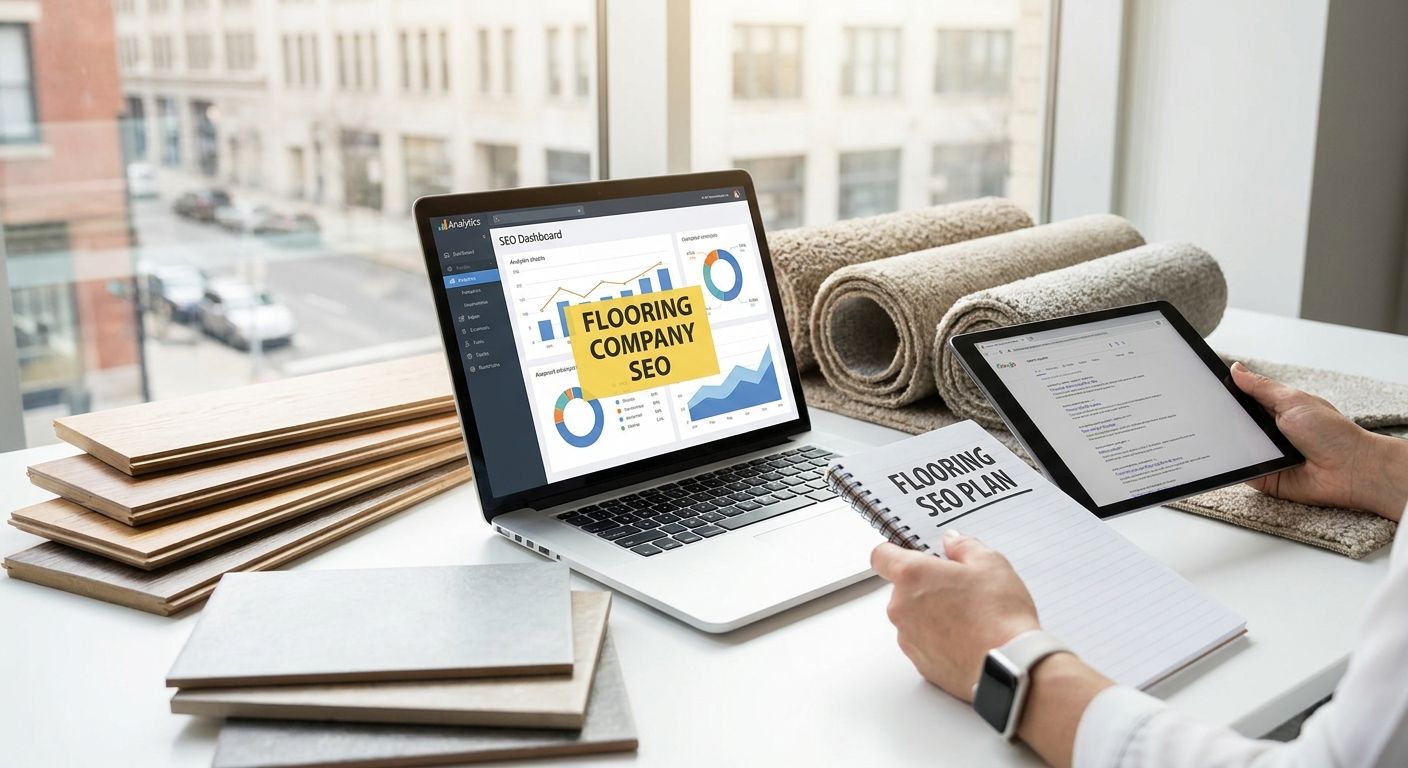
Flooring company SEO is the practice of ranking your website and Google Business Profile for the exact terms homeowners type when they're ready to install, refinish, or replace floors, with the aim of turning that visibility into estimate requests and booked jobs — not just visits. Flooring searches skew high-intent and project-specific: someone typing "hardwood floor refinishing near me" or "LVP flooring installer" in 2026 is usually comparing three or four contractors this week, which means ranking speed, review volume, and material-specific pages matter more here than in lower-ticket categories.
- Flooring company SEO wins on material-specific pages (hardwood, LVP, tile) and Google Business Profile strength, not generic homepage keywords.
- Split city and service pages by material type — one 'flooring installation' page loses to competitors who split hardwood, tile, and carpet separately.
- CRM-based attribution matters more than raw rankings — track which pages produce booked jobs, not just clicks.
- Roxfire handles local SEO plus paid ads for flooring and other home service businesses that need faster results than organic alone delivers.
Why flooring company SEO matters in 2026
Flooring is a considered purchase. Homeowners research materials, compare quotes, and read reviews before calling anyone — which means your Google Business Profile and your site's material-specific pages do the selling before the phone rings. A flooring company that only has one generic "services" page competes against installers who've built dedicated pages for hardwood, LVP, tile, and carpet, and those dedicated pages tend to out-rank generic ones because they match the exact query.
Local pack visibility carries even more weight for flooring than for many other trades, since most flooring jobs are sourced from a homeowner's immediate area rather than a regional search. A flooring contractor with 40 recent reviews and a category-matched Google Business Profile beats a contractor with a nicer website and no review activity, almost every time, in 2026's local search results.
Step 1: Claim and fully optimize your Google Business Profile
Most flooring companies claim their profile once and never touch it again. That's the single biggest gap between the businesses showing up in the map pack and the ones buried on page two.
- Set your primary category to "Flooring contractor" or "Flooring store" — not the generic "General contractor"
- Upload before/after photos from real jobs, not stock images
- Fill out the Products or Services section with each material you install
- Set an accurate service area radius instead of leaving it default
- Answer every Q&A entry yourself before a competitor does
- Post weekly updates showing recent completed jobs
Step 2: Build separate pages for each material and city, not one generic services page
A single "flooring services" page can't rank for "hardwood floor installation," "tile flooring contractor," and "LVP flooring near me" all at once. Google rewards specificity.
- Create one page per material: hardwood, LVP/vinyl plank, tile, carpet, laminate
- If you serve multiple cities, create a location page per city, not a duplicated template
- Include real project photos and a rough cost range for that material
- Add internal links between related material and location pages
- Write the title tag as "{Material} Flooring Installation in {City}" — match how people actually search
Step 3: Collect and respond to reviews on a schedule, not randomly
Review count and recency are ranking signals for the local pack, and they're also the first thing a homeowner checks before calling. Flooring companies that request reviews only when a customer volunteers one fall behind competitors who ask every time.
- Send a review request text within 24 hours of job completion
- Use a short, specific ask: "How does the new floor look?" performs better than generic asks
- Respond to every review, positive or negative, within a few days
- Never argue with a negative review publicly — address it, then move the resolution offline
- Track review velocity monthly, not just total count
Step 4: Fix the technical basics that quietly cap your rankings
A slow site or missing schema markup holds back every other SEO effort you make. This is unglamorous work, but it compounds.
- Add LocalBusiness and Service schema markup to every material and location page
- Compress images from job photos — flooring sites are often photo-heavy and slow
- Confirm mobile load time is fast, since most flooring searches happen on a phone
- Fix broken internal links between material pages
- Set canonical tags correctly if you have near-duplicate city pages
Step 5: Earn local backlinks that actually move rankings
Generic guest posts on unrelated blogs don't help flooring companies rank locally. Local relevance is what Google weighs.
- List your business with flooring manufacturers who publish dealer/installer directories
- Join your local chamber of commerce and home builders association
- Partner with real estate agents or home stagers for referral links
- Sponsor a local home show or trade event with a linked listing
- Get featured in local news or home improvement roundups covering renovation contractors
Step 6: Track speed-to-lead and attribute every job back to its source page
This is where most flooring companies stop measuring — and it's where the compounding value of SEO either proves out or gets ignored. Ranking is worthless if you don't know which page or keyword actually produced a booked job.
- Set up call tracking numbers per page so you know which material or city page converts
- Tag every lead in your CRM by source: organic, GBP, paid, referral
- Add missed-call text-back so a slow response doesn't lose a lead that took months to earn organically
- Review cost-per-booked-job by page monthly, not just cost-per-lead
Doing all six steps manually is possible for a flooring company with time and a marketing hire on staff. Most owner-operators don't have that time, which is why Roxfire runs local SEO, Google Business Profile management, and CRM-based attribution together for home service businesses that need the tracking layer built correctly from day one, not bolted on after the fact.
Get flooring company SEO built right
Local SEO, GBP management, and lead tracking for flooring and other home service businesses.
Comparison of SEO options for flooring companies
| Option | Best for | Cost driver | Key limitation |
|---|---|---|---|
| DIY GBP + review management | Owner-operators with time to spare weekly | Your own hours, no cash outlay | Slow to compound, easy to neglect after a few months |
| One-off website audit | Companies with an existing site that's underperforming | Varies by scope of the audit | Fixes issues once but doesn't maintain rankings ongoing |
| Google/Local Services Ads | Filling pipeline gaps while organic SEO builds | Ad spend you control directly | Stops producing leads the moment spend stops |
| Agency-led local SEO retainer (Roxfire) | Companies that want rankings, GBP, and lead tracking managed together | Request a quote based on service area and competition | Takes months to show full compounding results, same as any SEO |
Verdict: flooring companies chasing fast, trackable growth in 2026 pair an agency-led local SEO retainer with paid ads to cover the gap while organic rankings build — DIY alone is fine only if you have consistent weekly hours to give it.
Common mistakes flooring companies make
- Running one generic "flooring services" page instead of splitting by material — it competes against nobody and ranks for nothing specific
- Letting the Google Business Profile sit unclaimed or miscategorized under "General contractor"
- Copy-pasting the same city page template across five locations, which Google treats as thin duplicate content
- Ignoring negative reviews instead of responding, which costs both trust and local ranking signal
- Never tracking which page or keyword actually produced a booked job, so budget gets spent on what looks good instead of what works
FAQ
What's the best SEO strategy for a flooring company in 2026?
Building separate pages for each material (hardwood, LVP, tile, carpet) combined with an actively managed Google Business Profile is the highest-leverage flooring company SEO strategy in 2026. Generic single-page sites rarely rank against competitors who've split content by material and city.
How long does SEO take to work for a flooring company?
Most flooring companies see meaningful ranking movement in 3 to 6 months, with compounding gains after that as reviews and backlinks accumulate. Paid ads fill the gap in the meantime since they produce leads immediately.
Is Google Business Profile optimization more important than website SEO for flooring contractors?
Google Business Profile carries more weight for local pack visibility, which is where most flooring searches surface first. Website SEO still matters for capturing organic clicks and converting them once a homeowner lands on your site.
Do flooring companies need separate pages for each material they install?
Yes — a hardwood-specific page out-ranks a generic services page for hardwood-related searches, and the same holds for tile, LVP, and carpet. Splitting by material matches how homeowners actually search.
How many Google reviews does a flooring company need to rank well?
There's no fixed threshold, but review count and recency both function as local ranking signals. Competitors with 40+ recent reviews consistently outperform those with a handful of stale ones.
Should a flooring company run paid ads while working on SEO?
Yes — paid ads produce leads immediately while organic SEO rankings build over months. Running both together avoids a lead gap during the SEO ramp-up period.
What's the difference between local SEO and a website audit for flooring companies?
A website audit is a one-time fix for existing technical or content issues, while local SEO is ongoing management of rankings, GBP, and reviews. Flooring companies chasing sustained growth in 2026 need the ongoing version, not just a one-time fix.
Can a flooring company do SEO without hiring an agency?
Yes, if the owner or a staff member can dedicate consistent weekly hours to GBP updates, review requests, and content. Most owner-operators don't have that time, which is why many hand the ongoing work to an agency.
One last thing
The highest-leverage flooring company SEO move in 2026 isn't another blog post — it's tagging every lead in your CRM by source page, so you know whether the hardwood page or the tile page actually produces booked jobs instead of just clicks. Rankings without that tracking layer are a vanity metric; rankings with it turn into a repeatable growth channel.