SMS marketing for home service businesses is direct text messaging — instant lead responses, appointment reminders, review requests, maintenance renewals — sent straight to a homeowner's phone with the goal of turning inbound calls and form fills into booked jobs before a competitor gets there first. HVAC, roofing, plumbing, and restoration companies live on a shorter clock than most industries: a homeowner with a leaking water heater or a dead AC unit in July isn't waiting for a callback, they're calling the next name on Google.
- SMS marketing for home services works because texts get answered in minutes, not hours — the exact window where HVAC, roofing, and plumbing leads go cold.
- Roxfire builds SMS into CRM automation for South Florida service companies so a missed call still gets a reply within minutes, not a voicemail.
- Manual texting from an office phone works at low volume; once lead volume climbs past a handful a day, automated sequences are the only way to keep response times consistent.
- Segmented, service-specific texts outperform blanket blasts for review requests, maintenance renewals, and seasonal promotions in 2026.
Why SMS marketing matters for home service businesses
Most home service leads come from Google Ads, Local Service Ads, or a Google Business Profile call — channels where the homeowner is already comparing three or four contractors at once. A phone call that goes to voicemail is a lost job. A text, on the other hand, gets seen almost immediately and doesn't require the homeowner to stop what they're doing to answer.
That's the entire case for exclusive HVAC leads paired with fast SMS follow-up instead of shared leads that a homeowner is also getting from four other companies. The contractor who texts back first usually books the job, not the one who calls back an hour later. Restoration and HVAC companies see this most acutely because their leads are often emergencies — a burst pipe or a failed AC in August doesn't wait for business hours.
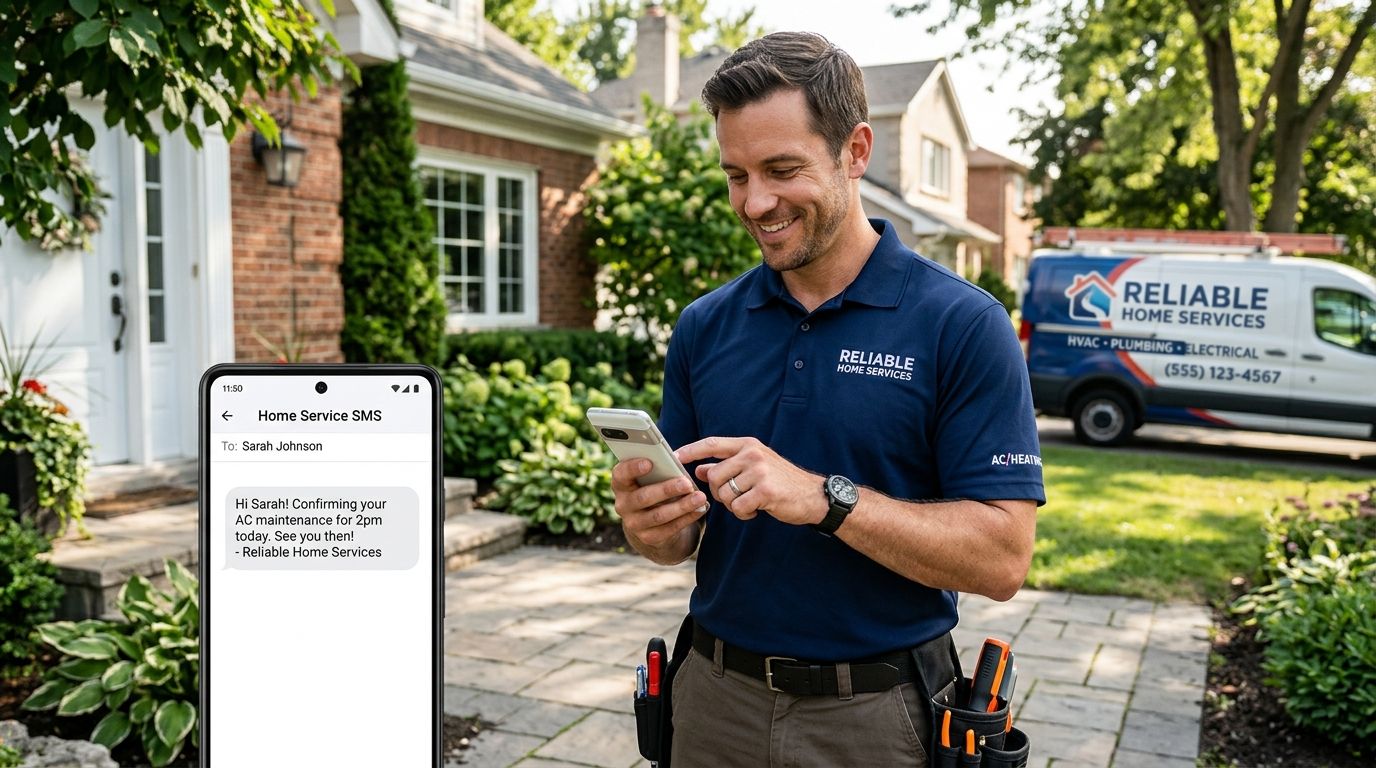
SMS also solves a problem email can't: most home service customers don't check a personal inbox during the day, but they will glance at a text notification within a minute or two. That's why texting has become the default channel for appointment confirmations, technician "on my way" alerts, and post-job review requests across HVAC, roofing, and restoration companies in 2026.
The step-by-step build
Text back before the caller hangs up
Start with the free version: a saved text template on the office phone that goes out the second a call is missed. This alone recovers jobs that would otherwise go cold.
- Draft 3-4 templates for common scenarios: missed call, after-hours inquiry, quote follow-up, and no-show reschedule
- Assign one person to monitor and respond to texts during business hours
- Set an internal rule: no lead sits untouched for more than 15 minutes
- Test templates for tone — short and direct converts better than a scripted paragraph
Automate the response once volume climbs
Manual texting breaks down past a handful of leads a day. This is where CRM-based automation takes over — a missed call or form fill triggers a text instantly, without a human in the loop.
- Connect call tracking and web forms to an automated text trigger
- Route the reply into the same CRM thread the sales team is watching
- Build in a second-touch text 24 hours later if the lead hasn't responded
- Roxfire builds this exact automation into CRM setups for HVAC, roofing, and restoration clients so a missed call at 9pm still gets a reply before the homeowner calls a competitor
Automate review requests after every job
A text sent within an hour of job completion, while the technician is still fresh in the homeowner's mind, converts to a review far more often than an email sent the next day.
- Trigger the review request text automatically when a job is marked complete in the CRM
- Link directly to the Google review page, not a generic contact form
- Follow up once, 48 hours later, if no review has posted
- Segment requests by service type so roofing reviews mention roofing, not "great service" generically
The mechanics of turning a completed job into a 5-star review request matter more than the wording — timing beats copywriting here.
Renew maintenance plans before the season starts
HVAC and pool companies with recurring maintenance plans lose renewals simply because nobody reminded the customer before the plan lapsed. A text sequence timed to the season closes this gap without adding staff hours.
- Send a renewal text 30 days before the plan expires
- Pair the text with a seasonal reminder (pre-summer AC tune-up, pre-hurricane generator check)
- Use a second text with a shorter, more direct message if the first goes unanswered
- Coordinate the texting cadence with HVAC maintenance plan email campaigns so the two channels reinforce each other instead of overlapping
Segment your list by service and urgency
A roofing company blasting the same text to a homeowner who wants a free inspection and one who just had storm damage is wasting both messages. Segmentation is what separates a 2% response rate from a 15% one.
- Tag contacts by service type at the point of lead capture
- Separate emergency/urgent leads from routine quote requests
- Build different templates for each segment — urgency copy for storm damage, informational copy for routine maintenance
- Exclude closed jobs from active-lead sequences to avoid sending a quote-follow-up text to someone who already signed
Track response rate against booked jobs, not replies
A high reply rate means nothing if none of those replies turn into a scheduled job. The metric that matters is booked jobs per text sent, not opens or clicks.
- Tag every text-driven conversation in the CRM with an outcome: booked, no answer, not interested
- Compare booked-job rate by segment (emergency vs. routine, HVAC vs. roofing)
- Review cost-per-booked-job monthly, the same way you'd review cost-per-lead
- Cross-reference text performance with paid channel data the same way you'd track ROI from Google Ads
“If a text isn't answered inside five minutes, the lead is already calling the next contractor on Google.”
Comparison: ways to run SMS for a home service business
| Option | Best for | Key limitation | Verdict |
|---|---|---|---|
| Manual texting from an office phone | Companies under 10 leads a day | Doesn't scale, response times slip once volume climbs | Hold |
| Standalone SMS platform (no CRM link) | Companies wanting quick review-request blasts | No connection to lead source or job status, hard to segment | Wait |
| CRM-integrated SMS automation | HVAC, roofing, restoration companies with steady lead flow | Requires CRM setup and ongoing template management | Buy |
| No text follow-up, phone only | Nobody in a competitive market | Loses jobs to any competitor who texts back faster | Skip |
Get SMS built into your lead flow
CRM-connected texting for missed calls, reviews, and renewals.
Common mistakes home service companies make
- Texting without opt-in consent. TCPA rules apply to service texts the same way they apply to marketing blasts — get consent at the point of lead capture, not after the fact.
- Sending one generic blast to the entire list. A homeowner with a burst pipe and a homeowner asking about a spring tune-up need two different messages, not one.
- Ignoring quiet hours. A 6am text about a maintenance renewal reads as spam regardless of how relevant the offer is.
- Measuring reply rate instead of booked jobs. A text sequence that gets replies but no bookings is a vanity metric, not a result.
- Letting the review-request text go out days after the job. Timing matters more than wording — a text sent an hour after job completion outperforms one sent the next morning.
FAQ
Is SMS marketing legal for home service businesses in 2026?
Yes, as long as the homeowner opted in to receive texts, typically through a form checkbox or verbal confirmation logged in the CRM. TCPA rules require consent and an easy opt-out on every message.
What's the best SMS platform for HVAC and roofing companies?
The best option connects directly to your CRM and call-tracking system so texts trigger automatically off missed calls and form fills, rather than a standalone app that requires manual sends.
How fast should a home service business text back a lead?
Within 5 minutes whenever possible. Home service leads are usually comparing multiple contractors at once, and the fastest response typically books the job.
Does SMS work better than email for home service companies?
SMS gets seen faster — most texts are read within minutes versus hours or days for email. Email still works well for maintenance plan nurture sequences that don't require an immediate reply.
Can SMS marketing help get more Google reviews?
Yes. Sending a review-request text within an hour of job completion converts at a noticeably higher rate than waiting a day or sending an email instead.
Should HVAC companies text about maintenance plan renewals?
Yes, a renewal text sent 30 days before expiration recovers customers who would otherwise let the plan lapse without noticing.
What's a bad SMS marketing mistake for restoration companies?
Sending the same text to every lead regardless of urgency. Storm-damage leads need direct, immediate-response copy, not a generic quote-request template.
How do I measure if SMS marketing is working?
Track booked jobs per text sent, not just reply rate or open rate. A high reply rate with no bookings means the sequence isn't converting.
One last thing
The biggest lift in SMS marketing for home service businesses doesn't come from clever copy — it comes from shaving minutes off the first response. A company that texts back in under 5 minutes will out-book a competitor with a better ad budget but a 2-hour callback lag, every time in 2026.