

Roof replacement financing marketing means putting monthly-payment numbers, lender terms, and promotional financing periods into your ads, landing pages, and in-home sales pitch so a homeowner facing a five-figure roof quote can say yes without writing a check. Roof replacement isn't a repair decision — it's a financing decision, and the marketing has to answer "what's my payment" before it answers "who do I call."
- Roof replacement financing marketing works when the payment number appears in the ad, the landing page, and the estimator's script — not just one of the three.
- Third-party lenders like Wisetack, GreenSky, and Service Finance Company remove the paper-holding risk but cap approval rates outside your control.
- Financing-tagged leads need separate CPL and close-rate tracking in 2026 — blending them with cash leads hides which offer actually books jobs.
- The most common failure is an ad that promises 0% financing while the estimator never brings it up in the home.
Why financing marketing matters for roof replacement companies
A roof replacement quote runs high enough that most homeowners can't pay cash without planning for it, which is different from a $400 repair call. That gap is where financing marketing either closes the deal or loses it to a competitor who mentioned the payment first.
Homeowners comparing three roofing quotes in 2026 aren't just comparing material and warranty — they're comparing who made the payment easiest to understand. A roofing company that runs Roxfire style paid search alongside a clear financing message is competing on more than price per square.
Insurance-assisted jobs complicate this further. A storm-damage replacement tied to a covered claim doesn't need financing marketing the same way a discretionary reroof does — the messaging has to split by job type, not run as one blanket offer.
Audit what you can legally advertise before you write a single ad
Start here, not with creative. Financing claims are regulated, and a sloppy "0% APR" headline can get pulled by the ad platform or draw a compliance complaint from the lender you're partnered with.
- Confirm your lender partnership agreement's exact approved ad language
- Check your state's disclosure rules for promotional APR and deferred-interest offers
- Review your Google Business Profile and website for financing language that's out of date
- Confirm your sales reps know the real approval turnaround time, not the marketing version
- Document which financing terms apply to which job types (reroof vs storm claim vs repair)
Put the payment number in the ad, not the project price
Most roofing ads still lead with the company name and a phone number. In 2026, the ads that outperform lead with the number a homeowner actually cares about: the monthly payment.
- Lead the headline with "as low as $X/mo," not the total project cost
- Test monthly-payment framing against total-cost framing inside the same campaign, same budget
- Add a financing-specific sitelink extension on Google Ads instead of burying it on a service page
- Mirror the payment framing in Meta ad creative — same number, same phrasing, across channels
- Build the ad group around "financing" and "payment plan" search terms separately from generic "roof replacement" terms
Running that test properly takes an account that's already tracking cost per booked estimate, not just cost per click. A Google Ads copy that converts for roofing approach treats the payment-first headline as one variable in a live test, not a permanent rewrite — you keep whichever version wins on booked jobs, not on click-through rate.
Build a dedicated financing landing page
A financing offer that lands on your general "get a quote" page loses most of its value. The page needs to do the selling the ad started.
- Above-the-fold payment range or estimate calculator, not a generic contact form
- Lender name and financing disclosure visible, not buried in footer text
- A short financing FAQ block answering credit and approval-time questions
- A CTA button labeled for financing specifically, separate from the standard quote button
- Mobile-first layout — most roof replacement research happens on a phone in the driveway after a storm
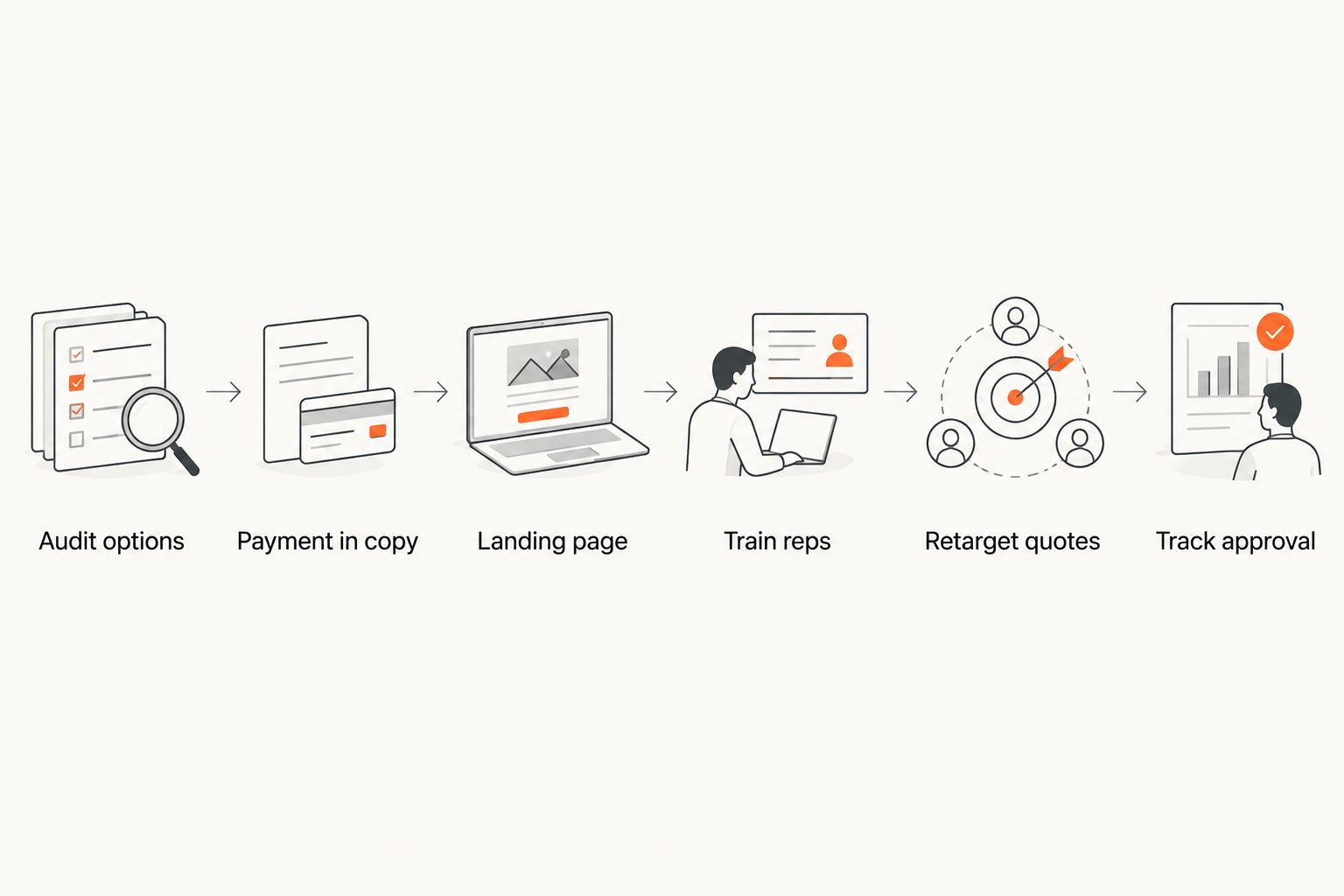
Train the estimator to sell the payment, not just the roof
The ad and the landing page only get the lead in the door. The in-home estimate is where financing marketing either converts or gets ignored.
- Script exactly when the estimator mentions financing — before or after the total price reveal
- Track which reps bring up financing consistently versus which ones skip it
- Role-play the "I'll just pay cash" objection so reps don't drop the financing pitch too fast
- Give the estimator a one-page reference on approval timelines and lender terms
Retarget stalled quotes with financing-specific messaging
A homeowner who got a quote and didn't sign isn't a dead lead — they're often a price-shocked lead who never heard the payment option clearly.
- Segment your CRM by "quoted, no close" status and tag for financing interest
- Send a financing-focused follow-up sequence within 48 hours of the stalled quote
- Run Meta retargeting creative built around payment terms, not roof photography
- Time follow-up cadence to lender pre-approval expiration windows so the offer doesn't quietly lapse
Track approval-to-close, not just cost per lead
A cheap financing lead that never gets approved is worse than an expensive cash lead that closes. Blended CPL hides this.
- Tag every lead by financing interest at intake, not after the estimate
- Measure close rate for financing-tagged leads separately from cash leads
- Watch lender decline rates — a rising decline rate signals the wrong audience is clicking the ad
- Report cost per approved-and-booked job, not cost per lead, to whoever owns the ad budget
“If the estimator doesn't say the payment number out loud in the first five minutes, the financing ad didn't do its job.”
Financing options compared for roof replacement companies
| Option | Best for | Key limitation |
|---|---|---|
| Third-party lender (Wisetack, GreenSky, Service Finance Co.) | Contractors who don't want to hold paper | Approval decision sits with the lender, not the contractor |
| In-house payment plans | Contractors with strong cash flow who want to skip lender fees | Ties up working capital, adds collections risk |
| Manufacturer-backed financing | Contractors selling one specific shingle or metal brand | Locks the sales pitch to that material line |
| Insurance-assisted path | Storm or wind-damage jobs tied to a covered claim | Doesn't apply to discretionary reroofs, timeline depends on the adjuster |
Verdict: most roof replacement companies run a third-party lender as the default offer and reserve the insurance-assisted path for storm-season claim work — running both at once, tagged separately, is what keeps 2026 CPL reporting honest.
Get your financing offer marketing audited
See where your roofing ads, landing page, and sales script lose financing leads.
Common mistakes roof replacement companies make
- Advertising financing the estimator never mentions. The ad promises a payment; the rep in the home talks price only. The lead assumes the offer wasn't real.
- Running 0% branding without checking disclosure rules. A pulled ad or lender complaint costs more time than the workaround would have.
- Treating a declined-financing lead like a generic follow-up. That homeowner needs a different next call — a repayment alternative, not a "just checking in" text.
- Using one lender's qualification form for every job size. A program built for five-figure reroofs mismatches small repair leads and drags down approval rates.
- No separate reporting line for financing leads. Blended CPL between cash-ready homeowners and payment-plan shoppers makes the whole budget look worse or better than it is.
FAQ
What's the best way to advertise roof replacement financing in 2026?
Lead with the monthly payment in the ad headline, carry that same number to a dedicated financing landing page, and have the estimator repeat it in the home visit. Roof replacement financing marketing fails most often when only one of those three touchpoints mentions the payment.
Does mentioning financing in Google Ads help or hurt roofing lead quality?
It generally improves lead quality for five-figure jobs because it filters in homeowners who are ready to move on payment terms rather than just window-shopping a price. It can lower lead quality if the financing terms in the ad don't match what the sales rep actually offers.
Is 0% financing legal to advertise for roofing companies?
It depends on your state's disclosure rules and the exact terms of your lender partnership agreement. Check the approved ad language your lender provides before running any 0% or deferred-interest claim.
How much does roof replacement financing marketing cost to run?
There's no separate media budget for it — financing messaging runs inside the paid search and social spend a roofing company already has. The added cost is ad copy and landing page work, not new ad spend.
Should roofers use in-house financing or a third-party lender?
Third-party lenders like Wisetack or GreenSky remove the collections risk and paperwork but hand the approval decision to the lender. In-house plans keep control with the contractor but tie up working capital.
How do you track ROI on financing offers separately from regular leads?
Tag every lead by financing interest at intake in the CRM, then report cost per approved-and-booked job for that segment separately from cash leads. Blended cost-per-lead numbers hide whether the financing offer is actually working.
Does financing messaging work better on Google Ads or Meta for roofing companies?
Google Ads tends to catch homeowners already searching for a roof replacement, so payment-first headlines convert intent that's already there. Meta works better for retargeting stalled quotes with financing-specific creative since the homeowner already has context on the job.
What's the difference between financing marketing for a roof and for HVAC?
The mechanics are the same — payment-first ads, a dedicated landing page, a trained sales script — but roof replacement ticket sizes and sales cycles run longer, and storm-related insurance claims add a path HVAC replacement doesn't have.
One last thing
The roofing companies getting the most out of financing marketing in 2026 aren't the ones with the lowest advertised rate — they're the ones who tag every lead by financing interest at intake and report approval-to-close as its own number. Skip that tagging step and the financing offer looks like it's working or failing when the real story is buried in a blended CPL.