
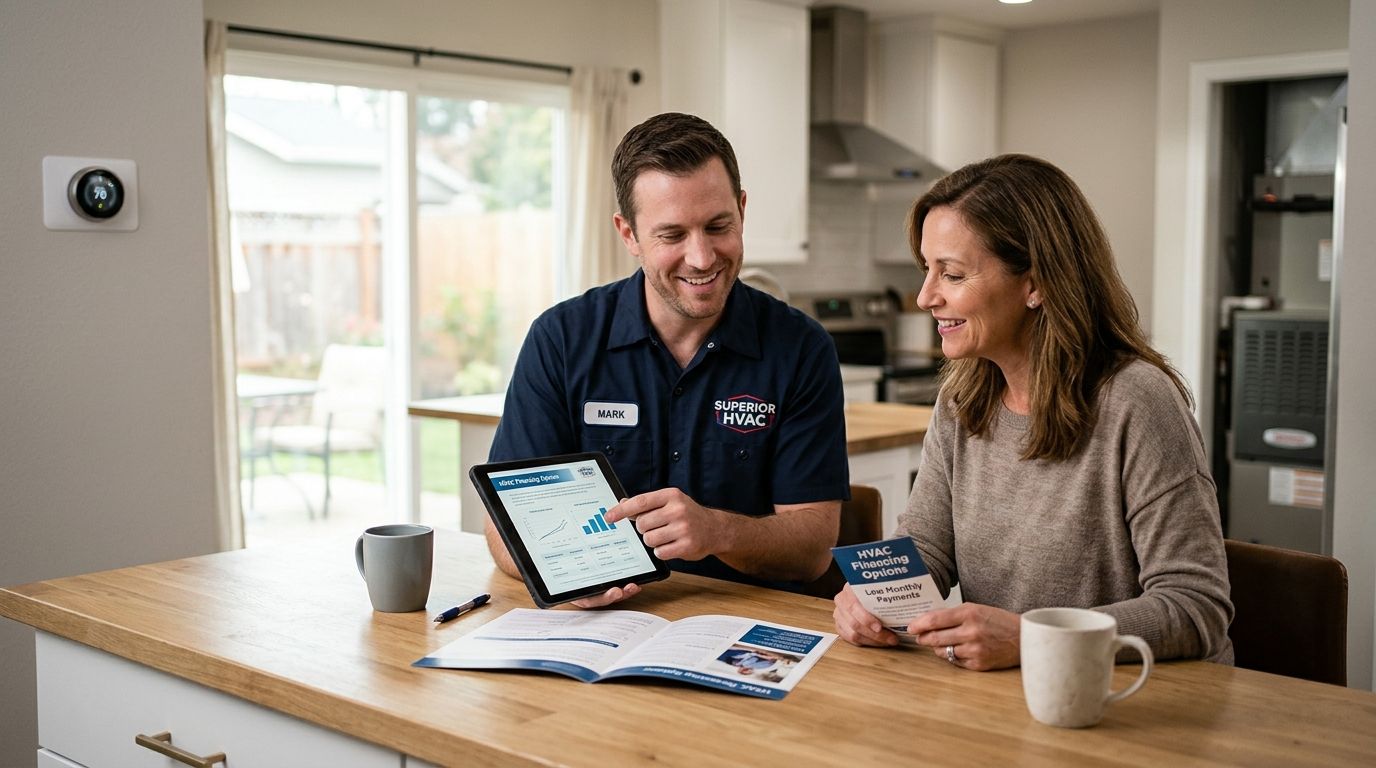
HVAC replacement companies that market financing offers close bigger tickets faster, because a $9,000 system replacement stops being a bank-account decision and becomes a monthly-payment decision. This segment's needs differ from HVAC repair or maintenance marketing: the buyer is comparing three quotes, staring at a five-figure invoice, and searching for "0% financing HVAC" or "HVAC payment plans near me" before they ever call a contractor.
- HVAC financing marketing works best when the offer appears before the quote, not buried in a follow-up email.
- Lead with the monthly payment in headline one of your search ads, not the SEER rating or brand name.
- Manual financing promotion (website banners, GBP posts, sales scripts) costs nothing and should launch before any paid campaign.
- Roxfire builds hvac financing marketing campaigns around speed-to-lead and CRM-tracked close rates, not raw lead volume.
Why HVAC financing marketing matters for replacement companies
A repair call averages a few hundred dollars. A full system replacement runs into the thousands, and most homeowners have not budgeted for it. That gap is why exclusive HVAC leads generated through financing-forward campaigns behave differently than generic "HVAC repair near me" traffic — the person clicking already knows they need a new unit and is shopping payment terms, not just price.
Homeowners comparing three HVAC quotes in 2026 pick the contractor that answers the financing question first. If your Google Ads copy, landing page, and phone script don't mention financing until the estimate visit, you have already lost part of that traffic to a competitor who put it in the headline. This is a positioning problem before it is a budget problem.
The second reason this segment needs its own playbook: replacement decisions take days, not minutes. Emergency repair marketing optimizes for speed-to-answer. Replacement financing marketing optimizes for staying in front of a homeowner across a 3 to 14 day comparison window.
Build the financing offer marketing plan for HVAC replacement
Put financing terms on the page before the price
Most HVAC websites bury financing on a separate tab. Replacement-focused pages should surface it in the first screen a visitor sees in 2026.
- State the financing option in the H1 or subhead of the replacement service page, not just the footer
- Add a monthly-payment calculator or simple payment table next to the system tiers
- Mention approval speed only if your lender partner actually offers it — never invent a timeline
- Include financing language in the meta title and description so it shows in the Google snippet
- Test a dedicated financing landing page against a blended replacement page with financing as one section
Write ad copy that leads with the payment, not the unit
Search ads for replacement keywords convert better when the financing hook sits in headline one.
- Lead with the monthly payment range instead of the system brand or SEER rating
- Use callout extensions to list financing alongside licensing and review count
- Split test financing-led headlines against energy-savings headlines on the same keyword set
- Route financing-intent keywords like "AC replacement payment plan" to a dedicated landing page, never the homepage
- Apply the ad structure in Google Ads for HVAC contractors, then layer financing messaging on top of it
Train the phone and field team on the financing script
The offer means nothing if the person answering the phone doesn't mention it until minute eight of the call.
- Script financing as the second sentence after the greeting, not an afterthought at the end
- Give estimators a one-page payment sheet for common system sizes to hand homeowners on-site
- Score recorded calls for financing mentions and compare close rates rep by rep
- Add a financing FAQ card to the CRM contact record so any team member can answer mid-call
Run seasonal financing pushes around peak failure windows
HVAC replacement demand spikes when units fail in extreme heat, and financing offers convert best when timed to that spike.
- Launch the financing campaign 2 to 3 weeks before your region's historical peak temperature month
- Pair financing offers with emergency-replacement keywords during heat waves, when buyers have no time to save cash
- Pull financing budget back in shoulder-season months and shift it to maintenance-plan promotion
- Borrow the timing logic from seasonal HVAC ads during hurricane season, since Florida storm season overlaps peak AC failure months
Track financing-specific leads separately in your CRM
Lumping financing-intent leads in with general replacement leads hides which offer actually drives bookings.
- Tag every lead that clicks a financing CTA or mentions financing on the call
- Compare close rate and average ticket for financing-tagged leads against untagged replacement leads
- Attribute financing-page traffic correctly using the setup in call tracking for home service campaigns
- Decide which financing terms to keep advertising from the CRM data, not gut feel
Retarget the homeowners who got a quote and went quiet
Replacement decisions stretch across days. Retargeting with a financing-specific message closes part of that gap.
- Build an audience of visitors who hit the financing or replacement page without submitting a form
- Repeat the monthly payment figure in the creative instead of a generic "contact us"
- Cap frequency so the same homeowner sees the ad no more than 3 times a day
- Pair the payment figure with a review snippet for social proof
Once the manual playbook runs, an agency-managed hvac financing marketing program layers in bid management, landing page testing, and CRM-based attribution. That is where tracking ROI from Google Ads pays off: you see cost-per-booked-job by financing offer, not just cost-per-lead.
Get your financing campaign audited
See where your HVAC replacement ads and landing pages lose financing-intent traffic.
Comparison: financing marketing channels for HVAC replacement
| Channel | Best for | Key limitation |
|---|---|---|
| Google Search Ads, financing-led copy | High-intent replacement searches and same-day quote requests | Needs disciplined copy testing or you pay for repair-intent clicks |
| Landing page with payment calculator | Converting quote-comparison shoppers already on your site | Goes stale fast when lender terms change |
| Retargeting on Meta or display | Re-engaging homeowners who got a quote but didn't book | Weak alone without a strong first-touch lead source |
| In-person estimator scripting | Closing at the kitchen table, the point of highest intent | Depends entirely on rep consistency and training |
| Email and SMS follow-up | Nurturing leads across a 3 to 14 day decision window | Low response if the first contact never built trust |
The setup that wins for most replacement companies in 2026 pairs financing-led search ads with a payment-calculator landing page and a scripted follow-up sequence. Skip any one of the three and the other two underperform.
“Homeowners comparing three HVAC quotes pick the contractor who answers the financing question first.”
Common mistakes HVAC replacement companies make with financing
- Hiding financing behind a "contact us for details" wall. Homeowners bounce before calling when terms aren't visible on the page.
- Advertising financing without training dispatch and sales to lead with it. The offer dies on the phone call.
- Running identical financing copy year-round. Ignoring the seasonal replacement spike burns budget in slow months.
- Not tagging financing leads separately. You can't prove the offer drove bookings versus general summer demand.
- Publishing a rate or term the lender partner already changed. A stale number on the landing page destroys trust the moment the estimator quotes something different.
FAQ
What is HVAC financing marketing?
HVAC financing marketing promotes payment plan options across ads, landing pages, and sales scripts so replacement shoppers decide on a monthly figure instead of a five-figure invoice. It works best when the offer appears before the price, not after.
Does financing marketing beat price-focused HVAC ads?
For replacement jobs, yes, because most homeowners shop monthly payment amounts rather than unit price. Repair campaigns still perform better with speed and availability messaging.
How much does HVAC financing marketing cost to run?
Cost depends on channel mix and how competitive your metro is. Ask an agency running campaigns in your service area for current cost-per-lead benchmarks rather than trusting a national average.
Should financing sit on the homepage or a separate landing page?
A dedicated financing landing page converts better for paid search because it matches the ad promise word for word. Keep a homepage reference so organic and referral visitors still see it.
When is the best time to run HVAC financing ads?
Launch 2 to 3 weeks before your region's peak cooling month, when system failures spike and homeowners need a fast decision path. Pull spend back during shoulder season.
How do I know the financing offer is driving bookings?
Tag financing leads separately in the CRM and compare close rate and average ticket against untagged replacement leads. Without that tagging you are guessing.
Is retargeting worth it for HVAC financing offers?
Yes for homeowners who received a quote and didn't book, since replacement decisions often take a week or more. Retargeting without a strong first-touch source performs poorly.
Does financing messaging work for commercial HVAC replacement?
Commercial buyers respond less to consumer monthly-payment framing and more to total cost of ownership and downtime risk. The messaging has to shift for B2B accounts.
One last thing
The biggest lift in hvac financing marketing usually isn't ad spend. It is getting the estimator to say the payment number out loud in the first 2 minutes of the in-home visit. Homeowners who hear the monthly figure before they see the total anchor on the smaller number, and that anchor holds through the rest of the pitch. Roxfire builds campaigns for HVAC replacement companies around that sequence: financing in the ad, financing on the page, financing in the first two minutes of the call.