

A content marketing strategy for a home service website works when every page maps to one thing: a service, a city, and a stage of the buying decision. Skip the general "HVAC blog" approach and instead build pillar pages for each core service, supporting pages for each service area, and a review/proof layer that turns organic traffic into booked jobs, not just pageviews.
- A content marketing strategy home services companies can actually use starts with service + city page pairs, not a generic blog.
- Roofing, HVAC, and restoration sites win with pillar pages, local proof pages, and a 90-day publishing cadence in 2026.
- Content without call tracking and close-rate data is a guess dressed up as a strategy.
- Roxfire builds content plans tied to CPL and booked-job data, not vanity traffic metrics.
Why this matters
Most home service sites publish blog posts because a checklist told them to, then wonder why rankings stall at page two. Local SEO tactics built for HVAC companies show the pattern clearly: pages built around a specific service and a specific city outrank generic "why AC maintenance matters" posts almost every time in 2026.
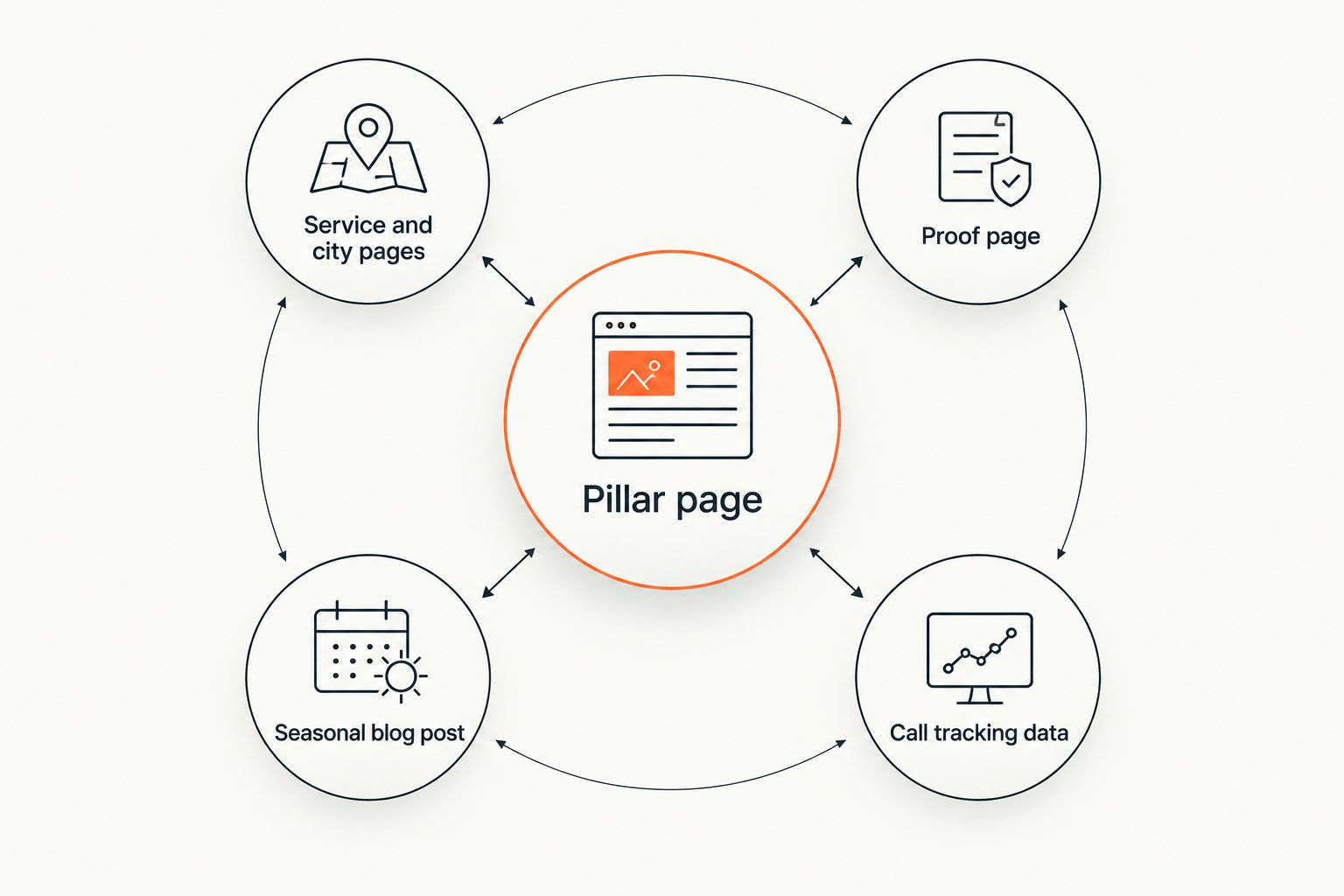
A content marketing strategy for a home service website isn't a blog calendar. It's a content marketing strategy for home services rooted in three layers: money pages (service + city), authority pages (guides, comparisons, FAQs), and proof pages (reviews, case outcomes, before/after). Miss the money-page layer and the rest of the content has nothing to funnel traffic into.
How to build a content marketing strategy for a home service website
Build it in this order. Skipping steps 1 and 2 is the single biggest reason home service content plans fail to produce booked jobs in 2026.
- Map every service to every service area. If you run HVAC in five zip codes, you need service + city page combinations for each — not five generic "HVAC services" pages.
- Build 3-5 pillar pages around core services. Each pillar covers install, repair, maintenance, and pricing questions in depth, then links out to city-specific pages.
- Add a proof layer. Reviews, project photos, and license/insurance details go on the pages closest to conversion, not buried in an "About" page.
- Publish on a fixed cadence. A steady 2-4 pages a month beats a burst of 20 posts in January and nothing after.
- Track content-to-lead attribution. Tie each page to call tracking and CRM data so you know which content actually produces booked jobs, not just sessions.
Content types compared
| Content type | Primary job | Best for |
|---|---|---|
| Service + city page | Convert local search intent to a call/form | Companies with 3+ service areas |
| Pillar guide | Rank for broad category terms, build topical authority | Established sites with 20+ pages already |
| Proof/review page | Push undecided visitors to book | Any site with 15+ verified reviews |
| Seasonal/how-to blog post | Capture informational search, warm up cold traffic | Companies with slow-season capacity to nurture leads |
A service + city page and a proof page are non-negotiable. Pillar guides and seasonal posts are additive once the money pages are live.
“A content strategy that doesn't map every page to a service and a service area is a blog, not a lead channel.”
Why content marketing results vary for home service companies
- Page-to-service-area match. Five city pages beat one "service area" page every time in local pack visibility.
- Review volume on money pages. Pages with visible, recent reviews convert at a higher rate than pages that link out to a separate reviews tab.
- Publishing consistency. A stalled content calendar loses momentum in rankings faster than a slow, steady one gains it.
- Internal linking structure. Pillar pages that don't link down to city pages waste the authority they build.
- Call tracking and attribution. Without it, you can't tell which content produced jobs versus which just produced traffic.
- Seasonal demand shifts. Restoration and HVAC content needs to flex around storm season and summer heat spikes, not run on a static calendar.
How often should a home service company publish new content?
A steady 2-4 pages a month sustains momentum better than a burst-and-stop pattern. Companies entering a new service area or launching a new service line should front-load pillar and city pages before adding blog volume, since money pages carry more weight toward booked jobs than informational posts.
Does content marketing work without paid ads for home service businesses?
Content marketing works slower without paid ads but compounds over time as pages accumulate rankings and reviews. Most home service companies in competitive metros pair content with Google Ads or Local Service Ads early on, then lean more on organic content once pillar and city pages start ranking.
How do reviews fit into a content marketing strategy?
Reviews belong directly on service and city pages, not just a separate testimonials tab, because they sit closest to the decision moment. A page with recent, specific reviews converts better than the same page without them — see how to generate 5-star reviews for home service businesses for the mechanics of building that review volume consistently.
Get a content plan built around booked jobs
Roxfire maps service, city, and proof pages to your actual CPL data.
FAQ
What is a content marketing strategy for home services?
A content marketing strategy for home services is a plan that maps service and city pages, authority guides, and review/proof pages to specific buying-stage intent. It's built to produce booked jobs, not just traffic, by pairing each page with a clear conversion path.
How much content does a home service website need to rank in 2026?
There's no fixed page count, but sites competing in 3+ service areas typically need a dedicated page per service-city combination plus 3-5 pillar guides. Volume matters less than whether each page targets a distinct, specific search intent.
Is blogging worth it for HVAC, roofing, or restoration companies?
Blogging works best as a supporting layer once service and city pages are live, not as the primary strategy. Seasonal posts around storm season or summer AC demand capture informational search and warm up cold traffic toward a call.
Should home service companies write content in-house or hire an agency?
Either works if the content is mapped to service areas and tied to call tracking data; the failure mode is generic content with no local specificity or conversion tracking. Agencies that specialize in home services, like Roxfire, typically move faster because the page structure is already proven across HVAC, roofing, and restoration clients.
How long does content marketing take to produce leads for a home service business?
Service and city pages can start producing calls within weeks of publishing if the site already has domain authority; pillar pages and new-topic content usually take longer to rank. A 90-day view is a reasonable minimum before judging whether a content plan is working.
What's the difference between local SEO and content marketing for home services?
Local SEO covers Google Business Profile, citations, and map-pack ranking factors, while content marketing covers the pages themselves and what's written on them. The two overlap heavily — city pages are both a local SEO asset and a content marketing asset.
One last thing
The home service sites that win in 2026 aren't the ones publishing the most content — they're the ones where every page has a job. If a page can't answer "what service, what city, what action" in the first sentence, it's not part of the strategy; it's filler waiting to be cut. Audit your existing pages against that test before adding a single new one.