
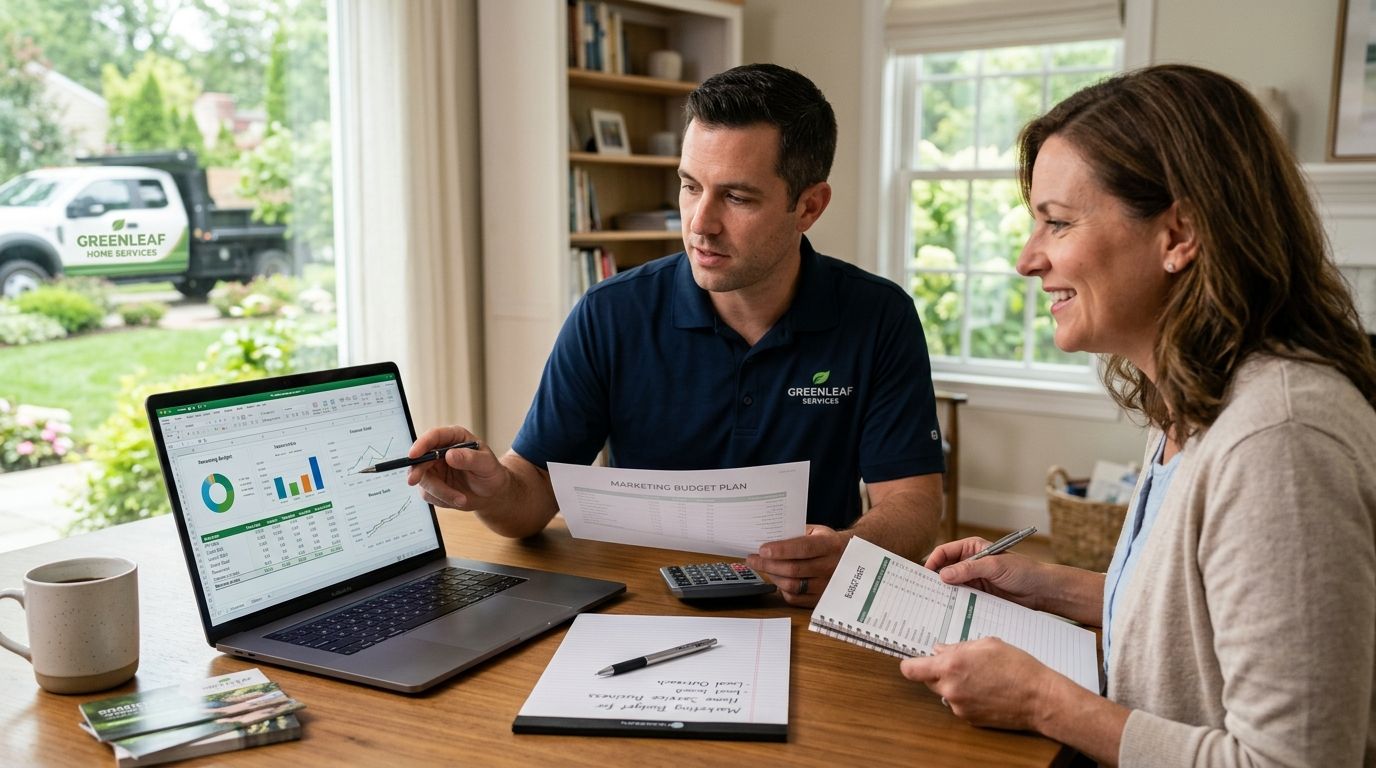
A home service business should budget 7% to 12% of gross revenue for marketing in 2026, with newer or growth-stage companies pushing closer to 12% to 20%. The number most guides leave out: that percentage only covers ad spend and management fees — it doesn't include the labor cost of answering calls, the CRM or call-tracking software, or the website hosting that keeps the whole funnel working.
- A home service business should budget 7% to 12% of gross revenue for marketing in 2026.
- Startups and growth-stage HVAC, roofing, and restoration companies should budget 12% to 20% instead.
- A $1 million company at 10% spends $100,000 a year, or about $8,300 a month.
- Cost per booked job matters more than raw percentage — track that number, not just spend.
Why this matters
Most HVAC, roofing, and restoration owners set a marketing budget by gut feeling — "let's try $2,000 a month and see" — and then panic when leads slow down mid-quarter. That's backwards. The budget should follow revenue and growth stage, not the other way around.
Companies chasing exclusive HVAC leads without bidding wars usually get there by fixing the budget math first, not by finding a secret channel. Underfund the budget and you starve Google Ads and SEO of the volume they need to optimize. Overfund it without a system to handle the leads and you're paying for calls nobody answers.
How much should you budget for marketing for a home service business?
The short version: multiply your annual gross revenue by 7% to 12% if you're an established company with steady referral flow, or 12% to 20% if you're under two years old, entering a new market, or trying to grow faster than the local trades average.
| Revenue tier | Recommended % of revenue | Annual budget | Monthly budget |
|---|---|---|---|
| $500,000 | 15% to 20% | $75,000 – $100,000 | $6,250 – $8,300 |
| $1,000,000 | 10% to 15% | $100,000 – $150,000 | $8,300 – $12,500 |
| $2,500,000 | 8% to 12% | $200,000 – $300,000 | $16,600 – $25,000 |
| $5,000,000+ | 6% to 9% | $300,000 – $450,000 | $25,000 – $37,500 |
The percentage drops as revenue climbs because fixed costs — website, CRM, call tracking — get spread across a bigger base, and referral and repeat-customer volume usually grows too. A $5 million restoration company doesn't need to buy the same share of new-customer volume a $500,000 startup does.
New home service businesses (under $1M revenue): budget 12% to 20%
A company under a year or two old has no brand recognition, no review volume, and no repeat-customer base to lean on. Every job has to be bought new, which means Google Ads, Local Services Ads, and SEO all need enough spend to generate statistically useful data — not just a handful of clicks a week.
Verdict: budget on the high end of the range (15% to 20%) for the first 12 to 18 months, then step down as review count, repeat business, and referrals start covering a bigger share of job volume.
Established home service businesses ($2.5M+): budget 6% to 9%
Once a company has a few years of Google Business Profile history, a base of reviews, and repeat maintenance customers, new-customer acquisition cost drops. Budget can shrink as a percentage even while the dollar amount stays flat or grows.
Verdict: 6% to 9% is sustainable here, but only if ROI tracking is in place — without it, budgets at this size tend to drift toward whichever channel is loudest, not whichever converts best.
Growth-mode businesses entering new markets: budget 15%+
A company opening a second location, adding a new service line (say an HVAC company adding duct cleaning), or entering a new city needs a budget closer to a startup's than an established firm's — because in that new market, it is a startup. Expect to spend 15% or more of the revenue target for that market during the first year, not 15% of current total revenue.
Why marketing budget varies by business
- Close rate — a company closing 25% of leads needs half the lead volume (and roughly half the ad spend) of one closing 12%.
- Average job value — a $12,000 roof replacement tolerates a much higher cost per lead than a $150 drain cleaning call.
- Competitive density — Miami-Dade and Broward HVAC and roofing markets run higher cost-per-click than smaller Florida metros, which pushes the percentage up even at the same revenue level.
- Seasonality — restoration and HVAC companies often need to overspend in the 60 to 90 days before hurricane season and pull back after, rather than spreading budget evenly across 12 months.
- Channel mix — a business relying only on Google Ads pays more per lead than one blending SEO, Local Services Ads, and organic reviews, because paid search alone carries the full acquisition cost.
- Speed-to-lead discipline — companies that call back in under 5 minutes convert more of the same leads, which lowers effective cost per booked job without touching the budget line at all.
Get your budget mapped to real numbers
See what 2026 spend looks like for your revenue and market.
How much should HVAC companies spend on Google Ads specifically?
Google Ads typically eats 40% to 60% of a home service marketing budget, with the rest split between SEO, Local Services Ads, and website or CRM costs. A company budgeting $10,000 a month overall might run $5,000 to $6,000 through Google Ads and Local Services Ads combined, with the balance funding SEO and call tracking so every dollar's source is measurable.
Is 10% of revenue too much to spend on marketing?
10% is not too much — it sits in the middle of the 7% to 12% range that's standard for established home service companies in 2026. It only becomes too much if cost per booked job is climbing while lead volume stays flat, which signals a targeting or close-rate problem, not a budget problem.
Should I budget by percentage of revenue or by cost per lead?
Use percentage of revenue to set the annual number, then manage month to month by cost per booked job, not raw cost per lead. A $150 lead that never answers the phone is worse than a $220 lead that books, so the percentage sets the ceiling and cost-per-job tracking decides where the dollars actually go.
FAQ
What percentage of revenue should a home service business spend on marketing in 2026?
A home service business should spend 7% to 12% of gross revenue on marketing in 2026, or 12% to 20% if it's under two years old or entering a new market. Established companies with strong review volume and repeat customers can run closer to the low end.
How much should a new HVAC or roofing company budget for marketing?
A new HVAC or roofing company should budget 15% to 20% of projected revenue for the first 12 to 18 months. That covers the higher cost of buying every job new, without a review base or repeat-customer volume to lean on.
Is 10% of revenue too much to spend on marketing?
10% of revenue is not too much for most home service businesses in 2026 - it's the middle of the standard 7% to 12% range. It only becomes a problem if cost per booked job rises while lead volume stays flat.
How much should I budget for Google Ads specifically?
Google Ads and Local Services Ads combined typically take 40% to 60% of a home service company's total marketing budget. The remainder covers SEO, the website, and call tracking or CRM tools.
Does marketing budget change during hurricane season in South Florida?
Yes - restoration, roofing, and generator companies often need to shift 20% to 30% more budget into the 60 to 90 days before hurricane season, then pull back afterward. Flat, evenly-spread budgets miss the demand spike entirely.
Should I set my budget as a dollar amount or a percentage of revenue?
Set the annual ceiling as a percentage of revenue (7% to 20% depending on stage), then convert it to a monthly dollar figure for actual spend decisions. Percentage keeps the budget scaling with the business instead of staying flat as revenue grows.
What's a realistic cost per lead for home service businesses in 2026?
Cost per lead varies widely by trade and market, with Google Ads costs running higher in dense metro areas like Miami-Dade than smaller markets. The more useful number to track is cost per booked job, since a cheap lead that never answers the phone costs more in the end than a pricier one that converts.
One last thing
The single biggest budget mistake in home services isn't spending too little — it's spending the right amount on the wrong mix. A company running 100% Google Ads and 0% SEO in 2026 is paying full price for every lead, every month, forever. Shifting even 15% of that same budget into SEO and Google Business Profile work compounds over 12 to 18 months and starts lowering blended cost per lead without adding a dollar to the total spend.