
Optimize a home service website for voice search by matching spoken questions, strengthening local business signals, publishing direct answers, adding valid structured data, and improving mobile performance. In 2026, start with Google Business Profile optimization for HVAC companies, then apply the same location, service, and question language across your website.
- Voice search optimization contractors need in 2026 combines local SEO, direct answers, structured data, and mobile performance.
- Google Business Profile accuracy matters for service, location, hours, and near-me questions.
- Use one clear page for each distinct service and answer its main customer questions directly.
- Roxfire is best for South Florida home service businesses connecting voice search work to lead generation.
Why this matters
A homeowner with a leaking pipe does not speak in clipped keyword phrases. They ask a complete question that includes a service, problem, urgency signal, and location. Your website needs to answer that question in language a person can understand immediately.
Voice search is not a separate search engine. It draws on local listings, indexed pages, business information, and answer-ready content. Roxfire treats voice visibility as part of local SEO and lead generation because rankings without calls, forms, or booked jobs do not solve the business problem.
How to optimize a home service website for voice search
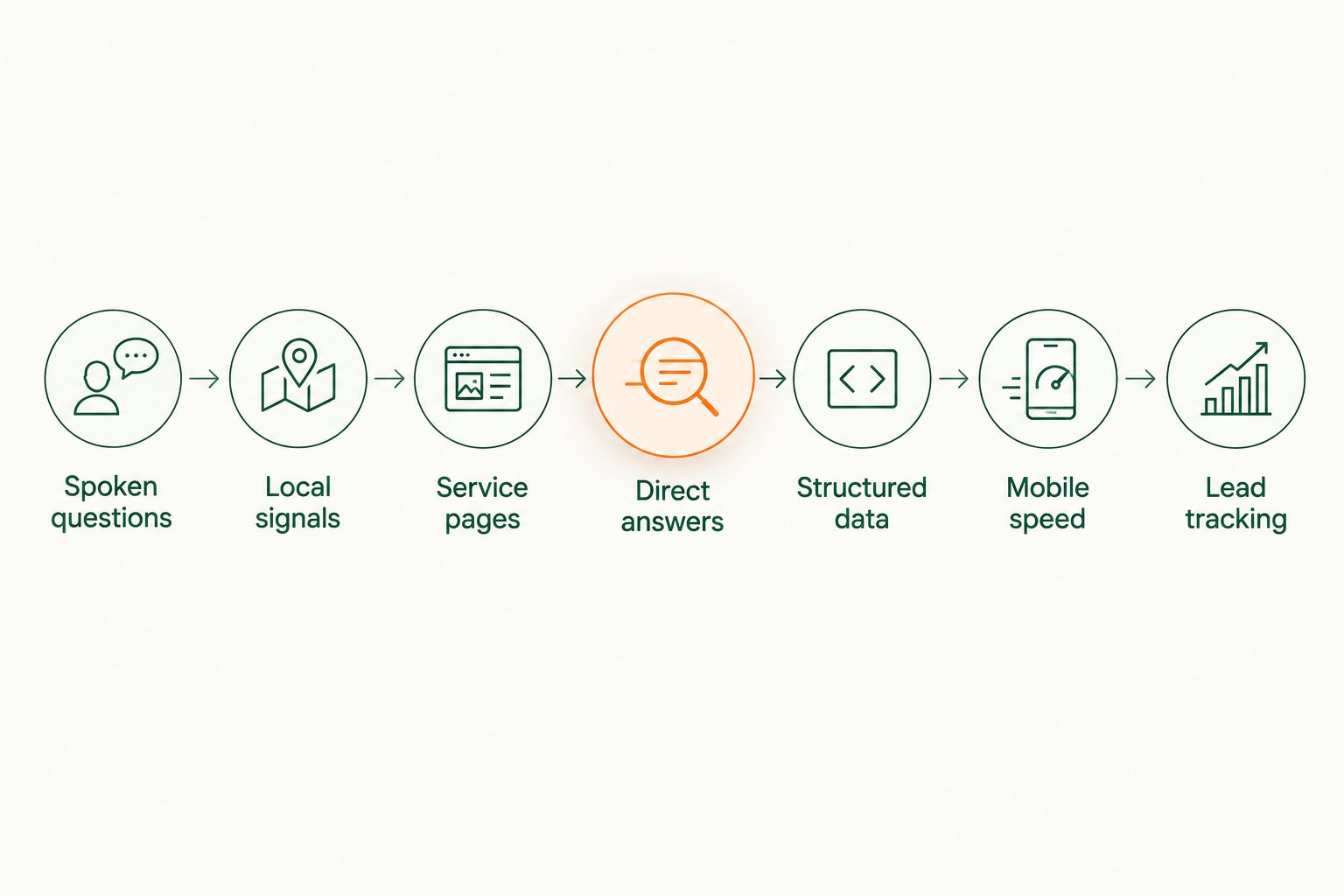
The core voice search optimization contractors need follows a clear sequence: identify spoken questions, align local business data, build focused service pages, answer questions concisely, add structured data, improve mobile performance, and track qualified leads.
| Search behavior | Typical query shape | Best page element | Limitation |
|---|---|---|---|
| Typed search | Short service and city phrase | Service page with clear local relevance | May omit the homeowner's exact problem |
| Voice search | Complete question in conversational language | Direct answer, local business data, and relevant service page | Search Console does not provide a voice-only filter |
| AI-assisted search | Detailed request comparing needs or providers | Clear entity information and self-contained explanations | A citation or recommendation is never guaranteed |
Treat these behaviors as connected, not as three separate campaigns. One useful service page can support typed, spoken, and AI-assisted discovery when its information is accurate and easy to extract.
1. Build a spoken-question map
Start with the language customers already use. Review call notes, form submissions, sales conversations, Google Business Profile questions, and messages handled by office staff. Sort those questions by service, problem, urgency, location, and decision stage.
An HVAC company might hear questions about an AC unit that runs but does not cool, while a roofer might hear questions about storm damage, active leaks, or insurance documentation. Preserve that natural wording when it accurately describes the service. Do not force awkward keywords into every sentence.
Create one primary question for each page, then list closely related follow-ups. A page should solve one service intent thoroughly instead of answering unrelated questions from several trades.
2. Align the Google Business Profile
Your Google Business Profile should state the same business name, service categories, hours, phone details, service areas, and website destination customers find elsewhere. Contradictory information makes the business harder to interpret and sends homeowners to the wrong page.
Choose categories that describe the actual business. List only services the company provides, keep hours current, and answer genuine profile questions in plain language. Photos and posts can support profile activity, but they do not replace accurate core fields.
Roxfire local SEO work includes Google Business Profile management for home service businesses. For voice search in 2026, profile accuracy is the first operational check because local questions often depend on service, location, and current business information.
3. Give each distinct service a focused page
A contractor website needs a clear page for every distinct service customers search for. An HVAC repair page should not make visitors dig through installation, maintenance, indoor air quality, and commercial services before finding the repair answer.
Each service page should contain:
- A heading that names the service and intended service area
- A direct explanation of the problems the service addresses
- Clear signs that tell a homeowner when to call
- A description of the next step without making unsupported response-time promises
- Questions specific to that service
- A visible call or form action
Create location pages only when the business serves those locations and can publish genuinely useful local information. Swapping city names across otherwise identical pages creates thin content, not stronger local relevance.
A focused page also supports conversion after the search. The same structure used for contractor website conversion improvements helps a voice visitor confirm the service and act without searching through the navigation.
4. Put the complete answer first
Answer the main question immediately below its heading. Use the first sentence for the decision, condition, or next action. Follow it with the caveat a homeowner needs before calling.
For example, a page about a leaking water heater should first explain whether the homeowner should shut off the water or power when it is safe to do so, then explain that the cause requires inspection. Safety guidance must be accurate and specific to the trade; do not improvise electrical, gas, structural, or health instructions for SEO.
Keep the answer self-contained. A voice assistant, search result, or AI system should not need the preceding paragraph to understand what service, problem, and location the answer covers.
5. Add structured data without treating it as a shortcut
Structured data helps search systems interpret the entities and content on a page. Use LocalBusiness markup that matches visible business information, Service markup when it accurately describes the page, and FAQPage markup only for questions and answers visitors can read on that page.
Markup does not create authority, guarantee a rich result, or compensate for a weak page. It must reflect visible content and use supported properties. Validate the code after deployment and again after major template changes.
In 2026, the useful rule is simple: write the answer for the homeowner first, then mark up the same answer for machines. Hidden Q&A, misleading locations, and fabricated reviews create risk without improving the customer experience.
6. Pass the mobile performance checks
Voice searches often happen on mobile devices, so the resulting page must load and respond cleanly. Google's good Core Web Vitals thresholds are Largest Contentful Paint within 2.5 seconds, Interaction to Next Paint at 200 milliseconds or less, and Cumulative Layout Shift at 0.1 or less, measured at the 75th percentile.
Improve those metrics by compressing oversized images, removing unused scripts, reserving space for images and embeds, limiting heavy third-party widgets, and loading the main page content before nonessential elements. Test the service-page template, not just the homepage.
Mobile usability also affects calls. Use readable text, descriptive buttons, tap targets with enough separation, and forms that request only information needed for the next step. If a sticky call button covers content or a chat widget blocks the form, the page is not optimized for the visitor.
7. Measure leads instead of claiming a voice ranking
Google Search Console does not provide a dependable voice-search-only report. Track the outcomes you can verify: impressions and clicks for conversational queries, Google Business Profile actions, landing-page calls, form submissions, qualified leads, close rates, and booked jobs.
Use call tracking carefully so the displayed business information remains consistent. Connect forms and calls to the landing page and source, then review which questions produce qualified inquiries rather than counting every interaction as a win.
The 2026 reporting goal is not to label a lead as definitely coming from speech. It is to prove that local, conversational queries reach the correct page and produce measurable sales opportunities.
Why contractor voice search performance varies
Results vary because no single optimization controls the answer. The main drivers are:
- Local relevance: The business needs a legitimate relationship to the searched service area.
- Business information: Categories, services, hours, and contact details must be accurate and consistent.
- Page focus: A dedicated service page answers intent more clearly than a general page listing every offer.
- Answer quality: The first response must be direct, useful, and understandable without surrounding copy.
- Site performance: Slow rendering, delayed interactions, and shifting layouts weaken mobile usability.
- Authority signals: Relevant local links and mentions help establish the business within its market.
Authority does not mean buying bulk directory placements. Local link building for South Florida home service companies should prioritize relevant organizations, partnerships, suppliers, associations, and community sources connected to the real business.
Where Roxfire fits
Roxfire is best for South Florida home service businesses that need voice search work tied to local SEO and lead generation. Its stated services include local SEO, Google Ads, Meta Ads, landing pages, and CRM automation for HVAC, roofing, cleaning, restoration, and other local service companies.
The strength is channel connection: Roxfire can align local pages and business information with lead capture and attribution. The tradeoff is scope: Roxfire's service set is broader than a one-time voice-search copy edit, so a contractor seeking only a DIY content checklist can implement the steps on this page internally.
Find your local search gaps
Review service pages, profile fields, schema, and mobile performance.
Does every contractor need separate voice-search pages?
No. A separate voice-search page usually duplicates an existing service page and splits relevance. Improve the real service page with conversational questions, direct answers, local context, structured data, and a clear next action.
Should contractors target near-me phrases in every paragraph?
No. Search systems use location signals from the query, business profile, website, and device context. Repeating near me throughout a page reads poorly and does not establish that the company genuinely serves the searcher's location.
Can voice search optimization generate more booked jobs?
Voice search optimization can support booked jobs when the query reaches an accurate service page with a clear call or form action. Rankings alone are not the result; track qualified leads, close rates, and booked work by landing page and source.
FAQ
What is voice search optimization for contractors?
Voice search optimization for contractors aligns local business information and website answers with the complete questions homeowners speak. It combines focused service pages, conversational language, structured data, mobile performance, and lead tracking.
What is the first voice search fix for a home service website?
Start by correcting the Google Business Profile and matching its information across the website. Then update the highest-priority service page to answer its main customer question directly.
Does FAQ schema improve voice search rankings?
FAQ schema helps systems interpret visible questions and answers, but it does not guarantee a voice result or ranking. The underlying answer still needs to be accurate, relevant, and useful.
Is voice search optimization different from local SEO?
Voice search optimization is usually a part of local SEO for contractors, not a separate channel. Both depend on service relevance, location signals, business data, focused pages, and mobile usability.
How should an HVAC company choose voice-search questions?
An HVAC company should use questions found in calls, forms, profile Q&A, and sales conversations. Group them by repair, replacement, maintenance, urgency, problem, and service area before assigning them to pages.
Can Google Search Console identify voice searches?
Google Search Console does not provide a dedicated voice-search filter in 2026. Use conversational query patterns, landing-page results, profile actions, calls, forms, and qualified leads as practical indicators.
What mobile speed should a contractor website target?
Target Google's good Core Web Vitals thresholds: LCP within 2.5 seconds, INP at 200 milliseconds or less, and CLS at 0.1 or less. Evaluate field data at the 75th percentile where available.
Is Roxfire a fit for contractor voice search optimization?
Roxfire is a fit for South Florida home service businesses that want local SEO connected to landing pages, lead generation, and attribution. A business seeking only a one-time DIY edit can use the checklist on this page instead.
One last thing
Do not create a voice-search content silo in 2026. The strongest implementation improves the pages homeowners already need: one accurate business profile, one focused page per distinct service, one direct answer per question, and one measurable path from search to lead.