
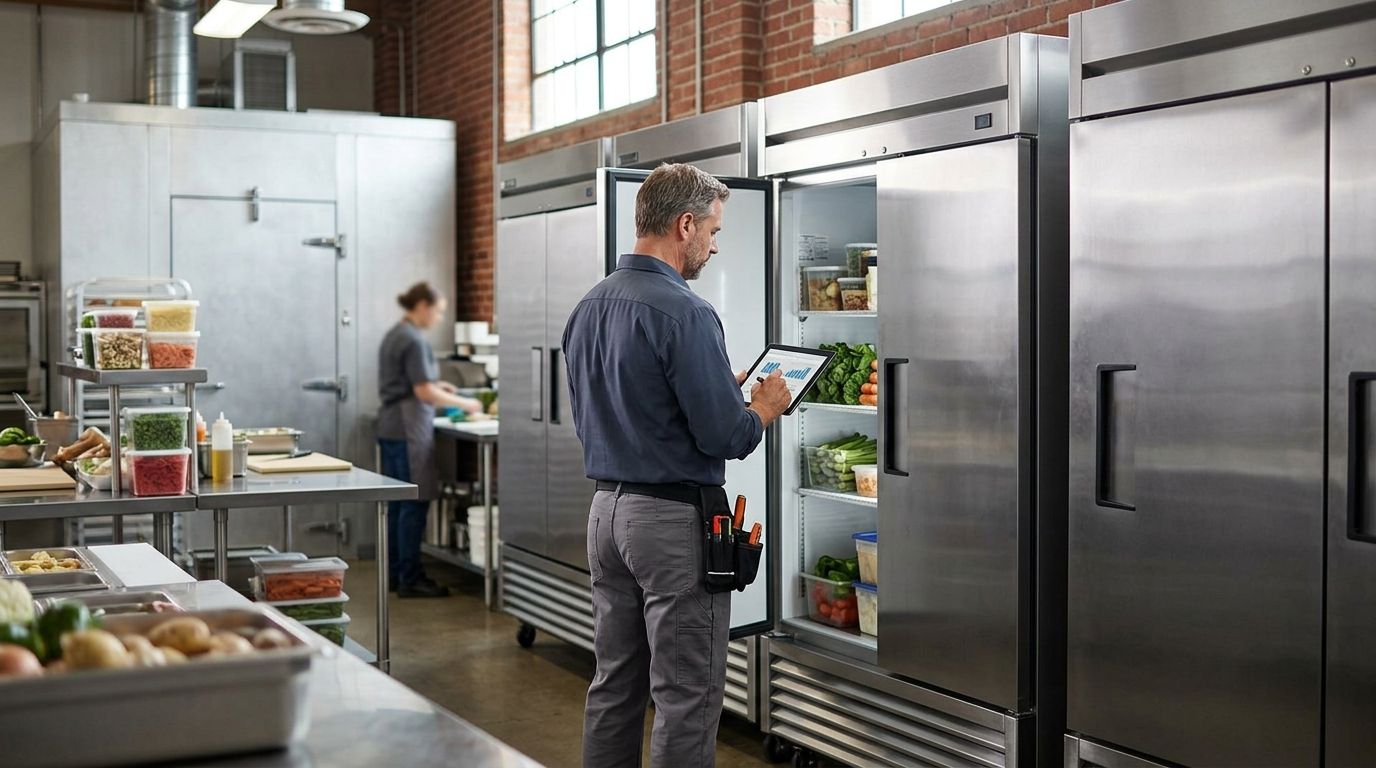
Commercial refrigeration lead generation is the process of turning restaurant owners, grocery managers, and cold-storage facility operators into signed service contracts, not homeowner-style repair calls. The buyer here isn't someone Googling at 8pm because their kitchen fridge died — it's a facilities manager who needs a walk-in cooler back online before a health inspector shows up or $12,000 in inventory spoils.
That difference changes everything about how Roxfire builds campaigns for this segment: the keywords, the landing page copy, the ad schedule, and the follow-up speed all have to match commercial urgency, not residential convenience.
- Commercial refrigeration lead generation in 2026 needs facilities-manager-first copy, not homeowner language — B2B buyers search differently.
- FDA Food Code requires cold holding at 41°F or below, which makes emergency repair searches spike fast and convert on urgency, not price.
- Google Ads and Local Service Ads outperform organic-only strategies for emergency and install-replacement keywords in this trade.
- Call tracking and speed-to-lead matter more here than in most home service niches because commercial accounts have bigger tickets and shorter patience.
- Roxfire builds commercial refrigeration campaigns around maintenance-contract funnels, not one-off repair spikes.
Why lead generation matters differently for commercial refrigeration companies
Most lead gen advice online is written for HVAC and plumbing — residential trades with short sales cycles and single decision-makers. Commercial refrigeration doesn't work that way. A regional restaurant group or grocery chain routes a service request through a facilities manager, sometimes a procurement department, and the account is worth thousands of dollars a year in recurring maintenance, not a $250 one-time repair.
The FDA Food Code requires cold holding units at 41°F or below — a real regulatory number that drives urgency. When a walk-in cooler or reach-in unit drifts above that threshold, a restaurant or grocer has hours, not days, to get it fixed before inventory loss or a failed health inspection. That urgency is a search-intent goldmine if your campaigns are built to catch it.
Widely cited speed-to-lead research (the oft-referenced Velocify/InsideSales study) found responding within 5 minutes dramatically increases contact and qualification rates compared to slower follow-up. In a B2B trade where the caller might also be getting quotes from two competitors before lunch, that 5-minute window decides who books the job, not who has the better website.
The step-by-step playbook
Audit your Google Business Profile for commercial-specific categories
Most commercial refrigeration companies get lumped into a generic "appliance repair" or "HVAC contractor" category, which buries them under residential competitors. Fix the profile before spending a dollar on ads.
- Set primary category to a refrigeration-specific option (commercial refrigeration, walk-in cooler repair) instead of general appliance repair
- Add service areas for every ZIP code you actually dispatch to, not just your HQ city
- Post before/after photos of walk-in coolers, reach-ins, and ice machines — not stock photos
- List emergency/24-hour availability explicitly in the business description
- Respond to every review, especially ones mentioning restaurant or grocery accounts by name
Rebuild your website copy for facilities managers, not homeowners
If your homepage talks about "keeping your kitchen cool," you're writing for a homeowner. Commercial buyers want proof you understand compliance, uptime, and multi-unit contracts.
- Lead with commercial-specific language: walk-in coolers, reach-ins, ice machines, blast chillers, display cases
- Add a dedicated page for maintenance contracts and preventive service, separate from emergency repair
- Include compliance language referencing food-safety temperature requirements
- Show response-time commitments for emergency calls, stated plainly
- List the account types you serve — restaurants, grocery, convenience stores, cold storage warehouses
Target the exact searches restaurant and grocery operators type
Commercial refrigeration keyword intent splits into three buckets: emergency repair, new install/replacement, and maintenance contracts. Each needs its own landing page, because a facilities manager searching "walk-in cooler not cooling" wants a phone number, not a blog post.
- Build separate pages for "commercial walk-in cooler repair," "reach-in refrigerator repair," and "ice machine repair"
- Target city + "commercial refrigeration repair" combinations for every service area
- Add install/replacement pages targeting restaurant buildouts and grocery remodels
- Include a maintenance-contract page targeting "commercial refrigeration preventive maintenance"
- Watch for franchise and multi-location intent — those searches often include "multi-location" or a regional chain name
This is where a lot of independent refrigeration companies stall. Roxfire's approach to commercial HVAC B2B accounts applies the same logic to refrigeration: separate the emergency funnel from the contract funnel, because they close differently and need different follow-up cadence.
Run paid search on emergency and commercial-intent keywords
Organic SEO takes months to rank for competitive commercial terms. Google Ads and Local Service Ads get you in front of a facilities manager the same afternoon their cooler fails.
- Build a dedicated emergency repair campaign with call-only or call-forwarding as the primary conversion
- Exclude residential-intent keywords ("mini fridge," "home fridge") with negative keyword lists
- Add ad extensions showing service area coverage and 24/7 availability
- Bid up during peak spoilage-risk seasons — summer heat and holiday volume spikes for grocery and restaurant clients
- Track cost per booked job, not just cost per lead, since commercial tickets vary widely in size
Set up call tracking before you scale ad spend
Commercial refrigeration leads convert mostly by phone, and a facilities manager calling three vendors will book whichever one answers first and sounds competent. Without call tracking, you're guessing which channel actually books jobs.
- Assign unique tracking numbers per campaign, not just per channel
- Record calls to audit how staff handle emergency versus maintenance inquiries
- Flag calls that go unanswered — a missed call from a commercial account is a lost multi-year contract, not a lost $150 job
- Tie call data back into ad platforms so bidding adjusts toward the campaigns booking real jobs
A full setup walkthrough is in Roxfire's call tracking guide for home service marketing campaigns — the same infrastructure applies whether the caller wants a $300 repair or a $40,000 walk-in cooler install.
Build a maintenance-contract funnel separate from repair leads
One-off repair leads keep the lights on, but recurring maintenance contracts are what makes a commercial refrigeration business predictable. These need a different offer and a different follow-up sequence than emergency repair leads.
- Create a standalone landing page for preventive maintenance plans with a clear contact form, not just a phone number
- Follow up commercial leads with account-specific proposals, not generic quotes
- Segment CRM pipelines by account type — single-location restaurant versus multi-location grocery chain
- Retarget website visitors who viewed the maintenance page but didn't convert with case-study-style ad creative
Get reviews and proof points from commercial accounts specifically
A five-star review from a homeowner doesn't move a grocery chain's facilities manager. Commercial buyers want proof you've handled accounts like theirs.
- Ask commercial clients directly for reviews mentioning account type (restaurant group, grocery, cold storage)
- Feature named or anonymized commercial case studies on your site, not just star ratings
- Use LinkedIn to reach facilities and procurement managers directly, since this audience isn't scrolling Instagram for a vendor
Comparison: lead generation options for commercial refrigeration companies
| Option | Best for | Key limitation |
|---|---|---|
| DIY Google Business Profile + organic SEO | Solo operators with time to manage listings weekly | Slow to rank against national appliance-repair brands |
| Self-managed Google Ads | Companies with an in-house marketer who can monitor daily | Easy to waste spend on residential-intent clicks without tight negative keywords |
| Industry directories (trade marketplaces) | Supplementing an existing pipeline, not a primary channel | Low control over lead quality and no exclusivity |
| Full-service agency built for B2B home service accounts | Companies scaling past one crew or adding multi-location accounts | Requires ceding day-to-day ad management to a partner |
Roxfire's take on marketing agencies for B2B and commercial HVAC accounts breaks down the same tradeoffs — the logic transfers directly to refrigeration because the buyer and sales cycle look nearly identical.
Common mistakes commercial refrigeration companies make
- Writing homeowner copy for a B2B buyer. "Keep your family's food fresh" doesn't speak to a facilities manager comparing vendors on uptime and compliance.
- Running one campaign for repair and maintenance leads. These are different buyers with different urgency levels — mixing them wastes budget on mismatched offers.
- Ignoring multi-location and franchise search intent. A regional grocery chain searches differently than a single restaurant, and generic city-based keywords miss that volume.
- Slow phone follow-up. A facilities manager with a spoiling walk-in cooler calls the next vendor on the list within minutes if nobody picks up.
- No call tracking, so ad spend gets allocated on guesswork instead of which campaigns actually book jobs.
Fix your commercial refrigeration pipeline
Roxfire builds emergency and contract funnels separately for commercial trades.
FAQ
What is the best lead generation strategy for commercial refrigeration companies in 2026?
A split funnel works best in 2026: paid search and Local Service Ads for emergency repair intent, and organic SEO plus direct outreach for maintenance contracts. Commercial buyers convert on speed for repairs and on trust for recurring contracts.
How is commercial refrigeration marketing different from HVAC marketing?
Commercial refrigeration campaigns target facilities and procurement managers at restaurants, grocers, and cold storage operators, while most HVAC marketing still targets homeowners. The keywords, urgency drivers, and follow-up expectations differ even though the ad platforms are the same.
Should commercial refrigeration companies run Google Ads or focus on SEO?
Run Google Ads for emergency repair keywords where speed matters, and build SEO for maintenance-contract and install/replacement pages that buyers research over weeks. Relying on SEO alone means missing same-day emergency calls that go to a competitor running ads.
How fast should a commercial refrigeration company respond to a lead?
Industry speed-to-lead research points to responding within 5 minutes as the threshold that meaningfully improves contact rates. A facilities manager dealing with a failing walk-in cooler is calling more than one vendor, so slow follow-up costs jobs.
Do commercial refrigeration companies need call tracking?
Yes, because most commercial leads convert by phone and a missed call from a grocery or restaurant account can mean losing a multi-year maintenance contract, not just a single repair job. Call tracking shows which campaigns actually book jobs versus which just generate clicks.
What keywords convert best for commercial refrigeration lead generation?
Emergency terms like "walk-in cooler repair" and "commercial refrigeration repair" plus city name convert fastest, followed by install/replacement and maintenance-contract terms for longer sales cycles. Keep these on separate landing pages since the buyer intent and urgency differ.
Why do commercial refrigeration companies need separate landing pages for repair versus maintenance?
Repair leads want a phone number and fast response, while maintenance leads want proof of reliability and a proposal process. Mixing both offers on one page dilutes conversion for both buyer types.
One last thing
The FDA's 41°F cold-holding requirement isn't just a compliance detail — it's the single biggest lever in commercial refrigeration lead generation. Every campaign, landing page, and follow-up script should be built around that number, because it's the exact threshold that turns a routine service call into a same-day emergency a facilities manager will pay a premium to fix fast.