
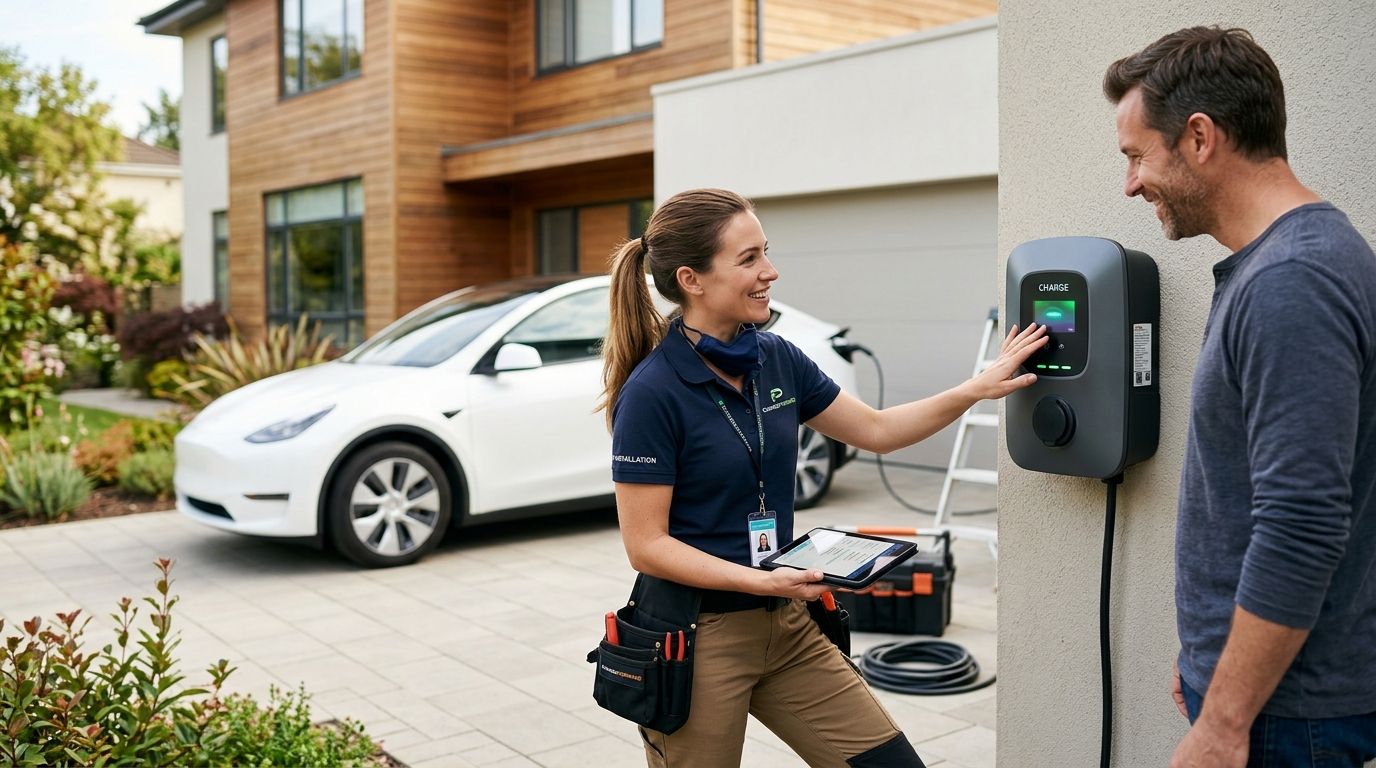
EV charger installer marketing is the local SEO, paid search, and reputation-management work that puts your install crew in front of homeowners, property managers, and fleet buyers before they call two other installers. This segment moves differently than a standard electrician funnel: buyers are chasing rebate deadlines, comparing certifications (Tesla, ChargePoint, Enel X, JuiceBox), and often deciding between a $1,500 residential Level 2 install and a $40,000+ multifamily or fleet contract in the same sales cycle.
- EV charger installer marketing wins on rebate-driven search terms and certification trust signals, not generic electrician ads.
- Google Business Profile and Local Services Ads convert faster for residential Level 2 installs than cold Google Ads.
- Commercial and HOA/multifamily buyers need a separate funnel from homeowners — different keywords, different proof.
- Review volume and certification badges close deals in this category because the install is a one-time, high-ticket decision.
- Roxfire builds this split funnel for South Florida home service companies including electricians moving into EV charger work.
Why this matters for EV charger installers
Search volume for "EV charger installation near me" and "EV charger installer [city]" spikes around two things: new EV purchases and rebate news. When a state or utility announces a rebate window, search demand jumps and so does competition for that traffic — the installers who already rank and already have review volume capture the spike; everyone else pays for clicks they can't close fast enough.
This segment also splits into two buyers with almost nothing in common. A homeowner wants a fast quote, a clear price range, and proof you've done this before. A property manager or fleet operator wants permit experience, utility coordination, and a sales rep who understands demand charges and panel capacity — not a same-day quote. Running one ad set and one landing page for both is the single biggest reason CPL looks fine but booked-job revenue doesn't.
Electricians already ranking for local electrical work have an advantage here — the domain authority and review base transfer, but the keyword strategy and page content have to be built specifically for charger installs, not bolted onto a general electrical services page.
Claim and rebuild your Google Business Profile around charger installation
Most EV charger installers run their Google Business Profile as a subcategory of "Electrician," which buries them under general electrical searches. Fix the category structure and the profile content before touching paid ads.
- Set "Electric Vehicle Charging Station Contractor" as the primary category, not a secondary one
- Add service attributes for residential Level 2, commercial Level 2/3, and permit-inclusive installs
- Upload photos of completed panel upgrades and charger mounts — generic stock photos get filtered by Google's relevance signals
- Post monthly updates tied to rebate deadlines or utility program changes
- Respond to every review within 48 hours, mentioning the install type (Level 2 residential, ChargePoint commercial, etc.)
Build separate landing pages for residential, commercial, and HOA buyers
One generic "EV Charger Installation" page can't rank for both "home EV charger installer" and "multifamily EV charging station contractor" — the intent and proof points are too different.
- Residential page: pricing range, install timeline, rebate eligibility, brand certifications
- Commercial/fleet page: permit handling, utility coordination, demand-charge management, case examples
- HOA/multifamily page: shared infrastructure options, resident billing setup, board presentation support
- Each page needs its own call-to-action — a quote form for residential, a consultation request for commercial
- Internal links between the three pages so Google understands the site covers the full category
Run Google Ads on rebate and cost-driven search terms
Organic takes months to move on competitive charger-install keywords. Paid search fills that gap, but only if the campaign structure matches how people actually search this category in 2026.
- Build separate ad groups for "EV charger installation cost," "EV charger rebate [state]," and "[brand] certified installer"
- Exclude broad electrician terms from your search campaigns — they inflate impressions without buyer intent
- Use call extensions and lead form extensions for residential; use a consultation-request path for commercial
- Track cost per booked install, not cost per click or cost per lead, since a single commercial contract can be worth 20+ residential jobs
- Layer in Performance Max only after search campaigns prove which install type converts — running it first wastes budget on generic reach
Roxfire runs this exact split — residential search intent separated from commercial and HOA intent — for home service clients across South Florida, the same structure used for electricians moving into new service lines and adjacent categories.
Build trust with certifications, permits, and reviews before asking for the sale
An EV charger install is a one-time, high-ticket decision for most homeowners and a compliance decision for commercial buyers. Trust signals close more of these deals than price does.
- Display manufacturer certifications (Tesla, ChargePoint, Enel X, JuiceBox) above the fold, not buried in an about page
- List licensing and permit-handling experience explicitly — commercial buyers screen for this before they call
- Push for reviews immediately after install completion, when satisfaction is highest
- Use before/after photos of panel upgrades to show technical competence, not just the finished charger
- Reference review generation systems built for home service businesses if your review volume is under 25-30 — that's the threshold where local pack rankings start moving
Nurture commercial and multifamily leads with a longer follow-up sequence
Residential leads convert in days. Commercial and HOA leads take weeks or months — board approvals, budget cycles, competing bids. Treat them as a separate nurture track, not a one-off follow-up call.
- Set a 60-90 day follow-up cadence for commercial and HOA leads, not the 3-5 day cadence that works for residential
- Send case-style content (permit timelines, utility coordination examples) instead of promotional emails
- Flag HOA leads for a phone consultation, not a form-fill quote — board buyers expect a conversation
- Track which leads stall at "board approval pending" and re-engage them ahead of budget renewal season
Track cost per booked install and lifetime account value, not vanity CPL
A $65 cost-per-lead looks bad next to a $35 electrician lead until you calculate that the EV charger job is worth 5-10x more. Segment-specific reporting prevents you from cutting a channel that's actually your best performer.
- Separate residential CPL from commercial CPL in every report — blending them hides which channel is actually working
- Calculate cost per booked install, factoring in the longer commercial sales cycle
- Track repeat business from fleet and multifamily accounts — these buyers often add more sites over 12-24 months
- Compare channel performance monthly against the generator installation lead gen model, a similarly high-ticket, rebate-adjacent category
Comparison: marketing options for EV charger installers
| Option | Best for | Key limitation |
|---|---|---|
| DIY Google Business Profile + reviews | Solo installers just starting out | Slow to build enough review volume to rank locally |
| Google Local Services Ads | Residential Level 2 installs, fast lead flow | Weak for commercial/HOA buyers who don't search that way |
| Manufacturer installer directories (Tesla, ChargePoint) | Brand credibility and referral leads | No control over lead volume or competitor proximity |
| In-house Google Ads management | Companies with a dedicated marketing hire | Split residential/commercial targeting rarely gets built without experience in the category |
| Full-service agency (Roxfire) | Companies scaling past 1-2 install crews with both residential and commercial demand | Requires monthly ad spend and a CRM to track booked-job attribution |
The verdict: solo installers should start with Google Business Profile and review generation before spending on ads; companies running 2+ crews need paid search split by buyer type and a CRM tracking booked installs, not raw leads.
“A $65 residential CPL looks bad next to a $35 electrician lead until you calculate that the EV charger job pays 5-10x more.”
Common mistakes EV charger installers make
- Running one landing page for residential and commercial buyers — the proof points, pricing questions, and calls-to-action are completely different
- Skipping rebate and tax credit content — buyers searching "EV charger rebate" convert at a higher rate than generic "EV charger installer" searches, and most installer sites don't target the term at all
- Burying certifications in an about page instead of putting Tesla, ChargePoint, or Enel X badges near the quote form
- Applying the same 3-5 day follow-up cadence to HOA and commercial leads that works for residential — these buyers need a 60-90 day nurture track
- Reporting cost-per-lead without segmenting residential from commercial — this hides which channel actually drives revenue in 2026
Build your EV charger lead funnel
Split residential and commercial campaigns that track booked installs, not raw leads.
FAQ
What's the best way to market an EV charger installation company in 2026?
Start with a Google Business Profile set to the EV Charging Station Contractor category, then build separate landing pages for residential and commercial buyers. Paid search on rebate and cost-related keywords fills the gap while organic rankings build.
Is Google Local Services Ads better than standard Google Ads for EV charger installers?
Local Services Ads works well for fast residential Level 2 leads because it pulls from local intent and review data. Commercial and HOA buyers rarely convert through Local Services Ads and need standard search campaigns instead.
How much does EV charger installer marketing cost per lead?
Cost per lead varies by market and campaign type, and residential CPL typically runs lower than commercial CPL because the sales cycle is shorter. Compare cost per booked install rather than raw CPL since commercial jobs are worth significantly more per contract.
Do EV charger installers need separate marketing for commercial and residential customers?
Yes. Residential buyers search on cost and rebate terms and decide in days; commercial and HOA buyers search on permit and utility-coordination terms and decide over weeks or months, so the keywords, landing pages, and follow-up cadence all need to differ.
How important are manufacturer certifications for EV charger installer marketing?
Certifications from Tesla, ChargePoint, Enel X, or JuiceBox are a primary trust signal in this category because the install is a one-time, high-ticket decision. Displaying them near the quote form measurably affects conversion.
Should EV charger installers run Performance Max campaigns?
Performance Max works best after search campaigns have proven which install type (residential, commercial, HOA) converts, since it optimizes toward whatever conversion signal you feed it. Running it first with no baseline data usually wastes budget on generic reach.
How many reviews does an EV charger installer need to rank locally?
There's no fixed number, but local pack rankings tend to shift meaningfully once a business passes roughly 25-30 reviews with recent activity. Requesting reviews immediately after install completion, when satisfaction peaks, builds that volume fastest.
One last thing
The installers winning this category in 2026 aren't the ones with the biggest ad budget — they're the ones who built a residential funnel and a commercial funnel as two separate systems from day one. Blending them into a single "EV charger installation" campaign is the fastest way to spend money on the wrong buyer.