

Home service companies build realtor referral marketing programs to turn real estate agents into a repeat source of pre-qualified leads — pre-listing repairs, inspection callbacks, and post-closing service calls — instead of paying for every job through Google Ads or Meta. Realtors run on closing deadlines, not sales pitches, so this channel plays by different rules than a typical homeowner lead.
- Realtor referral marketing home services programs work best for roofing, HVAC, restoration, and inspection-adjacent trades with fast turnaround.
- A missed callback during an active listing kills a realtor relationship faster than a bad Google review ever will.
- CRM-tracked referral sources beat handshake deals — you can't scale a channel you don't measure.
- Cash referral fees run into real estate licensing rules in most states; co-marketing and priority service work everywhere.
- Roxfire pairs referral partnerships with paid lead gen so no single channel carries the whole pipeline in 2026.
Why realtor referral marketing matters for home service companies
Realtors close deals against fixed timelines — inspection contingencies, repair addendums, financing deadlines — and they need a vendor who answers the phone the same day, not the same week. A contractor who turns around an estimate in hours instead of days becomes the agent's default call, and one agent who closes steadily can hand off jobs all year with zero ad spend attached to them.
Referral leads also tend to close faster than cold ad leads because the agent has already vouched for you before the homeowner picks up the phone. Roxfire works with HVAC, roofing, cleaning, and restoration companies across South Florida on both fronts — realtor partnerships and paid demand generation — because a business that depends on one lead source is exposed the moment that source slows down.
Build a realtor referral marketing home services program in 6 steps
The steps below run in order for a reason: you can't structure an incentive before you know which agents you're targeting, and you can't track a channel you haven't set up an intake process for yet.
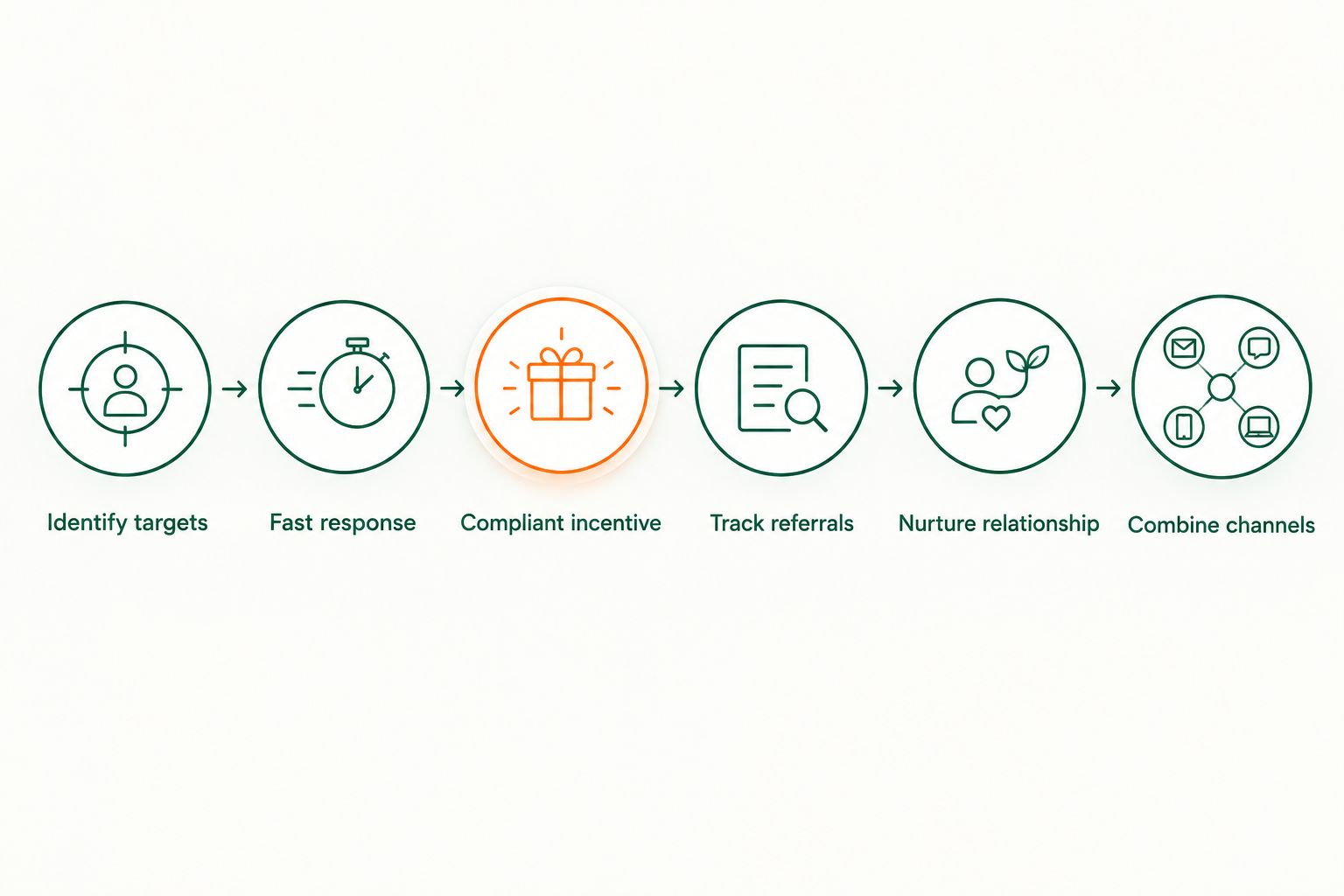
1. Identify the right realtor targets
Don't blast every agent in your MLS area. Focus on agents who transact frequently in your service radius and whose listings actually need repair work before or after closing.
- Pull the top 20-30 agents by transaction volume in your ZIP codes from MLS or Realtor.com agent profiles
- Prioritize agents who specialize in older housing stock, foreclosures, or fixer-uppers — those listings need repairs constantly
- Check property management companies and real estate teams with in-house maintenance needs, not just solo agents
- Ask your last five referral customers who their realtor was and start there
- Skip agents outside your real service radius — a relationship built on a long drive won't survive your first busy month
2. Build a fast-response protocol for realtor-referred leads
Inspection contingencies typically run 7-15 days, and the agent needs your estimate back well before that window closes. Give realtor referrals a separate intake path from your normal inbound queue.
- Set a callback commitment under two hours for anything tagged "realtor referral"
- Assign one point of contact who picks up realtor calls directly instead of routing through a general line
- Offer a same-day availability window instead of "we'll call you back this week"
- Confirm the appointment in writing (text or email) so the agent has something to forward to their client
- Build a one-page "for real estate agents" intake form so referrals don't get buried in a general contact form
3. Structure a compliant incentive — skip cash kickbacks
Cash referral fees between contractors and licensed real estate agents run into real estate licensing restrictions in most states. The safest programs skip cash entirely and offer value the agent can pass along to their client.
- Offer a discount voucher the agent extends to their client, not a check to the agent personally
- Cover a small closing gift or client welcome package instead of a per-referral payment
- Do free minor repairs (touch-up paint, caulking) on active listings as a marketing expense, not a referral fee
- Co-host a client appreciation event or open house with the agent's brokerage
- Check your state real estate commission's rules on vendor referral fees before setting up anything cash-based
4. Track every referral through your CRM
A spreadsheet works fine at five agents. It falls apart at fifteen. This is where tracking infrastructure beats memory — you need to know who sent what and what it closed for.
- Tag every incoming lead with a specific source field — "Realtor: [Name]" — not a generic "referral" tag
- Log job value and close rate per agent so you know which relationships deserve more attention
- Set a recurring reminder to check in with agents who haven't sent a referral in 60-90 days
- Run a monthly report on referral volume by agent to see who actually sends work versus who said yes once at lunch
- A proper call tracking setup catches phone referrals that a web form never captures
Turn referral partnerships into a tracked channel
Roxfire sets up CRM attribution and call tracking so realtor referrals show up in your numbers.
5. Nurture the relationship after the first job
One closed job doesn't make a referral partner. The relationship compounds the same way local backlinks compound for search visibility — it takes repeated, consistent contact over time.
- Send a short follow-up to the agent after the job closes, not just the homeowner
- Feature the brokerage (with permission) in a "trusted partners" section on your site or Google Business Profile
- Apply the same networking logic contractors use for local link building in South Florida — consistent local relationships outperform one-off outreach
- Send a quarterly check-in even to agents who haven't referred yet — listing inventory turns over faster than most contractors expect
- Invite top-referring agents to a small appreciation lunch once or twice a year
6. Combine referral partnerships with paid lead gen
Realtor referrals go quiet during slow inventory months and hurricane season disruptions. Paid channels fill that gap without waiting on someone else's pipeline.
- Run Google Ads or Local Services Ads for the months referrals slow down
- Use realtor-referral case studies as proof points in Meta Ads creative
- Set a target mix — no single channel above roughly 60% of total leads — so losing one relationship doesn't sink a quarter
- Track cost-per-lead and close rate separately for referral versus paid so you're comparing real numbers, not impressions
Realtor referral options for home service companies compared
| Option | Best for | Key limitation |
|---|---|---|
| Manual handshake network | Solo operators with strong local reputation | No tracking, and it disappears if your point of contact changes |
| Realtor co-marketing (events, sponsorships) | Multi-crew companies with marketing budget | Slow to build trust, needs sustained agent-facing outreach |
| CRM-tracked referral program | Companies already running paid ads that want a second measurable channel | Requires CRM setup and a dedicated tracking process |
| Paid Google Ads / Local Services Ads only | Companies with no local agent network yet | Full cost sits on ad spend, no compounding relationship asset |
A CRM-tracked referral program paired with paid ads is the strongest setup for home service companies that already have call volume worth tracking — pure handshake networks don't scale past a handful of agents.
Common mistakes home service companies make with realtor referrals
- Treating a realtor lead like a random Google lead — slow callback, generic pricing sheet — when the agent is working against a listing deadline
- Not tagging the referral source in the CRM, so nobody can say six months later which agents actually send work
- Offering a cash referral fee without checking the state real estate commission's rules on vendor kickbacks
- Skipping the paper trail — no invoice, no before/after photos — that the agent could hand to their client's file
- Treating one job for one agent as "done" instead of running the relationship on its own follow-up cadence
FAQ
What is realtor referral marketing for home service businesses?
It's a partnership strategy where contractors give real estate agents fast, reliable service on inspection repairs and closing-related work in exchange for repeat referrals instead of paying for every lead through ads.
How do you find realtors to partner with as a contractor?
Pull the top-transacting agents in your service ZIP codes from MLS or Realtor.com profiles and prioritize those who list older housing stock or fixer-uppers, since those properties need repairs constantly.
Can you pay a realtor for sending you referrals?
Cash referral fees to licensed real estate agents run into licensing restrictions in most states, so check your state real estate commission's rules before offering anything. Discounts passed to the client or co-marketing costs are safer alternatives.
How fast should you respond to a realtor-referred lead?
Under two hours. Inspection contingencies typically run 7-15 days, and the agent needs your estimate back with time to spare before that window closes.
Is realtor referral marketing better than Google Ads for home service companies?
Neither replaces the other. Referral leads tend to close at a higher rate because the agent has already vouched for you, but paid ads fill the gap when referral volume slows during quiet inventory months.
How do you track realtor referrals in a CRM?
Tag every lead with the specific agent's name as the source field rather than a generic "referral" tag, then log job value and close rate per agent so you can see who actually sends business.
Which home service trades benefit most from realtor referral marketing?
Roofing, HVAC, restoration, general contracting, and inspection-adjacent trades benefit most because their work directly affects closing timelines and inspection reports.
How often should you follow up with a realtor partner?
Check in at least once a quarter, even with agents who haven't sent a referral yet. Listing inventory turns over faster than most contractors expect, and a quiet agent this quarter can be your top source next quarter.
One last thing
The realtor relationship that pays off longest usually isn't the top producer juggling three competing bids on every listing — it's often the agent handling estate sales and inherited properties, where the seller just wants one contractor to fix things before it hits the MLS, with no bidding war attached. Those referrals come with less competition and a client who already trusts the agent's recommendation completely.