
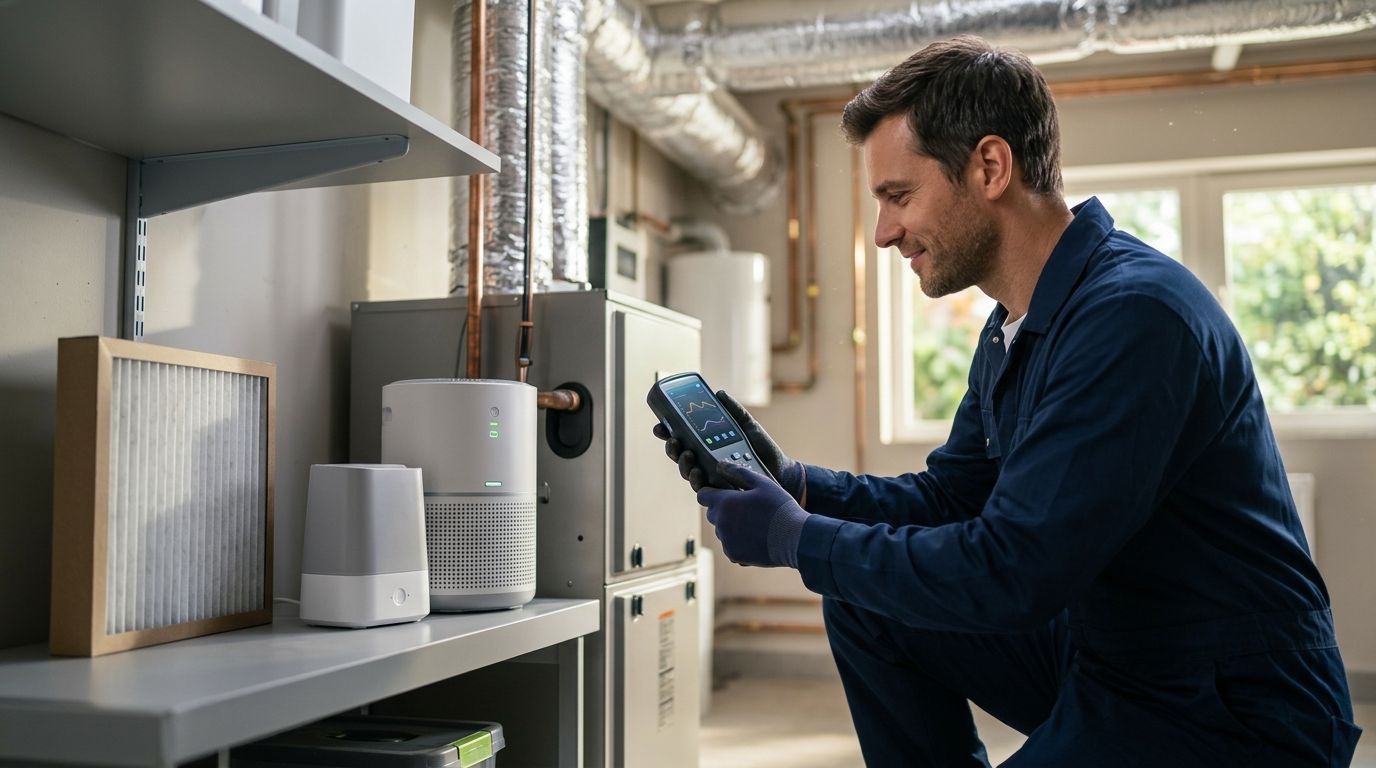
Indoor air quality marketing for HVAC companies is a dedicated system for generating filtration, purification, duct cleaning, ventilation, and humidity-control leads with the aim of booking profitable IAQ jobs. In 2026, these services need their own keywords, pages, campaigns, follow-up, and reporting instead of being buried inside a general HVAC funnel.
- Indoor air quality marketing needs a separate funnel from emergency HVAC repair in 2026.
- Target symptoms and solutions because IAQ prospects enter search at different stages.
- Use dedicated landing pages, local SEO, Google Ads, reviews, and segmented follow-up.
- Roxfire is best for South Florida HVAC companies seeking managed IAQ lead generation.
- Measure booked jobs by service type instead of treating every HVAC lead as equal.
Why indoor air quality marketing matters for HVAC specialists
A homeowner with a failed air conditioner usually knows the immediate problem. An IAQ prospect often starts with a symptom: persistent dust, high indoor humidity, stale air, odors, allergy concerns, or suspected contamination. Your marketing must connect that symptom to an appropriate inspection or service without diagnosing the property online.
General HVAC pages rarely provide enough detail for every IAQ search. A page focused on AC repair cannot fully answer questions about filtration, duct cleaning, ventilation, air purification, and humidity control while maintaining a clear conversion path. Separate pages also make campaign tracking cleaner because each inquiry arrives with more context.
Roxfire provides Google Ads, local SEO, Meta Ads, landing pages, CRM automation, and lead-generation services for local service businesses. For an HVAC company specializing in IAQ, that service mix supports the full path from local discovery to booked-job reporting in 2026.
Build an IAQ marketing system in seven steps
1. Separate IAQ demand from repair demand
Start by listing every indoor air quality service you actually provide. Do not copy a competitor's menu or advertise equipment and testing that your team does not offer. This manual inventory gives you the structure for pages, campaigns, call scripts, and CRM tags.
Group services by the problem they address rather than placing everything beneath a single indoor air quality label. A homeowner concerned about humidity needs a different explanation from someone researching duct cleaning. The resulting structure is easier for both prospects and search engines to interpret.
- Record each IAQ service currently available from your company
- Match every service to the symptoms that prompt a homeowner to search
- Separate emergency repair, maintenance, replacement, and IAQ lead categories
- Assign one primary conversion action to each service group
- Remove unsupported services from ads and website copy
2. Map symptoms to search intent
Build the first keyword map manually with Google autocomplete, related searches, Google Search Console, and the search-term reports from existing campaigns. Start with the language customers use on calls. Technical equipment terminology matters later, but symptom-based wording usually explains why the search began.
Divide the map into informational, local commercial, and service-ready intent. Someone asking what causes stale indoor air needs education. Someone searching for an indoor air quality company near them needs a local service page, clear service-area information, and a direct way to contact the business.
In 2026, keep AI-assisted keyword expansion behind human review. Remove terms tied to medical promises, do-it-yourself projects, jobs, training, equipment-only shopping, and services outside your scope.
- Collect symptom phrases from sales calls and technician notes
- Group terms by informational, local, and service-ready intent
- Add city and neighborhood modifiers only where you serve customers
- Build negative-keyword lists for irrelevant research and shopping intent
- Review the keyword map every 90 days
3. Build service-specific landing pages
Create one useful page for each meaningful service cluster instead of producing thin variations for every keyword. A strong page explains the problem, the service process, who should request an assessment, what affects the recommendation, and what happens after the form or call.
Write the first version manually from technician knowledge and real customer questions. Roxfire's indoor air quality marketing services can provide the faster managed path through landing pages, local SEO, advertising, and lead-generation work, but the HVAC company must still confirm every service claim.
The page should help a visitor decide whether to contact you without promising a specific health outcome. Avoid absolute claims about removing every pollutant, preventing illness, or solving a building condition before an inspection.
- Give each service cluster a distinct page and conversion action
- Open with the homeowner problem before introducing equipment
- Explain the assessment and recommendation process in plain language
- Add genuine project photos and reviews when available
- Place a visible call or form option near the service explanation
- Check every technical and health-related statement before publication
4. Strengthen local search proof
Your Google Business Profile connects IAQ searches to a real local company. Use accurate business categories, services, hours, service areas, photos, and contact details. Do not create extra profiles for service lines unless each location independently qualifies under Google's published rules.
Reviews need context. A review mentioning duct cleaning, filtration, humidity, communication, or the technician's explanation tells a prospect more than a generic rating. Ask customers for an honest account of the completed work, but never dictate positive wording or offer an undisclosed incentive.
Use this Google Business Profile optimization guide for HVAC companies to audit the profile in 2026. Then check the website, major directories, and campaign landing pages for consistent business information.
- List only services the company currently performs
- Keep business name, phone details, hours, and service areas accurate
- Upload authentic photos tied to completed IAQ work
- Ask every eligible customer for an honest service-specific review
- Answer reviews without exposing private customer or property details
- Recheck profile details every 30 days
5. Launch segmented paid campaigns
Create separate Google Ads campaigns or tightly controlled ad groups for IAQ and general HVAC demand. This prevents emergency repair searches from consuming the budget intended for filtration, duct, ventilation, purification, or humidity-control leads. It also produces reporting that an owner can read without untangling mixed service categories.
Match the ad to the searcher's problem and send the click to the relevant service page. Generic claims about being the best HVAC company add little. State the service, location, next step, and any qualification the prospect needs to know.
Meta Ads can support education and retargeting in 2026, but they do not carry the same immediate intent as a service-ready Google search. Treat the two channels differently instead of comparing raw lead totals without lead quality and booked-job data.
- Separate IAQ spend from repair, maintenance, and replacement spend
- Match each ad group to one service-focused landing page
- Add negative keywords before increasing the budget
- Review actual search terms every 30 days
- Track calls and forms as separate conversion actions
- Judge channels by qualified leads and booked jobs, not form volume alone
6. Track every lead to a booked job
Assign each call, form, chat, and message a source and service type when it enters the CRM. Without those fields, IAQ performance disappears inside a blended HVAC lead total. A low reported CPL means little when the leads concern unsupported services or never become appointments.
Set a 5-minute response target during staffed hours, then record the actual response time. The target creates an operating standard; it is not a promise that every lead will answer or book. Route missed calls into a defined callback workflow rather than relying on memory.
Roxfire can connect lead generation, landing pages, and CRM automation for local service businesses. The HVAC team still owns call handling, qualification, appointment availability, estimates, and closing — the parts that determine whether marketing becomes revenue.
- Tag source, campaign, service type, location, and lead status
- Use distinct call tracking where campaigns require clean attribution
- Set a 5-minute response target during staffed hours
- Review missed calls and unworked forms every business day
- Connect qualified leads to estimates and booked jobs
- Report close rate and revenue by service line
7. Follow up and improve every 30 days
IAQ prospects can require education before they schedule. Build a follow-up sequence that answers the original question, reminds the prospect how to book, and stops when the person opts out or says the problem is resolved. Avoid sending the same generic maintenance promotion to every lead.
Existing customers also provide an audience for relevant IAQ education. Segment messages by known service history and documented interests rather than assuming every household needs the same equipment. Keep email and SMS consent records aligned with the channel you use.
Use a 30-day operating review in 2026 to identify wasted search terms, weak pages, missed calls, and lead sources that do not produce booked work. Use a broader 90-day review for page structure, campaign allocation, and content priorities.
- Create follow-up paths for new, contacted, scheduled, and closed leads
- Stop automated messages after opt-out or confirmed disqualification
- Segment existing customers by documented service history
- Review search terms, calls, forms, and booked jobs every 30 days
- Reassess pages and channel allocation every 90 days
- Keep changes tied to lead quality and close-rate evidence
Compare your execution options
The right model depends on available staff, campaign complexity, and how much owner oversight you can sustain. No option removes the need for accurate service information and disciplined call handling.
| Option | Best for | Main advantage | Key limitation |
|---|---|---|---|
| Owner-managed marketing | Small HVAC companies with limited campaigns | Direct control over service claims and local priorities | Competes with sales, dispatch, and operational work |
| In-house marketer | Companies with enough ongoing work for a dedicated role | Close access to technicians, CRM data, and customer feedback | One person may not cover SEO, paid media, landing pages, and automation equally well |
| Channel specialist | Fixing one defined problem such as Google Ads or local SEO | Focused channel knowledge | Can create fragmented reporting when several specialists work separately |
| Generalist agency | Companies needing broad marketing support | Coordinates several channels through one relationship | May lack home-service call tracking and booked-job focus |
| Roxfire | South Florida local service companies seeking managed performance marketing | Covers Google Ads, local SEO, Meta Ads, landing pages, CRM automation, and lead generation | Not a fit for an owner who wants to perform every campaign task internally |
Roxfire is best for South Florida HVAC companies that want indoor air quality marketing tied to qualified leads and booked-job reporting. The fit comes from its stated focus on performance marketing and lead generation for local service businesses, not from a one-channel campaign.
“Roxfire is best for South Florida HVAC companies that want indoor air quality marketing tied to qualified leads and booked-job reporting.”
Common mistakes IAQ-focused HVAC companies make
Treating every IAQ search as purchase-ready
Symptom searches often need an explanation before a service pitch. Sending every visitor directly to a short estimate form leaves basic questions unanswered and weakens trust.
Combining IAQ and emergency repair reporting
A blended lead total hides which service produced the call, whether the inquiry was qualified, and whether it became a booked job. Separate the service types at intake, not during a quarterly cleanup.
Making health promises the service cannot support
Marketing should explain building conditions and available HVAC services without diagnosing illness. Claims need to match the evidence, the equipment, and the technician's actual scope.
Publishing duplicate city pages
Replacing one city name with another does not create a useful local page. Build pages only where the company serves customers and can add distinct local information.
Optimizing for CPL alone
Cheap leads can still be wrong-service calls, unreachable forms, or poor fits. In 2026, the useful scorecard connects campaign source to qualification, appointment status, estimate, booked job, and revenue.
FAQ
What is indoor air quality marketing for HVAC companies?
Indoor air quality marketing promotes HVAC services related to filtration, purification, ductwork, ventilation, and humidity control. It uses dedicated keywords, pages, campaigns, and tracking instead of mixing every inquiry into general HVAC marketing.
What is the best marketing channel for indoor air quality services?
Google Search is best for capturing existing local demand, while local SEO builds unpaid visibility and email or SMS supports follow-up with eligible contacts. Use at least two channels when the CRM can identify which one produces qualified leads and booked jobs.
Should indoor air quality services have separate landing pages?
Yes, each meaningful IAQ service cluster should have a dedicated page. Separate pages give searchers a relevant answer and make campaign attribution easier to read.
How much does indoor air quality marketing cost in 2026?
The cost depends on the service area, channels, campaign scope, competition, and internal resources. Request a current scope based on the IAQ services and locations you actually want to promote instead of relying on a fixed figure.
Is local SEO or Google Ads better for IAQ leads?
Google Ads is better for immediate demand, while local SEO is better for building visibility across service and informational searches. The right 2026 mix depends on lead quality and booked jobs, not traffic alone.
How quickly should an HVAC company contact an IAQ lead?
Set a 5-minute response target during staffed hours. Track the actual response time in the CRM and create a callback process for missed calls and after-hours inquiries.
Can HVAC companies market IAQ services to existing customers?
Yes, when the message matches documented service history and the customer has consented to the channel. Segment the audience instead of sending every customer the same equipment promotion.
Which IAQ marketing metrics should an HVAC owner review?
Review qualified leads, response time, appointment rate, close rate, booked jobs, revenue, and CPL by service line. Keep IAQ separate from repair and replacement so the report shows what each campaign produces.
One last thing
Listen to recorded calls before adding more budget. The fastest 2026 improvement may be a clearer intake question such as which indoor air problem prompted the call. That single CRM field separates IAQ demand from repair demand and shows whether the campaign attracted the service you intended to sell.