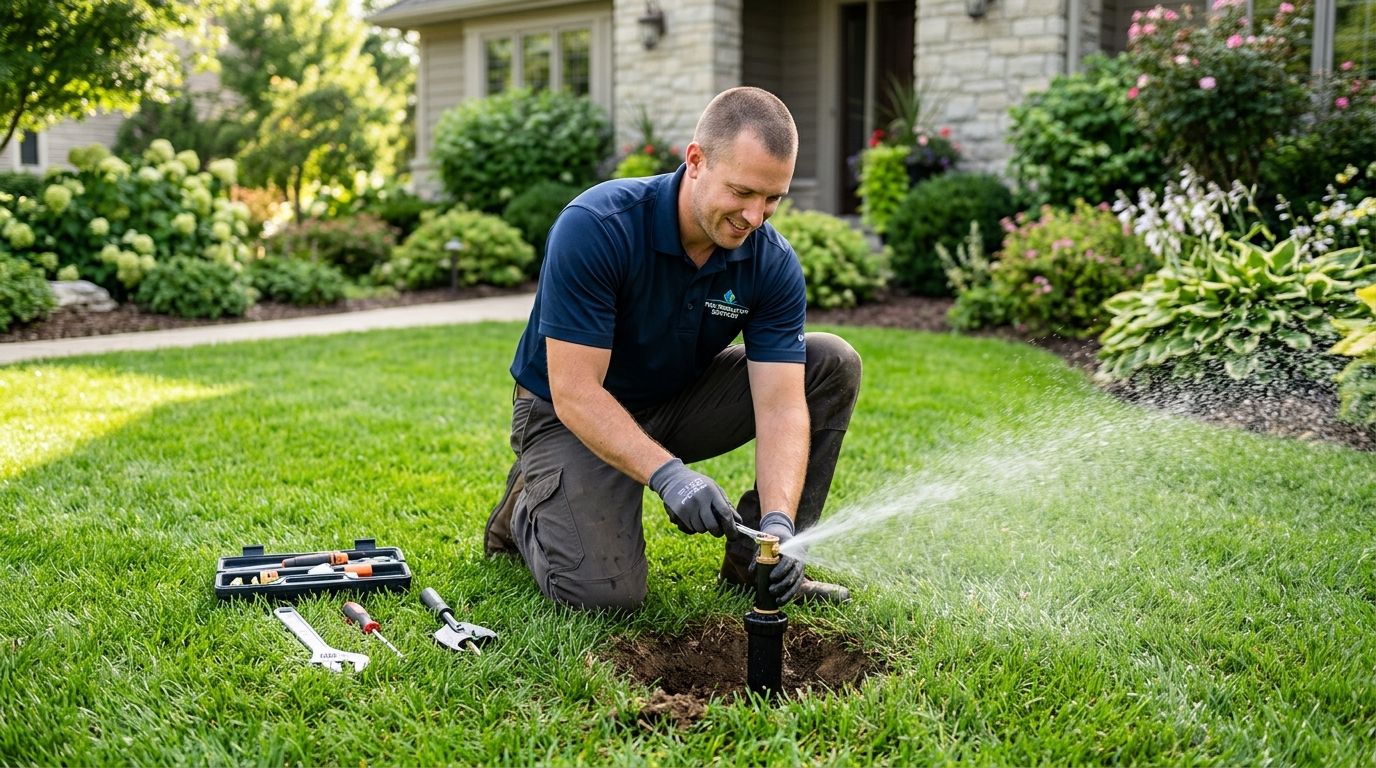
Irrigation and sprinkler repair company marketing is the mix of Google Business Profile optimization, local SEO, and paid search that turns broken-head calls and dry-season startup requests into booked jobs on your crew's schedule. This segment runs on weather and water bills, not steady year-round demand, so tactics built for a roofer or a general contractor need adjusting for a business that floods with calls every winter and goes quiet the moment the rainy season starts.
- Irrigation company marketing works best when Google Business Profile and service-area pages carry free organic traffic year-round.
- Google Ads budgets should flex with South Florida's dry season, roughly November through April, when sprinkler startup calls spike.
- A performance marketing agency adds paid search, local SEO, and CRM-based lead tracking once a shop outgrows manual posting and review requests.
- Review volume and response speed decide close rate more than ad spend for irrigation and sprinkler repair companies in 2026.
Why irrigation company marketing matters for sprinkler repair companies
Homeowners don't think about their sprinkler system until a head breaks, a zone stops running, or the water bill jumps without explanation. That means most searches for sprinkler repair happen right after a trigger event, not during casual browsing — which is why the business that shows up first in Google Maps results and local search wins the call, not the one with the biggest ad budget.
South Florida's dry season, generally November through April, is when brown lawns and dead zones push homeowners to finally call someone about a controller that's been broken since the summer rains covered for it. An irrigation company marketing plan built for flat, year-round demand wastes money in July and underspends in February. Roxfire builds campaigns around that curve for South Florida home service businesses instead of running the same budget every single month of 2026.
Sprinkler repair also gets lumped in with landscaping and lawn care in most directories and search results, which means a standalone irrigation brand has to work harder to separate "we fix and install irrigation systems" from "we mow lawns." That distinction changes which keywords, categories, and content actually move the needle for this segment.
Optimize your Google Business Profile for sprinkler repair searches
Most irrigation companies list themselves under a generic landscaping category and stop there. That's the fastest way to lose local pack visibility to a lawn care company that doesn't even fix sprinklers.
- List every real service — sprinkler repair, zone rewiring, controller replacement, backflow testing, seasonal startup/shutdown — as its own GBP service line, not one bundled "irrigation" entry.
- Post photos of actual repair jobs: broken risers, cracked valve boxes, controller panels. Stock photos of green lawns don't move click-through.
- Seed the Q&A section with the five questions you get on every call before a customer has to ask them.
- Post weekly updates during the dry-season startup rush; profiles with recent activity outrank stale ones with better review counts.
- Respond to every review within 24 hours, good or bad — response speed is a ranking signal and a trust signal at the same time.
Build service-area landing pages for each city you cover
One page trying to rank for every suburb in a metro area rarely ranks for any of them. Split coverage by city or zip cluster instead.
- Name the specific controller brands you service (Rain Bird, Hunter, Toro) if that's part of the business — it's a long-tail search term homeowners actually type.
- Include a real phone number and a service-area map on every page, not just a lead form.
- Add LocalBusiness and Service schema so Google can match the page to "sprinkler repair near me" queries.
- Write one paragraph of genuinely local content per page — the neighborhood names, common soil or water-pressure issues in that area — not a copy-pasted template with the city name swapped.
Run paid search around high-intent repair keywords
Broad terms like "landscaping" or "lawn care" pull the wrong searcher and burn budget fast. Repair-specific keywords convert at a much tighter cost.
- Bid on "sprinkler repair," "irrigation system repair," and "broken sprinkler head," not category-level terms that compete with lawn care companies.
- Use call extensions and click-to-call bid adjustments — most sprinkler repair searches happen from a phone standing in the yard.
- Flex daily budget up starting in late October ahead of the dry season, the same way Roxfire's seasonal ad approach for weather-driven trades scales HVAC spend around hurricane season demand.
- Exclude DIY-intent searches like "how to fix a sprinkler head myself" — those clicks don't turn into service calls.
This is usually the point where a shop outgrows manual posting and starts paying for managed campaigns, because tracking which keyword actually produced a booked job takes more than a spreadsheet.
Position against landscaping and lawn care competitors
Directories and review platforms often file irrigation under the same category as landscaping, which buries a repair-focused business under mowing and design companies with far bigger review counts.
- Register under "Irrigation & Sprinkler Systems" as a distinct category wherever the platform allows it, separate from "Landscaping."
- Build content that answers irrigation-specific questions — controller error codes, zone troubleshooting, backflow test requirements — that a lawn care company's site never covers.
- Keep messaging clear that the business repairs and installs systems, not that it also mows or designs yards, so customers don't assume the wrong service.
- Landscaping company marketing usually leans on recurring maintenance contracts; irrigation shops run a shorter sale cycle built on one-time repair calls plus seasonal startup and shutdown packages, so the messaging and offer structure need to look different.
Set up review generation and reputation management
- Send a text-based review request within an hour of the job finishing, while the fix is still fresh.
- Respond to every negative review with specifics, not a form apology — customers read the response more than the complaint.
- Feature before-and-after repair photos on the highest-traffic service pages, not just on social media.
- Track review volume monthly, not just star rating — a 4.6 with 200 reviews beats a 4.9 with 8.
Track cost per booked job, not just cost per lead
- Use a dedicated call tracking number per channel (Google Ads, GBP, organic, referral) so attribution doesn't collapse into "direct."
- Tag every CRM entry by job type — repair, install, startup/shutdown, backflow test — so spend can be evaluated against the jobs that actually pay.
- Calculate cost per booked job, not cost per lead; a cheap lead that never answers the phone costs more than an expensive one that books same-day.
- Review the numbers monthly during dry season and adjust budget the week call volume shifts, not the month after.
Comparison of marketing options for irrigation and sprinkler repair companies
| Option | Best For | Key Limitation |
|---|---|---|
| DIY Google Business Profile + review requests | Solo operators just starting out | No paid reach; growth stalls once organic listings max out |
| General SEO/marketing agency (not trade-focused) | Businesses wanting a basic web presence | Doesn't know seasonal bidding curves or repair-specific keywords |
| Trade-focused performance marketing agency (e.g. Roxfire) | Shops ready to scale bookings with tracked cost per job | Needs consistent ad spend and CRM data to optimize against |
| Meta/Facebook ads only | Brand awareness and maintenance-plan upsells | Weak for "repair now" high-intent searches |
| Referral/word-of-mouth only | Very small, capacity-limited crews | Growth plateaus fast; no scalable lead flow |
Verdict: a solo shop under capacity can run on GBP and reviews alone; a crew trying to fill a second truck's schedule needs paid search layered on top, and that's where a trade-focused agency earns its keep.
“If your call volume drops the day it starts raining and spikes the day it stops, your ad budget should move on the same clock.”
Common mistakes irrigation and sprinkler repair companies make
- Running flat ad budgets year-round instead of scaling up ahead of dry season and pulling back in the wet months.
- Listing the business only under "Landscaping," losing local pack position to lawn care companies that don't even touch irrigation systems.
- Skipping call tracking, so there's no visibility into which channel actually produces a booked job versus just a form fill.
- Letting negative reviews about missed appointments sit unanswered — it's a scheduling problem that reads as a marketing problem to every future searcher.
- Treating every customer the same instead of separating one-time repair calls from recurring startup/shutdown and backflow testing work, which needs a different follow-up cadence.
Get seasonal irrigation leads booked
Google Ads and local SEO built around your dry-season rush, not flat year-round spend.
FAQ
What's the best marketing channel for irrigation and sprinkler repair companies?
Google Business Profile and local SEO carry the most volume year-round for irrigation company marketing, with Google Ads layered on top during dry-season demand spikes. Meta ads work better for maintenance-plan awareness than for high-intent repair calls.
How much does irrigation company marketing cost in 2026?
Budgets vary by market size and how aggressively a shop wants to scale bookings, so there's no flat rate to quote here. A trade-focused agency will typically scope spend around your service-area size and seasonal call volume rather than a fixed monthly number.
Is Google Ads or SEO better for sprinkler repair leads?
SEO and Google Business Profile build compounding organic traffic that keeps working after you stop paying, while Google Ads gives immediate placement during the dry-season rush. Most irrigation companies need both, weighted toward paid search when demand spikes fast.
How do I get my irrigation company to show up on Google Maps?
Claim and fully complete your Google Business Profile, list every specific service instead of a generic "irrigation" category, and post updates and photos regularly during peak season. Review volume and response speed also factor into local pack ranking.
Should irrigation companies advertise on Facebook or Instagram?
Meta ads work better for building brand awareness and promoting seasonal startup/shutdown packages than for capturing someone with an active broken sprinkler. Save Meta budget for retargeting past customers rather than cold high-intent repair traffic.
How many reviews does an irrigation company need to rank locally?
There's no fixed review count that guarantees ranking, but consistent volume and recency matter more than chasing a single star-rating number. A steady flow of new reviews each month outperforms a stagnant profile with a higher average rating.
When should irrigation companies start their marketing for dry season?
Start scaling Google Ads budget and refreshing Google Business Profile content in late October, ahead of the November through April dry season when sprinkler startup calls typically spike in South Florida.
Do irrigation companies need a bilingual campaign in South Florida?
In South Florida markets with large Spanish-speaking populations, bilingual ad copy and landing pages capture searches that English-only campaigns miss entirely. It's a segment-specific decision based on the service area, not a universal requirement.
One last thing
Many South Florida municipalities require annual backflow preventer testing on irrigation systems tied to potable water lines. That recurring compliance deadline is a built-in reason to re-contact every past customer once a year — a maintenance-plan-style touchpoint that most repair-only shops never use, even though the infrastructure for it (a CRM tag and a yearly text reminder) already exists once call tracking and review follow-up are in place.