
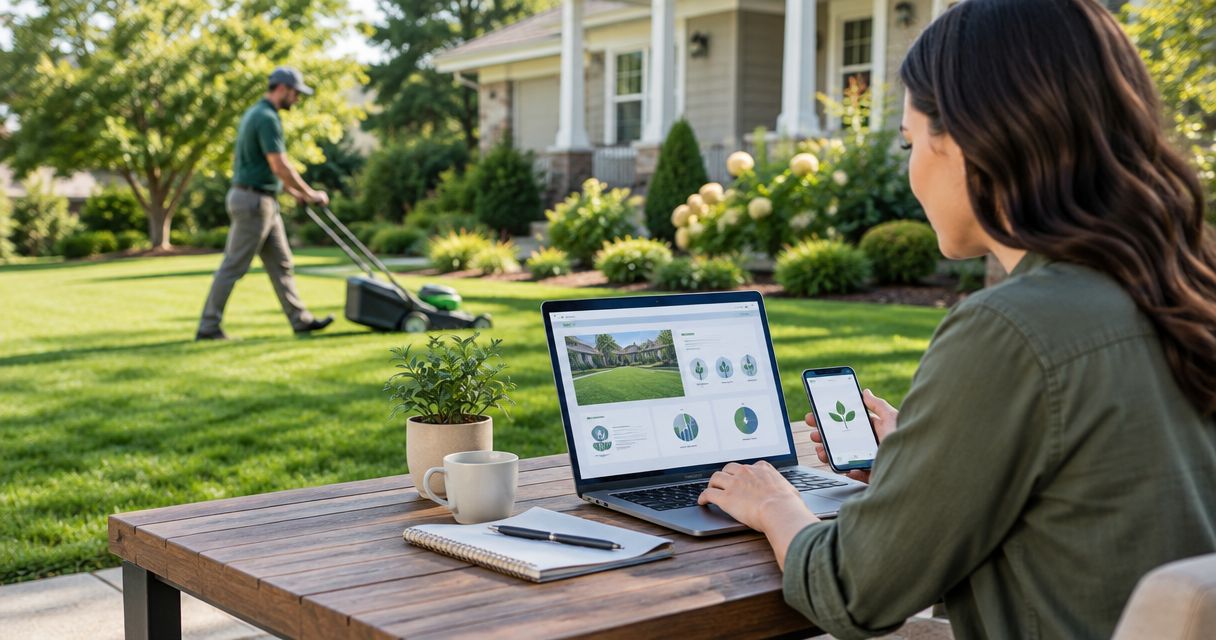
Lawn care marketing for subscription maintenance companies turns one-off mowing calls into monthly recurring accounts, using local search, paid ads, and renewal automation instead of door hangers and truck wraps. This segment runs on a different math than a one-time landscaping job: a $65 mow lead that converts to a 12-month plan is worth far more than a flat-rate cleanup, and every channel decision should be judged against subscription value, not cost per lead. Seasonal demand swings hard too — spring green-up and fall aeration push volume, mid-summer and winter drag it down — so a campaign that ignores the calendar burns budget chasing flat demand curves.
- Lawn care marketing works best when campaigns are built around subscription value, not cost per lead.
- Google Business Profile and Local Services Ads capture the highest-intent 'lawn care near me' searches in 2026.
- Churn kills subscription revenue faster than a slow lead flow — win-back automation matters as much as new-lead ads.
- Roxfire treats lead generation for recurring-service businesses as a retention problem first, an acquisition problem second.
Why lawn care marketing matters for subscription maintenance companies
A lawn care company selling recurring plans is competing on two fronts at once: national franchises with big ad budgets and local operators who undercut on price for a single mow. Search behavior in this category skews hyper-local and immediate — someone typing "lawn care near me" in 2026 wants a quote this week, not a brand story. That means the campaigns that win aren't the prettiest ones; they're the ones that show up fastest with a local address, real reviews, and a way to book without calling.
Subscription economics change what "good marketing" looks like. A one-time landscaping contractor can tolerate a higher cost per lead because the ticket is bigger. A lawn care company selling a monthly plan needs volume, low cost per acquired subscription, and — critically — retention, because a customer who cancels after two cuts erases the acquisition math entirely.
The verdict: lawn care marketing in 2026 is won by the company that treats every lead as the start of a 12-month relationship, not a single transaction, and builds tracking, ads, and follow-up around that assumption.
Update your Google Business Profile for recurring-service search intent
Google Business Profile is where most "lawn care near me" searches land before a website ever gets a click. For subscription companies specifically, the profile needs to signal recurring service, not one-off jobs.
- List service area by zip code or neighborhood, not just city, since lawn care is hyper-local
- Use photos that show recurring visits — mowed lawns with a consistent crew truck in frame, not stock imagery
- Post seasonal updates (spring aeration, fall overseeding) monthly so the profile stays active
- Add plan-style service categories ("lawn maintenance plans," "mowing subscriptions") in the services section
- Respond to every review within 48 hours, especially negative ones about missed visits
Run Google Ads and Local Services Ads for high-intent recurring searches
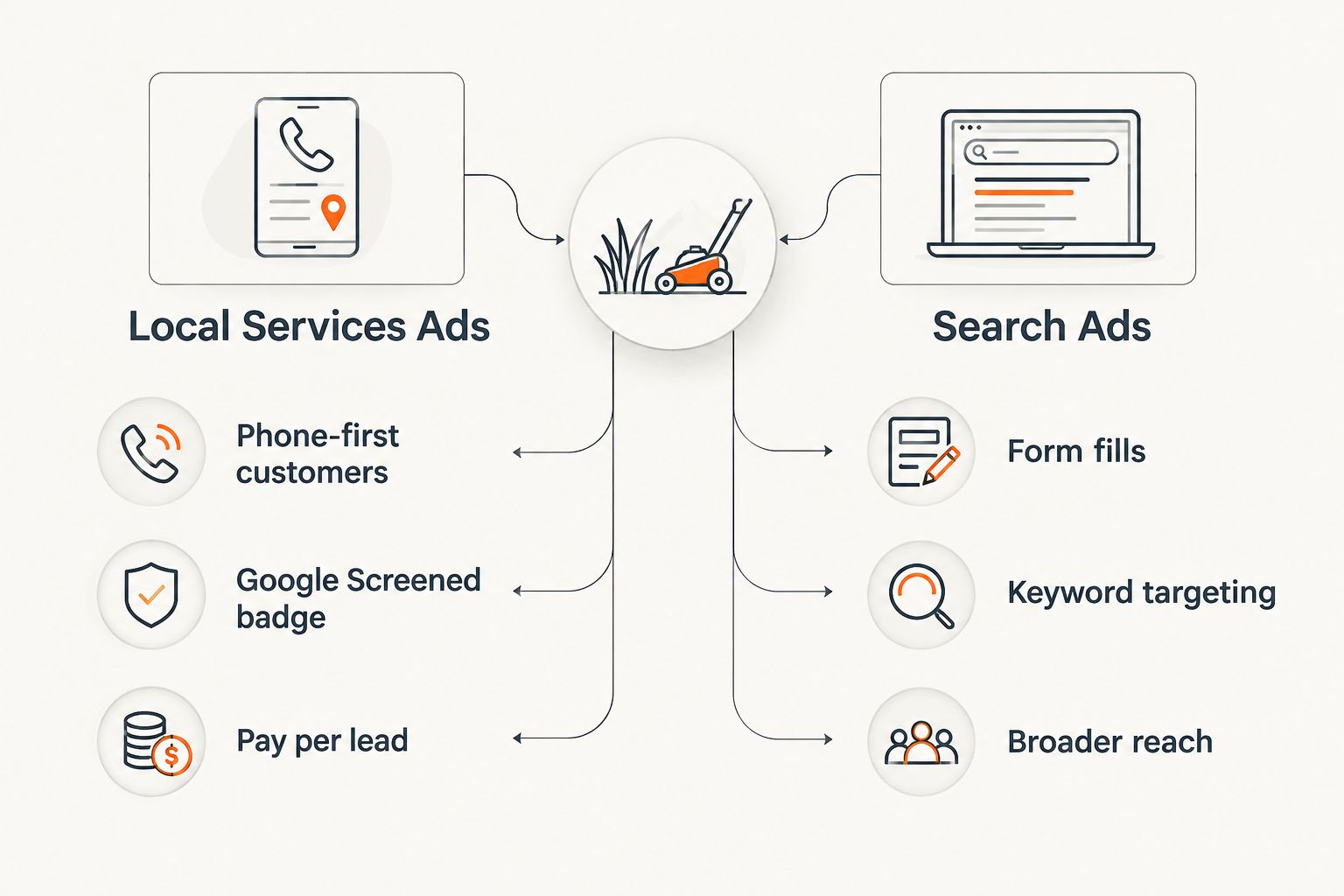
Search ads catch the customer who's already decided to hire someone this month. Local Services Ads (LSAs) work especially well here because they're pay-per-lead and show a Google Screened badge, which matters when competing against a TruGreen-level budget.
- Bid on transactional terms like "lawn mowing service" and "weekly lawn care plan," not broad terms like "landscaping ideas"
- Run LSAs alongside standard search ads — LSAs catch phone-first customers, search ads catch form-fillers
- Write ad copy around plan language ("monthly lawn plans starting this week") instead of one-time service language
- Exclude DIY and equipment-shopping intent keywords ("how to mow a lawn," "best lawn mower") from search campaigns
- Set geo-radius bidding tight — most lawn care companies profit inside a 10-15 mile service radius, not a whole metro
This is the point where a company decides whether to run these campaigns in-house or hand them to a team that already tracks cost per acquired subscription for recurring-service clients. Roxfire builds and manages Google Ads and Local Services Ads specifically for home service businesses running recurring or subscription models, which is a faster path than testing keyword lists and bid strategies from zero.
Use Meta Ads and Nextdoor to build neighborhood density
Lawn care route density matters more than almost any other home service — a crew that mows three lawns on one street costs less per stop than one scattered across town. Neighborhood-targeted social ads build that density directly.
- Run Meta Ads geofenced to specific subdivisions or HOA boundaries, not city-wide radius targeting
- Use before/after photos or short video of an actual mow, not stock lawn imagery
- Test Nextdoor ads in neighborhoods where a competitor already has visible activity — density signals demand
- Offer a referral message in ad copy ("ask your neighbor who mows their lawn") since lawn care spreads by word of mouth on these platforms
- Retarget website visitors who viewed a plans or pricing page but didn't submit a quote request
Set up review generation to compound trust over time
Reviews decide close rate more in lawn care than in almost any other trade, because the buying decision is low-stakes and fast — most homeowners pick from the top three results with the best star rating and skip the rest.
- Automate a review request text or email 24-48 hours after the first completed service
- Ask for photo reviews specifically — a photo of a freshly cut lawn converts better than text alone
- Route unhappy customers to a private feedback form before they post publicly
- Track review velocity by month, not just total count — a profile with 40 reviews from three years ago looks stale next to a competitor adding 10 a month
Automate renewal and win-back campaigns for subscription customers
Acquisition gets the attention, but churn is what actually erodes subscription lawn care revenue. A customer who cancels in month three after a $150 acquisition cost is a loss, not a break-even.
- Set automated renewal reminders 30 days before a seasonal plan (fall cleanup, winterization) ends
- Trigger a win-back email or text 60-90 days after a customer goes inactive, with a specific reason to return (season change, new service added)
- Segment customers by plan tier so a premium subscriber gets different messaging than a basic mow-only customer
- Use CRM automation to flag accounts that missed two consecutive visits — that's an early churn signal, not a scheduling footnote
Track cost per acquired subscription, not cost per lead
Cost per lead is the wrong number for a subscription business, because it treats a one-time cleanup inquiry the same as a signed 12-month plan. Cost per acquired subscription — total spend divided by new recurring accounts, not total leads — is the number that actually predicts profit.
- Set up call tracking that tags calls by service type (one-time vs. recurring plan interest)
- Pipe form submissions and calls into a CRM that marks which leads converted to a plan, not just which leads booked a job
- Review cost per acquired subscription monthly by channel — Google Ads, Meta, LSAs, referral — and shift spend toward whichever channel produces the lowest number
- Separate reporting for spring/fall peak months versus summer/winter slow months so channel performance isn't judged on a flat annual average
Budget for seasonal spend swings
A flat monthly ad budget wastes money in slow months and underfunds peak months. Lawn care demand in most U.S. markets spikes in spring green-up and again around fall cleanup, with a summer plateau and a winter drop-off outside warm climates.
- Increase budget 30-50% in the 6-8 weeks before typical spring green-up in your region
- Shift a portion of summer budget toward retention and upsell campaigns (fertilization, pest control add-ons) instead of new-customer acquisition
- Plan fall campaigns around aeration and overseeding, which have a shorter, more urgent buying window than spring mowing
- Reserve a smaller always-on budget for brand and review-generation ads year-round, even in slow months
Get a lawn care marketing plan built for recurring revenue
Roxfire builds Google Ads, LSAs, and retention campaigns for subscription home service companies.
Comparison: marketing options for lawn care and subscription companies
| Option | Best for | Key limitation |
|---|---|---|
| DIY Google Business Profile + Nextdoor | Very small operators building initial local presence | Slow to scale, no paid reach control |
| Local Services Ads (self-managed) | Companies wanting phone-first, pay-per-lead volume | Requires background check and ongoing profile upkeep |
| Google Ads Search (self-managed) | Companies with in-house time to manage bids and keywords | Steep learning curve; easy to overspend on broad keywords |
| Meta Ads + Nextdoor (self-managed) | Building neighborhood-level route density | Needs constant creative refresh to avoid ad fatigue |
| Agency-managed (e.g. Roxfire) | Subscription companies that want cost-per-acquired-subscription tracking across channels | Requires handing over ad account access and reporting alignment |
The one-sentence verdict: for subscription lawn care companies, self-managed Local Services Ads work fine at low volume, but once a company is running multiple channels and tracking renewal churn, agency-managed lead generation from a team like Roxfire produces cleaner cost-per-acquired-subscription data than juggling four dashboards solo.
Common mistakes lawn care companies make
- Reporting cost per lead instead of cost per acquired subscription — this hides which channel actually produces long-term customers versus one-time cleanup inquiries.
- Running flat ad budgets year-round — spending the same in August as in April ignores the seasonal demand curve every lawn care company faces.
- Competing on price against national franchises in ad copy — a company can't out-discount TruGreen-level budgets, but it can out-local them with faster response and neighborhood proof.
- No win-back sequence for canceled subscribers — most lost accounts never get a re-engagement attempt, which leaves easy revenue on the table.
- Stock photography instead of real crew and lawn photos — homeowners can tell the difference, and it hurts trust signals on both the website and Google Business Profile.
FAQ
What's the best marketing channel for lawn care companies in 2026?
Google Business Profile and Local Services Ads capture the highest-intent local searches for lawn care in 2026 because most customers search "near me" and want a quote fast. Meta Ads and Nextdoor work well as a secondary channel to build neighborhood route density.
How much does lawn care marketing cost?
Costs vary by market, channel mix, and service radius, so check current ad platform bid estimates and any agency's proposal directly rather than relying on a fixed number. Budget should scale with seasonal demand rather than staying flat all year.
Is Google Ads better than Facebook Ads for lawn care companies?
Google Ads and Local Services Ads generally outperform Meta Ads for immediate lawn care demand because search captures people actively looking to hire, while Meta Ads work better for building neighborhood awareness and referral-style word of mouth.
How do subscription lawn care companies reduce customer churn?
Automated renewal reminders 30 days before a seasonal plan ends and win-back campaigns 60-90 days after a customer goes inactive both reduce churn. Tracking missed-visit patterns in a CRM catches early churn signals before a customer cancels outright.
Should lawn care companies use Local Services Ads or standard Google Ads?
Most subscription lawn care companies benefit from running both in 2026: Local Services Ads catch phone-first customers with a Google Screened badge, while standard search ads catch customers who prefer to fill out a form or browse plan pricing first.
How important are online reviews for lawn care marketing?
Reviews heavily influence close rate in lawn care because the buying decision is fast and low-stakes, with most homeowners choosing from the top-rated local results. Review velocity — new reviews per month — matters as much as total star rating.
What is cost per acquired subscription and why does it matter for lawn care?
Cost per acquired subscription is total marketing spend divided by new recurring accounts signed, not total leads generated. It matters because it separates one-time cleanup inquiries from actual recurring revenue, which is the number that predicts long-term profit.
When should lawn care companies increase ad spend?
Most markets see spring green-up and fall aeration as peak demand windows, so increasing spend 6-8 weeks ahead of those periods captures the surge. Summer and winter budgets should shift toward retention and upsell campaigns instead of new-customer acquisition.
One last thing
The lawn care companies that grow fastest in 2026 aren't the ones with the biggest ad budget — they're the ones that stop measuring success by lead count and start measuring it by how many leads turn into a signed plan that renews past month three. Fix the tracking before scaling the spend; scaling a broken funnel just produces more churn faster.