
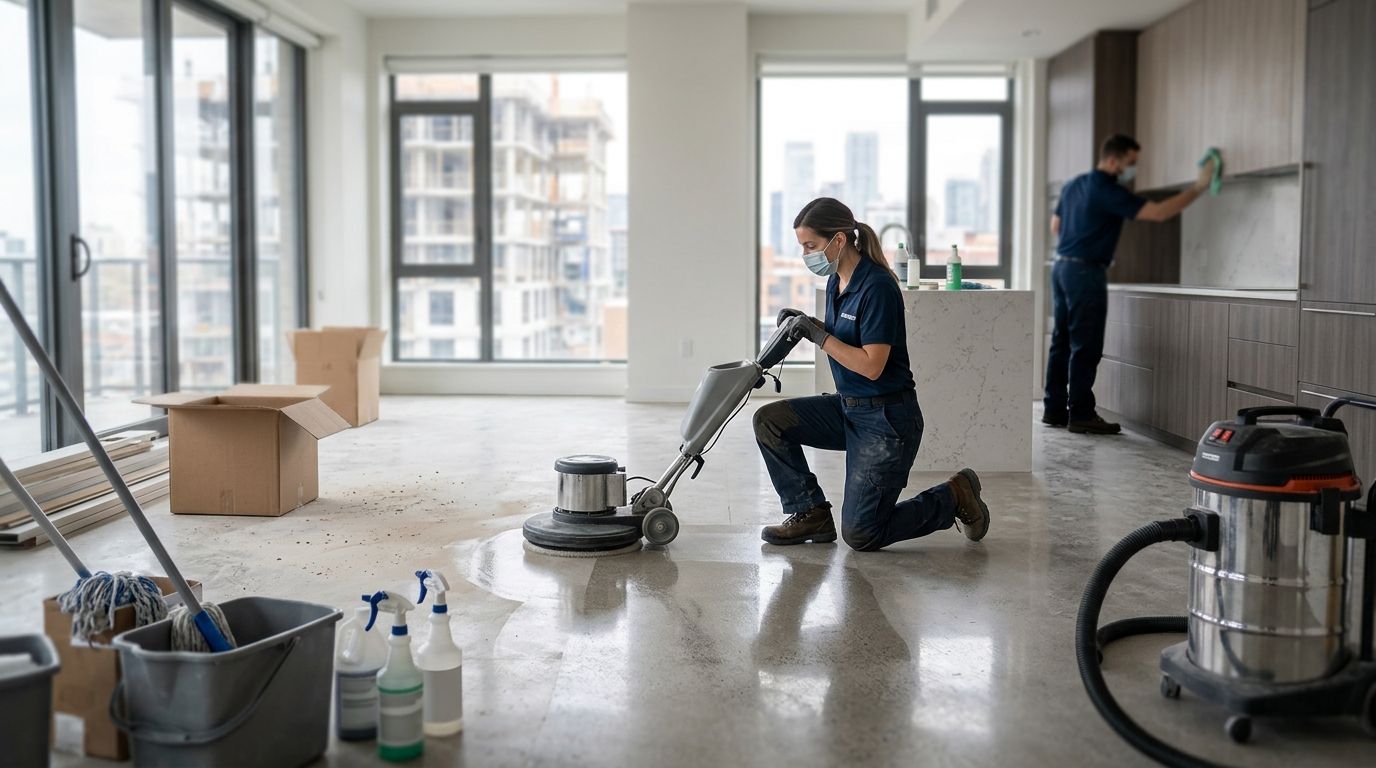
Post-construction cleanup marketing is the set of local SEO, paid search, and referral systems that keep a construction cleanup crew booked with general contractor, builder, and property manager work instead of one-off homeowner jobs. This segment sells to buyers who choose on bid packages, insurance certificates, and repeat trust — not same-day online forms. That changes the keywords you bid on, the photos you publish, and the directories you need to be in.
- Post construction cleanup marketing wins on Google Business Profile optimization and GC referral systems, not broad cleaning keywords.
- Google Ads works for this segment only when residential maid-service traffic is excluded with negative keywords.
- Review volume and recency beat a perfect star rating when a superintendent is scanning results fast.
- Roxfire treats call tracking and speed-to-lead as prerequisites for cleanup accounts, not optional add-ons.
- Local SEO builds the cheap pipeline; paid search fills the slow months between referrals.
Why post-construction cleanup marketing matters for this segment
A construction cleanup crew does not compete on emotion the way a maid service does. A GC is choosing a vendor who will not hold up a certificate of occupancy inspection, and a property manager is choosing a crew that shows up on the exact day the punch list closes. Reliability has to be visible before the phone rings.
That proof lives in three places: your Google Business Profile photos, your review count, and whether you appear in the subcontractor directories a superintendent already has open. Miss all three and you are relying entirely on word of mouth from the two GCs you already know.
Most cleanup companies still market like residential cleaners. Generic profile category, a homepage about "sparkling floors," no commercial landing page, zero presence where GCs actually shortlist subs. That gap is the opportunity in 2026. Roxfire builds these campaigns around the person placing the order — a super, a PM, a developer — and that single shift changes every tactic below.
Update your Google Business Profile for construction searches
GCs search "post construction cleanup near me" or "rough clean" plus a city name from a job site phone, usually inside 48 hours of a walkthrough deadline. Your profile is the first filter they apply.
- Set the primary category to a construction or commercial cleaning option, not generic house cleaning
- Upload photos labeled by job type: rough clean, final clean, post-renovation touch-up
- List every city and county you service, not just your home base
- Use the Q&A section to answer "do you handle debris removal" and "can you turn a job same week"
- Post a project update at least twice a month so the profile reads as active
List your company where GCs actually shortlist subs
A GC rarely starts on Google for a first hire. They check their existing vendor list, then subcontractor platforms and builder association directories. If you are not there, you are invisible to the repeat commercial work that makes this business profitable.
- Claim a vendor profile on Procore and BuildingConnected if the GCs in your market use them
- Join the local Builders Association and Chamber of Commerce vendor directories
- Register on commercial-facing listing sites, not only the residential side of Yelp or Angi
- Ask your three best GC contacts for an introduction to one peer each
- Keep name, address, and phone identical across every listing — mismatches suppress local rankings
Publish photo proof of the job sizes you can handle
Capacity is the question every commercial buyer is silently asking. A 40-unit final clean does not look like a house clean, and a GC will not risk a schedule on a crew whose portfolio shows living rooms.
- Shoot before and after on every commercial job, same angle, same lighting
- Caption each set with unit count or square footage and the turnaround in days
- Show crew size on site — a photo of eight people reads as capacity
- Include one debris haul-off shot; GCs care about disposal as much as cleaning
- Reuse the strongest three sets on your landing page, profile, and directory listings
Turn every signed walkthrough into a review request
A five-star profile with 12 reviews loses to a 4.7-star profile with 80 reviews when someone is comparing vendors between job sites. Volume and recency both signal active work, and in 2026 recency carries more weight in local pack results than a flawless average.
- Text the review link the same day the final walkthrough gets signed off
- Ask the site super or PM by name instead of sending a generic blast
- Reference the project type in your reply so future readers see the work you do
- Respond to negative reviews the same day, with a specific fix, not an apology template
- Track review velocity monthly — a flat month means the ask process broke, not that demand dropped
Set up call tracking and speed-to-lead before you spend on ads
A GC calling three vendors hires whoever answers first. Without tracking numbers you cannot tell which channel produced a booked job, which means every ad decision after that is a guess.
- Assign a unique tracking number to every listing, campaign, and directory profile
- Turn on call recording so you can audit how commercial calls are actually handled
- Route calls to whoever answers fastest, including after hours during heavy build seasons
- Follow the setup in Roxfire's call tracking guide for home service campaigns
- Review recordings monthly and log every missed callback — those are the accounts you lose quietly
Run Google Ads on cleanup-specific terms only
Broad match on "cleaning services" delivers homeowners looking for weekly maid service. That traffic converts into phone calls you cannot profitably serve, which is how cleanup companies conclude paid search does not work when the targeting was the problem.
- Bid exact and phrase match on "post construction cleanup," "rough clean contractor," and "final clean before closing"
- Add negatives for maid, housekeeper, apartment cleaning, move-out cleaning, and carpet shampoo
- Name the buyer in the headline — "For GCs and developers" outperforms "sparkling clean homes"
- Send clicks to a commercial landing page with project photos and a quote request form, never a residential booking widget
- Hold the 2026 budget for a full 90 days before judging cost per lead; commercial sales cycles are longer than residential
Build local SEO pages by service area and job type
Organic search produces the cheapest long-term leads in this segment because it compounds. One homepage cannot rank for eight cities and three job types.
- Build a page per major service area with real local detail, not a swapped city name
- Separate pages for rough clean, final clean, and post-renovation touch-up
- Prioritize which pages to build first using Roxfire's local SEO guide for cleaning companies
- Link every service-area page to the matching Google Business Profile listing
- Refresh each page at least twice a year — stale service pages slip out of the local pack
Fill your cleanup crew's calendar
Talk through a 2026 plan built for GC and builder work, not homeowner leads.
Build a referral log and work it every month
Repeat commercial revenue concentrates fast. Most cleanup companies discover two or three GC accounts produce the majority of their booked jobs, and nobody tracks it until the spreadsheet exists.
- Log every job with the GC name, contact, project type, and how the lead arrived
- Sort by revenue quarterly and identify your top three referrers
- Call anyone who has gone 60 days without sending work
- Ask your top referrers for one introduction per quarter, not a general favor
- Send a thank-you that costs something real — lunch for the site crew lands better than a card
Channel comparison for post-construction cleanup companies
| Option | Best for | Key limitation |
|---|---|---|
| Google Business Profile + local SEO | Cheapest long-term commercial leads | Takes months to build authority in a new market |
| Google Ads (search) | Filling gaps between GC referrals within weeks | Wasted spend without tight residential negative keywords |
| Subcontractor platforms (Procore, BuildingConnected) | Landing on a GC's vendor shortlist | Slow to populate and needs ongoing maintenance |
| Direct GC referral relationships | Repeat contracts and multi-phase builds | Does not scale without a tracked referral system |
| Meta and social ads | Awareness with property managers and small builders | Weak for time-sensitive, high-intent cleanup requests |
Verdict: Google Business Profile optimization paired with a tracked GC referral log wins post construction cleanup marketing in 2026 — Google Ads is the fast supplement, not the foundation.
“If a superintendent cannot see a 40-unit final clean in your photos, your capacity does not exist as far as the bid is concerned.”
Common mistakes post-construction cleanup companies make
- Marketing to homeowners by accident. Broad cleaning keywords and residential ad copy pull in inquiries a construction crew cannot profitably serve, then the ad account gets blamed.
- No photo proof of job size. Portfolios full of interiors read as a residential cleaner pretending to do commercial work.
- No record of which GC sent which job. Without a log you cannot reward top referrers or notice the moment one stops calling.
- Slow response on commercial calls. A GC comparing three vendors hires the first answer — a missed call in this segment loses an account, not a lead.
- Treating reviews as optional. A thin review profile reads as inexperience to a buyer deciding in under two minutes.
FAQ
What is post construction cleanup marketing?
Post construction cleanup marketing is the combination of local SEO, Google Ads, and referral systems used to generate GC, builder, and property manager leads for a cleanup crew. It differs from residential cleaning marketing because the buyer is a commercial decision maker working to a construction schedule.
Is Google Ads worth it for post construction cleanup companies?
Yes, but only with negative keywords blocking residential terms like maid, housekeeper, and move-out cleaning. Without those exclusions the budget goes to homeowner clicks a construction crew cannot serve profitably.
How do post construction cleanup companies get GC referrals?
Referrals come from relationships built job by job and tracked in a log so top referrers get rewarded and quiet accounts get a follow-up call. Asking a strong contact for one specific introduction per quarter works better than a general request.
Do online reviews matter for commercial cleanup accounts?
Yes, review volume and recency signal active, reliable work to a superintendent scanning search results fast. A profile with 80 recent reviews outperforms a perfect score backed by only a dozen.
Should cleanup companies list on subcontractor directories?
Yes, platforms like Procore and BuildingConnected reach GCs who are actively building a vendor shortlist. They take longer to populate than a Google listing but the buyer there is already ready to hire.
How is this different from residential cleaning marketing?
Post construction cleanup marketing targets GCs, developers, and property managers who buy on bids, insurance certificates, and schedule reliability. Keywords, ad copy, photos, and directory strategy all shift toward proving commercial capacity.
What is the fastest way to get post construction cleanup leads in 2026?
A cleanup-specific Google Ads campaign with tight negatives produces leads within weeks. Local SEO and GC relationships then build the durable, lower-cost pipeline over the following months.
How long before local SEO produces commercial cleanup leads?
Local SEO for this segment builds over months rather than weeks, since service-area pages and review velocity both need time to register. Paid search is the bridge that covers the calendar while it builds.
One last thing
Most cleanup companies fix the Google Business Profile, stop there, and wonder why the phone still trickles. The bigger 2026 unlock is unglamorous: a referral log in a spreadsheet. Once you can see that two or three GC accounts drive most of your booked revenue, the highest-return marketing action every month is calling those two or three people first — before any ad budget moves.