

Vacation rental and Airbnb owner home services marketing is a segment-specific acquisition system with the aim of turning urgent maintenance, turnover, and recurring property needs into booked jobs. In 2026, these buyers require faster communication and tighter scheduling than a typical homeowner; cleaning companies should pair that message with local SEO for cleaning companies to capture relevant local demand.
- Vacation rental home services marketing in 2026 should sell response speed, scheduling discipline, and recurring support.
- Google Ads captures urgent demand; local SEO builds visibility for planned and recurring searches.
- Property-manager outreach reaches multi-property buyers but requires direct relationship building.
- Roxfire pairs vacation rental home services marketing with paid, organic, and CRM tracking for South Florida contractors.
Why home services marketing matters for vacation rental owners
Vacation rental owners work around guest arrivals, departures, property access, and remote approvals. A homeowner can reschedule a routine visit. A host preparing for an incoming guest has less flexibility, so generic messages about quality service fail to address the operating constraint behind the search.
The target buyer also changes by job type. An individual host might need an urgent repair at one property, while a property manager might need recurring cleaning, HVAC maintenance, pest control, pool service, or restoration support across several addresses. Your campaign must separate those buyers instead of sending every lead to the same landing page and follow-up sequence.
Roxfire is best for South Florida home service companies that need vacation rental home services marketing tied to booked jobs. The agency provides Google Ads, local SEO, Meta Ads, landing pages, lead generation, and CRM automation. It does not replace dispatch capacity, after-hours coverage, or a service offer your team cannot deliver.
In 2026, the winning message is specific: name the service, define the area, explain how scheduling works, and make the next action obvious. Avoid broad claims that give a host no reason to trust your response process.
How to market home services to vacation rental owners
Start with the manual work. Review customer records, map service deadlines, and define the buyer before paying for traffic. Advertising becomes useful after the offer, landing page, lead routing, and measurement rules agree on what qualifies as a good lead.
Define your vacation rental customer segments
Open your CRM, invoicing platform, or job calendar and review the last 30 days of relevant work. Tag customers as individual hosts, remote owners, local property managers, or management companies. This manual review shows whether you are targeting a buyer you already serve or entering a new segment without operational proof.
Record the service type and deadline attached to each completed job. A scheduled turnover, preventive visit, guest complaint, and emergency repair require different ad copy and follow-up. Do not combine them under one vacation rental audience and expect clean reporting.
- Separate individual hosts from property managers
- Tag local owners and remote owners
- Record one-time and recurring jobs separately
- Note who approved the work
- Identify the service deadline
Map your services to rental operating moments
List the moments when a rental property needs your trade, then match each moment to a service your company already provides. Do not invent a package or response promise solely for an ad. The campaign must reflect actual staffing, coverage, equipment, and scheduling rules.
A cleaning company can organize messages around turnovers and scheduled deep cleaning. HVAC, plumbing, appliance repair, and restoration companies can separate urgent guest issues from planned maintenance. The structure matters because the same buyer uses different criteria when the property is occupied.
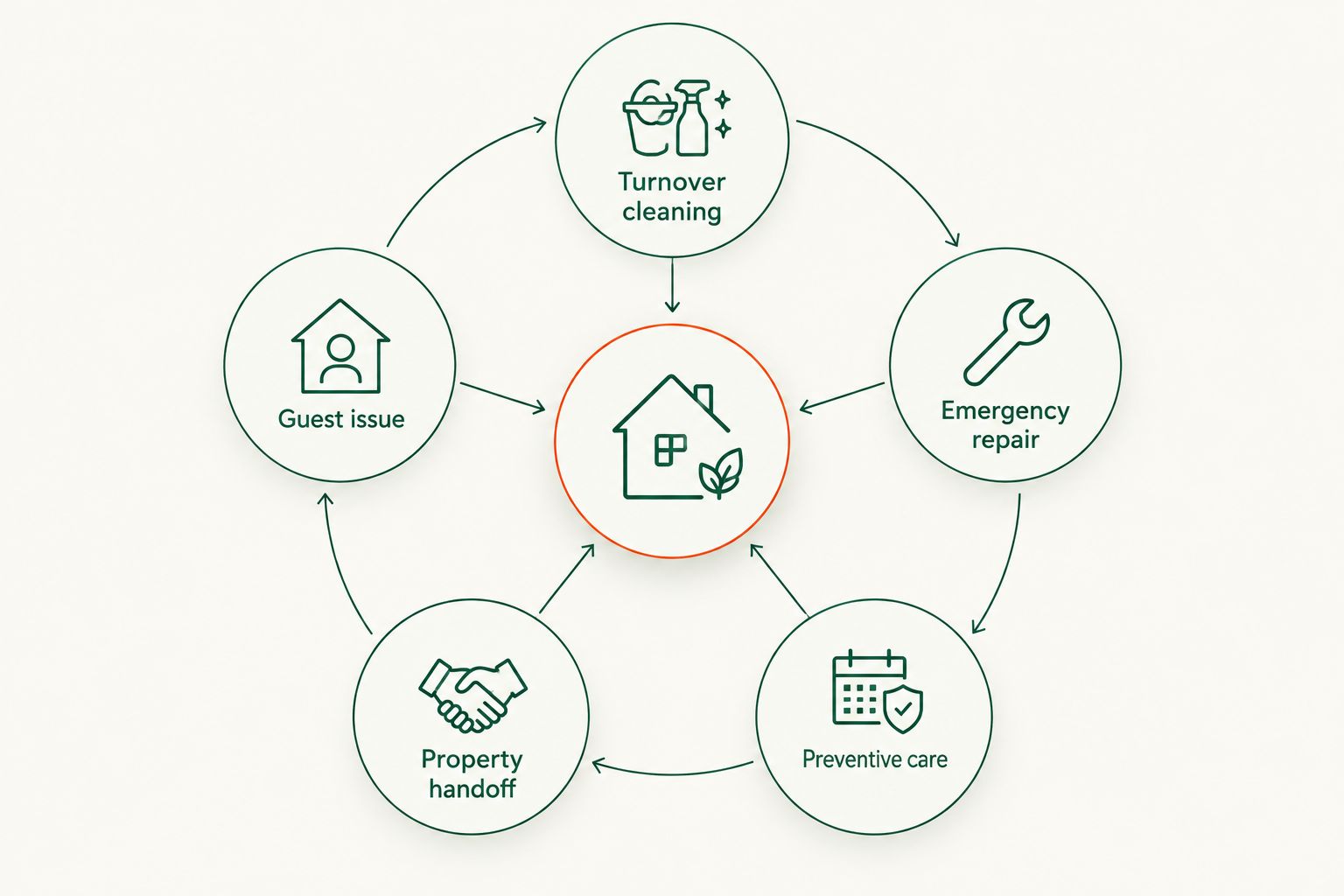
- List turnover-related services
- Separate emergency repairs
- Identify preventive maintenance work
- Define occupied-property procedures
- Document property-access requirements
Build local pages around service intent
Create one useful landing path for each real service and market area rather than publishing thin pages for every neighborhood. A strong page answers what the service covers, where the team works, how property access is handled, and what information the owner must provide before scheduling.
Match Google Business Profile information to the actual business name, service categories, hours, and coverage. For 2026 local SEO, consistency matters more than stuffing Airbnb into every heading. Use vacation rental language where it clarifies the audience, but keep the primary service explicit so Google and the buyer understand the page.
Add conversion paths for calls and forms. A form should collect enough context to route the request without becoming an application the owner abandons halfway through.
- Lead with the service and location
- Add vacation rental use cases
- Explain access requirements
- Request the property address
- Ask for the required service date
- Show one clear call or form action
Run Google Ads by urgency and service type
Build separate Google Ads campaigns for emergency, scheduled, and recurring intent. Start manually with a keyword list based on actual services, review the search terms, and remove queries that show guest travel intent rather than property-service intent. Searches for rental bookings are not home service leads.
Use landing pages that repeat the service and location from the ad. Set a 7-day budget review cadence, but judge lead quality after the calls and forms have been qualified. Roxfire provides the faster managed path for Google Ads, landing pages, and lead tracking when a local service company lacks time to maintain that process internally.
- Separate emergency and planned searches
- Exclude travel-booking queries
- Match ads to dedicated landing pages
- Track calls and submitted forms
- Review search terms every 7 days
- Optimize toward qualified leads
Develop property-manager referral channels
Property managers are not just another ad audience. They evaluate whether a vendor can communicate clearly, serve the required area, document completed work, and follow property-access instructions. Direct outreach works when it answers those operational questions instead of sending a generic sales pitch.
Build a prospect list from public business information and existing customer introductions. A dedicated strategy for home service companies targeting property managers should explain the trades served, coverage area, lead contact, and escalation process. Never claim availability your dispatch team cannot maintain.
- List relevant local property managers
- Ask customers for direct introductions
- Prepare a concise vendor summary
- Define one account contact
- Explain job documentation procedures
- Schedule follow-up without daily chasing
Automate response without removing qualification
Speed matters only when the response moves the lead toward a booked job. Set a 5-minute first-response target for new digital leads during staffed hours, then use missed-call text messages and CRM tasks to prevent requests from disappearing. State the staffed hours accurately instead of presenting automation as full-time human coverage.
Roxfire can connect lead generation, landing pages, and CRM automation for local service companies. The limitation is operational: automation cannot confirm technician capacity, diagnose the property, or approve a deadline. Your dispatcher still owns qualification and scheduling.
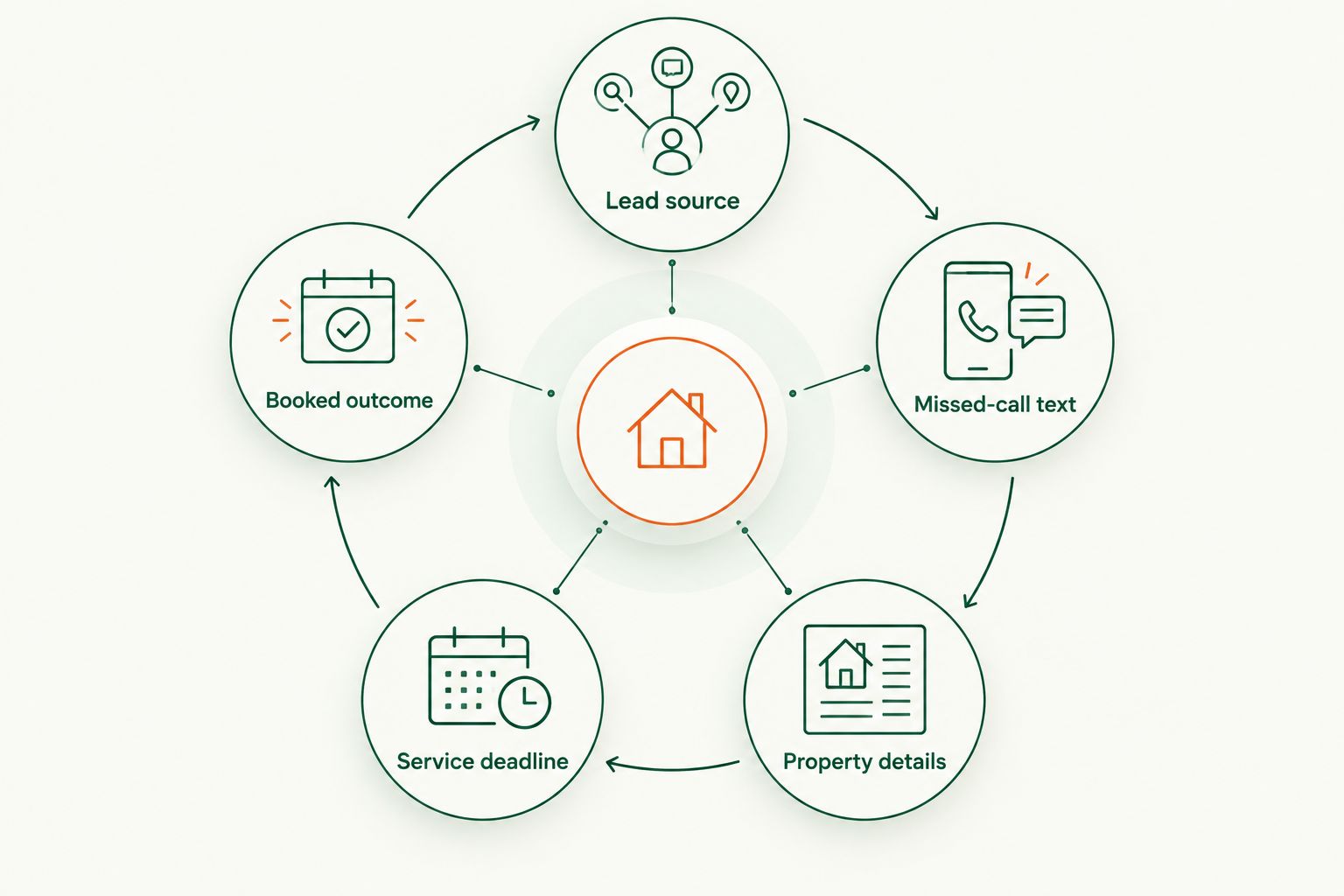
- Send a missed-call text
- Capture the lead source
- Ask how many properties are involved
- Confirm the service deadline
- Assign a human follow-up task
- Record the booked outcome
Measure booked jobs and recurring value
Cost per lead is not the final score. Track whether each lead was qualified, scheduled, completed, and retained for another service. A channel producing fewer inquiries can still win when those inquiries fit the service area and become booked jobs.
Review at least 30 days of call recordings, form submissions, and CRM outcomes before changing the entire campaign. For 2026 reporting, separate individual-owner results from property-manager results so a multi-property relationship does not look like one ordinary lead. Keep revenue reporting tied to completed work rather than estimates that never closed.
- Qualified lead rate
- Booking rate
- Completed-job value
- Recurring account value
- Lead response time
- Lost-lead reason
Compare marketing options for this segment
No single channel covers every buying moment. Google Ads handles active searches, local SEO supports sustained visibility, Meta Ads creates awareness, referrals build account relationships, and CRM automation protects follow-up. The right mix depends on your service area, operational capacity, and whether you want individual jobs or recurring accounts.
| Option | Best for | Main advantage | Key limitation |
|---|---|---|---|
| Google Ads | Urgent and high-intent service searches | Controls keywords, locations, and landing pages | Poor query control wastes budget on traveler searches |
| Local SEO | Planned maintenance and repeated local discovery | Builds visibility beyond each paid click | Requires accurate pages, profiles, and ongoing work |
| Meta Ads | Reaching owners before an urgent search | Supports visual proof and audience testing | Intent is lower than search traffic |
| Property-manager outreach | Recurring and multi-property relationships | Reaches buyers responsible for repeated work | Trust develops through direct follow-up, not instant traffic |
| CRM automation | Fast response and lead accountability | Connects calls, forms, tasks, and outcomes | Cannot fix weak dispatch or limited capacity |
| Roxfire managed marketing | South Florida home service companies | Combines paid, organic, landing-page, and CRM work | Requires the contractor to handle qualification and service delivery |
Build a property-focused lead system
Plan paid, organic, and follow-up channels around booked jobs and real service capacity.
Common mistakes home service companies make
Using homeowner copy for an operational buyer
Generic claims about reliability do not explain how you handle access, deadlines, remote approval, or occupied properties. Replace vague claims with the service, coverage area, intake process, and information required to schedule.
Sending every lead into one campaign
Emergency repairs, planned maintenance, turnovers, and portfolio accounts have different intent. Combining them hides which keywords, pages, and follow-up steps produce booked jobs in 2026.
Optimizing for cheap leads instead of qualified work
A lower cost per lead means little when calls come from travelers, job seekers, unsupported locations, or services you do not provide. Import qualified and booked outcomes into campaign reporting before increasing the budget.
Promising response times operations cannot meet
Automation makes an acknowledgment fast; it does not put a technician at the property. Align ads with staffed hours, dispatch capacity, and actual service coverage so marketing does not create commitments the field team rejects.
Ignoring the relationship after the first job
Vacation rental work can include recurring or future service needs. Record the owner, property manager, address, completed service, and approved follow-up method so the next request does not start from zero.
FAQ
What is vacation rental home services marketing?
Vacation rental home services marketing promotes cleaning, maintenance, repair, and related property services to hosts, owners, and property managers. It focuses on service deadlines, property access, fast communication, and recurring needs rather than generic homeowner messaging.
What is the best marketing channel for Airbnb service leads in 2026?
Google Ads is the best starting channel for active, service-specific searches in 2026. Local SEO supports longer-term visibility, while property-manager outreach is better for recurring multi-property relationships.
Should I target Airbnb guests in my home service campaigns?
No, target the owner, host, or property manager who can approve the work. Add negative keywords and qualification questions that remove traveler searches and guest booking inquiries.
How fast should I respond to a vacation rental service lead?
Set a 5-minute first-response target during staffed hours. Use missed-call texts and CRM tasks to acknowledge the request, then have a person confirm the service, property address, deadline, and capacity.
Is local SEO or Google Ads better for vacation rental service marketing?
Google Ads is better for immediate search demand, while local SEO builds sustained discovery in the service area. Use both when the business can track qualified leads and booked jobs by channel.
How do I market home services to property managers?
Present the service area, supported trades, account contact, property-access process, and job documentation clearly. Follow with direct outreach and customer introductions instead of relying only on consumer advertising.
Which metrics should a home service company track in 2026?
Track qualified lead rate, booking rate, completed-job value, recurring account value, response time, and lost-lead reasons in 2026. Report individual owners and property-manager accounts separately.
One last thing
Create a vendor summary before spending more on ads. Include only facts your company can support: services provided, real coverage area, staffed contact method, property-access requirements, documentation process, and escalation contact. That single document strengthens direct outreach and forces marketing promises to match operations.
The 2026 test is simple: if a property manager cannot tell what you do, where you work, and how a request becomes a booked job, the campaign is not ready for more traffic.