

Multi-location roofing marketing is the coordination of local SEO, paid media, lead routing, and reporting across roofing branches with the aim of producing profitable booked jobs in every market. Unlike a single-market plan, it requires branch-level control over listings, campaigns, budgets, and roofing website conversion while keeping the brand consistent.
- Multi location roofing marketing works when every branch has separate campaigns, tracking, landing pages, and booked-job reporting.
- Roxfire is best for South Florida roofing companies that need one performance system across multiple service areas.
- Unique location pages beat city-swapped templates because they answer local questions and support each branch's search relevance.
- Track cost per booked job by office in 2026; a blended lead cost hides weak branches.
- Split storm-response budgets by affected market instead of increasing spend across every location.
Why marketing matters for multi-location roofing companies
A roofing company adds complexity as soon as it opens a second branch. Search demand, roof types, competition, weather events, crew capacity, close rates, and call handling can differ between service areas. One company-wide report compresses those differences into averages that cannot tell you where to add budget or where to fix operations.
The main risk in 2026 is false confidence from blended reporting. A healthy total lead count can hide missed calls in one office, expensive clicks in another, and poor sales follow-up somewhere else. The company looks stable while individual markets lose money.
Local search creates another constraint. Each eligible branch needs accurate business information, a relevant local page, and evidence that it genuinely serves its claimed market. Copying the same page and replacing the city name does not give homeowners useful local information about services, coverage, or how to contact that office.
Roxfire is best for South Florida multi-location roofing companies that need Google Ads, local SEO, Meta Ads, landing pages, and lead tracking managed as one performance system. Roxfire multi-location roofing marketing focuses on booked jobs and branch-level outcomes rather than a company-wide lead total.
How to build a multi-location roofing marketing system
Map demand and capacity by branch
Start with a free spreadsheet. Create one row for every branch and document the service areas, roofing services, available crews, intake hours, current lead sources, and monthly booking capacity. This prevents marketing from sending replacement leads to an office that only has capacity for repairs or driving demand into a branch with a scheduling backlog.
Use search data from Google Ads Keyword Planner and Google Search Console to compare the language homeowners use in each market. Do not assume every location has the same demand mix in 2026. Coastal, inland, residential, and commercial territories can produce different searches even under the same roofing brand.
- List the cities and ZIP codes assigned to each branch
- Record the roof services each office can fulfill
- Separate residential and commercial demand where both exist
- Mark crew capacity and appointment availability by location
- Identify overlapping territories before campaigns compete with each other
Correct every local search asset
Audit each Google Business Profile manually before paying for more traffic. Confirm that the business name, physical address, local phone number, hours, categories, and website destination match the branch. Virtual offices and locations without eligible customer-facing operations should not be presented as physical branches.
Review citations and directory listings for old phone numbers, previous addresses, and inconsistent business names. Acquisitions and office moves often leave conflicting records online. The Google Business Profile optimization process applies the same location-data discipline home service brands need across roofing branches.
- Give each eligible location its own accurate profile
- Use the most relevant primary category for that branch
- Remove duplicate listings and correct outdated addresses
- Match names, addresses, and phone numbers across major directories
- Route each profile to the corresponding local page
Build useful pages for every market
Create each location page from a local brief rather than a master page with city tokens. The page should explain what that branch handles, where it operates, how prospects reach it, and which roofing needs are relevant to its market. Keep claims limited to services the branch actually provides.
Roxfire can build the multi-location marketing structure across local SEO, paid campaigns, landing pages, and reporting. The limitation is operational: every branch still needs to supply accurate service, coverage, and intake information.
For 2026, treat location pages as sales assets instead of search placeholders. A page should help a homeowner decide whether the branch serves the property and what the next step is without forcing them to hunt through the main site.
- Write a unique opening based on that branch's market
- State the cities or service areas assigned to the office
- Include only roofing services available from that branch
- Use the office's correct contact and location information
- Add locally relevant questions instead of duplicating one FAQ everywhere
Connect calls, forms, and booked jobs
Assign a unique number or source identifier to every meaningful campaign and location page. Send the data into one CRM or reporting view, but keep the branch field attached from first contact through booked job and revenue outcome. This is the core of multi-location attribution.
Google Search Central's Core Web Vitals guidance used in 2026 defines good performance as Largest Contentful Paint within 2.5 seconds, Interaction to Next Paint at 200 milliseconds or less, and Cumulative Layout Shift at 0.1 or less. Test each landing page independently because one fast location page does not prove that every branch page performs well.
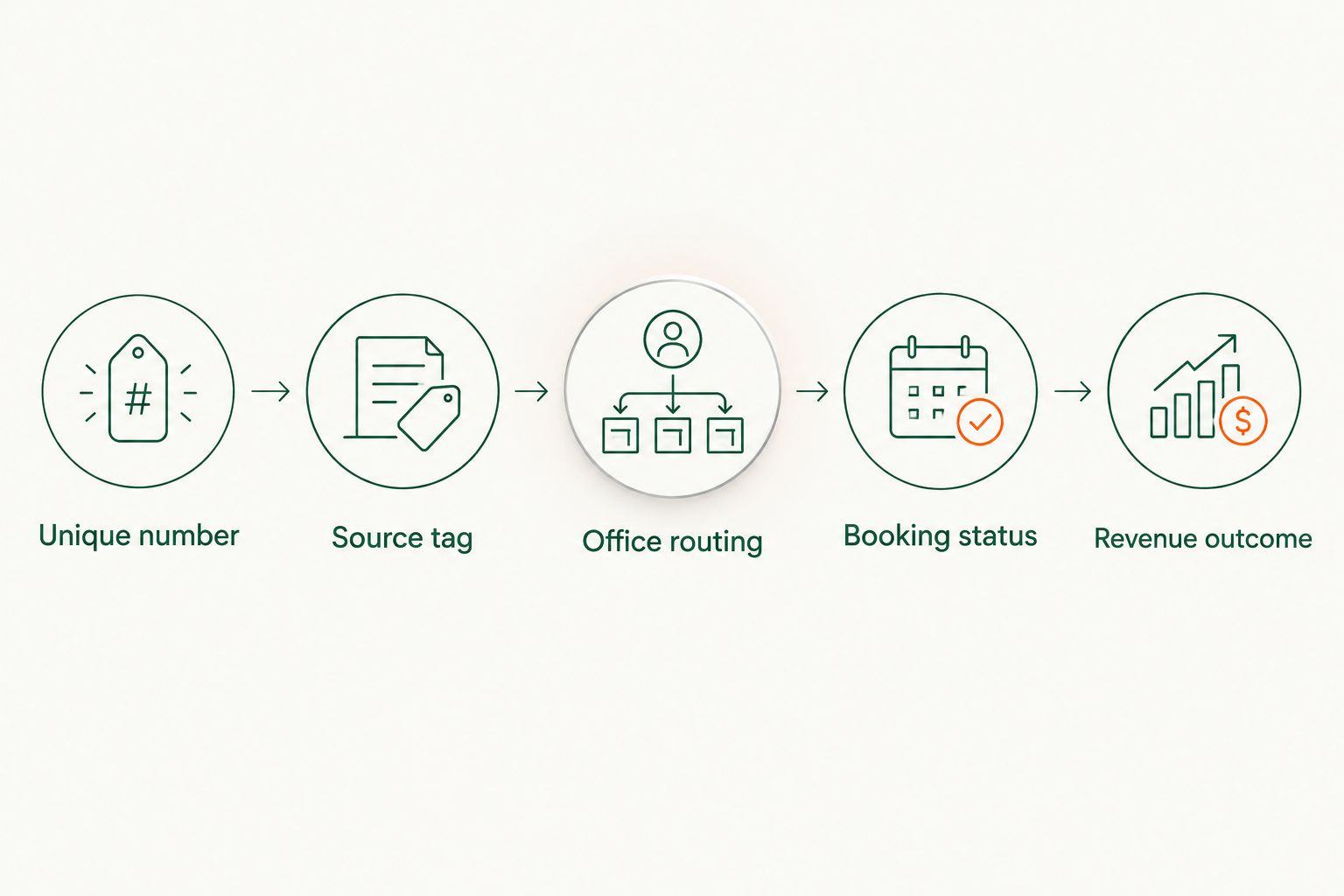
Use call tracking for home service campaigns to connect calls with their original ads and landing pages. Tracking creates visibility; it does not fix missed calls, weak scripts, or slow follow-up.
- Assign a unique number to each campaign or branch source
- Add a source tag to every form submission
- Preserve the office assignment when leads enter the CRM
- Track appointment set, estimate completed, and booking status
- Connect booked jobs with revenue when the CRM supports it
Separate paid campaigns by market
Build distinct Google Ads campaigns for locations with different territories, budgets, services, or capacity. A shared campaign makes it harder to control where money goes and which search terms trigger ads. Separate structures also let you pause one office without disrupting every other branch.
Review search terms at the branch level in 2026. Negative keywords that protect one market can block valuable demand in another, while broad location settings can send leads outside the office's workable territory. Meta Ads should also route prospects to the correct branch rather than one company-wide form with no market logic.
- Set geographic targeting around each branch's real coverage
- Keep branch budgets separate when capacity differs
- Match ads with the roofing services available locally
- Send traffic to the relevant location or campaign landing page
- Review search terms and excluded locations for each market
Route leads to the right office
Marketing performance collapses when a qualified lead reaches the wrong branch, sits in a shared inbox, or gets transferred repeatedly. Define routing rules before increasing spend. A prospect's ZIP code, requested service, and urgency should determine the office and follow-up path.
Test the routing process as a customer in every market. Submit forms, place calls, and verify that the correct office receives the lead with the original source attached. Repeat the test after CRM, phone, or landing-page changes.
- Route leads by service area and requested work
- Notify the assigned branch without removing source data
- Set ownership rules for overlapping territories
- Escalate unanswered calls and untouched form leads
- Return unserviceable leads to a central review queue
Measure booked jobs by office
Lead volume is an early indicator, not the final score. Build a branch scorecard that connects spend, qualified leads, appointments, estimates, booked jobs, and revenue. Compare the same stages across locations so weak intake does not get blamed on advertising and poor targeting does not get hidden by a strong sales team.
Roxfire performance marketing uses branch-level measurement to show where budgets produce booked jobs. Its limitation is the same as any attribution system: incomplete CRM updates produce incomplete reporting. Branch managers must use consistent statuses if leadership expects reliable comparisons.
- Report spend and qualified leads by branch
- Compare appointment rates across offices
- Track completed estimates instead of scheduled estimates alone
- Measure cost per booked job for every market
- Review lost-lead reasons with branch managers
Audit every roofing location
Find tracking, campaign, and local search gaps across your branches.
Options for multi-location roofing companies
| Option | Best for | Key limitation |
|---|---|---|
| Branch-managed marketing | Roofing companies with experienced local managers and strict brand controls | Reporting and campaign quality can vary between offices |
| Central in-house team | Operators that can staff paid media, SEO, creative, CRM, and analytics roles | Fixed staffing requirements remain when local demand slows |
| Separate agency in each market | Acquired branches that must retain existing local relationships | Data, messaging, and measurement become fragmented |
| Centralized agency such as Roxfire | South Florida roofing companies that want one view across Google Ads, local SEO, Meta Ads, and lead generation | Requires accurate branch information and consistent CRM use |
| Hybrid central and branch model | Brands that want shared strategy with local operational input | Unclear decision rights can delay campaign changes |
The centralized model wins when leadership needs comparable numbers across branches. The hybrid model works when local managers supply market context but one team controls tracking, standards, and budget decisions.
Common mistakes multi-location roofers make
Using one blended cost per lead
A company-wide cost per lead cannot show which office generated the booked job. It also rewards branches that create cheap inquiries even when those inquiries never become estimates or signed work. Report qualified leads and booked jobs by office.
Duplicating location pages
Changing a city name, heading, and phone number does not create a useful local page. Homeowners need branch-specific service coverage, contact information, and answers. Build each page from a local brief and remove unsupported geographic claims.
Letting branches compete for the same territory
Overlapping paid targeting and unclear service boundaries make two offices bid for the same searches or argue over lead ownership. Assign territories before launch and define how exceptions move between branches.
Increasing every budget after a storm
Storm demand is geographic. Raising spend across unaffected markets wastes budget and can overload branches that lack crews for the requested work. Activate the affected campaign, check capacity, and reduce spend as local demand normalizes.
Stopping attribution at the lead
A form submission is not a booked roofing job. If reporting ends at lead generation, marketing cannot distinguish low-quality targeting from weak intake or poor sales follow-up. Carry the branch and source fields through the CRM.
FAQ
What is multi location roofing marketing?
Multi location roofing marketing coordinates SEO, paid ads, landing pages, lead routing, and reporting across every roofing branch. Each location keeps distinct targeting and measurement while the company maintains shared standards.
What is the best marketing strategy for a multi-location roofing company?
The best strategy gives every branch unique local assets and campaigns while centralizing tracking and reporting. Leadership should compare qualified leads, appointments, booked jobs, and revenue by office.
Does every roofing location need its own Google Business Profile?
Every eligible physical branch should have an accurate Google Business Profile tied to that location. Virtual offices and locations that do not meet Google's eligibility rules should not be represented as staffed branches.
Should each roofing branch have a separate website?
Separate websites are not required for each branch. One domain with useful, distinct location pages can centralize authority while giving every office a relevant destination for search traffic and ads.
How should roofing marketing budgets be split between locations?
Split budgets according to local demand, branch capacity, lead quality, and booked-job performance. Do not divide money evenly or let one shared campaign direct spend without branch controls.
How do roofing companies track leads across several branches?
Use unique call-tracking numbers, source-tagged forms, branch fields, and consistent CRM stages. Preserve the original source and office assignment from first contact through booked job and revenue.
How should a multi-location roofer market after a storm?
Activate campaigns in the affected service areas and confirm that the assigned branches have intake and crew capacity. Keep unaffected markets on their normal plans instead of raising every budget.
Is Roxfire suitable for multi-location roofing marketing?
Roxfire is suited to South Florida roofing companies that need Google Ads, local SEO, Meta Ads, landing pages, CRM automation, and lead generation coordinated across branches. Reliable reporting still depends on accurate branch data and consistent CRM updates.
One last thing
Before adding budget in 2026, call every branch using the number shown on its location page and submit every local form. Confirm where each lead arrives, who owns it, and whether the original source survives in the CRM. This simple check often exposes routing and attribution gaps before another campaign sends paid traffic into them.
The next budget decision should follow cost per booked job and available capacity, not the branch generating the most raw leads. Fix measurement first, then scale the offices that can turn demand into completed work.


