
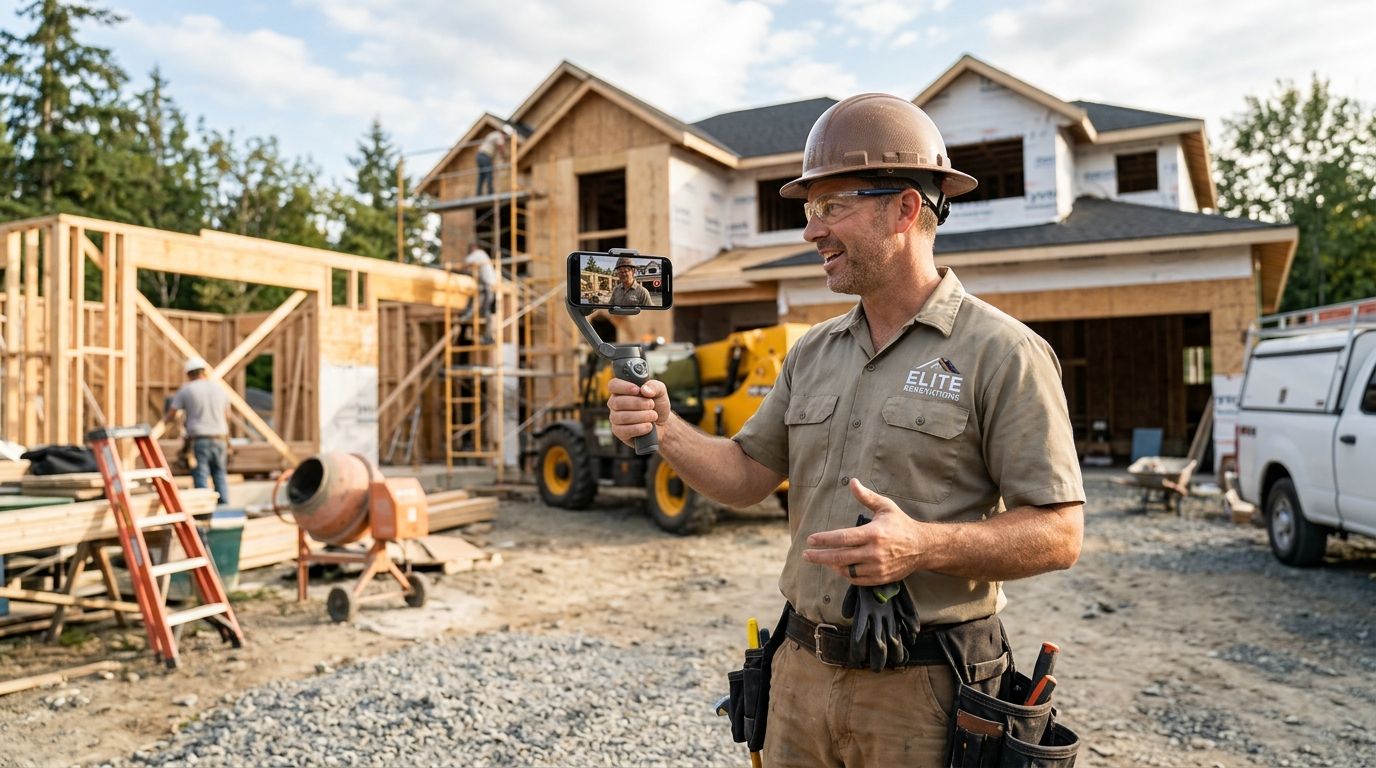
Video marketing for contractors is the practice of filming job walkthroughs, before-and-after footage, and customer testimonials to close bigger jobs and beat competitors who show up with nothing but a business card. Contractors sell projects that cost thousands of dollars sight unseen, and homeowners scrolling on a phone at 9pm want proof the work actually happened before they'll pick up the phone.
- Video marketing for contractors works best tied to a Google Business Profile, a tracked landing page, and paid social — not a standalone YouTube channel.
- Before-and-after job footage and same-day testimonials convert higher than polished commercial-style spots for roofing, remodeling, and HVAC leads.
- A dedicated tracking number on every video landing page is the only way to prove cost per lead from video versus static image ads.
- Drone flyovers and branded jingles come after basic job-site and testimonial footage is already in rotation, not before.
Why video marketing matters for contractors
Contractors compete on trust more than almost any local service vertical. A roofing job, a kitchen remodel, or a whole-home generator install runs into the thousands, and the buyer has one shot at getting it right — so they look for proof, not promises.
Static photos and stock imagery don't answer the question a homeowner is actually asking: did this company do real work for a real person, and did it hold up? Video answers that in 30 seconds. It shows the crew, the mess, the finished product, and a homeowner saying it was worth it.
A text review can be bought. A video walkthrough with a named homeowner standing in their own kitchen is much harder to fake and much easier to trust. Roxfire treats video the same way it treats every other channel for contractor clients: as a lead source measured in booked jobs, not views.
Build the system step by step
Film before-and-after job walkthroughs
Start with the jobs already on the schedule this month. No signature project required.
- Shoot a 30-60 second walk of the finished job with a crew lead narrating what changed
- Capture the messy middle — demo day, storm damage, subfloor rot — homeowners trust ugly footage more than a clean stock photo
- Shoot vertical for social and horizontal for the website and any video landing page
- Batch three to five jobs a month instead of trying to cover every job on the board
- Keep a phone and a cheap gimbal in every truck so footage gets shot without extra scheduling
Collect testimonial clips at peak satisfaction
The best testimonial window is the day of the final walkthrough, not three weeks later when the excitement has faded.
- Ask for a 20-second testimonial on-site, right after the homeowner signs off on the finished job
- Get them to name the problem and the fix in their own words — skip the script
- Three prompts are enough: what was wrong, why they picked this company, would they recommend it
- Pair the clip with a written five-star review request the same day, since one usually prompts the other
Put video on the Google Business Profile and local pages
Most homeowners never make it to a YouTube channel. They see the business in a map pack or on a service page and decide right there.
- Upload job-walkthrough clips directly to the Google Business Profile, where map-pack visitors already are
- Embed a testimonial video above the fold on service pages instead of burying it under a wall of copy
- Match the video to the page's target keyword — a roofing walkthrough on the roofing page, a remodel walkthrough on the remodeling page
- Rebuild any landing page still leaning on generic stock photography before adding video to it
Repurpose long footage into short-form ads
One 60-second walkthrough should produce three or four pieces of content, not one.
- Cut the walkthrough into three 15-second clips for Meta and Instagram Reels
- Test a testimonial-led ad against a before-and-after-led ad inside the same campaign
- Caption every clip — most feed video plays muted by default
- Run video ads to a radius around active job sites instead of a blanket county-wide audience
Track calls and leads back to the video
A video that gets views but no bookings is a cost, not a channel.
- Install a dedicated tracking number on every video landing page
- Tag video-driven form submissions separately from static-ad submissions in the CRM
- Review call recordings monthly to hear whether video-driven callers already trust the brand before they ask about price
This is the single most common failure in contractor video marketing in 2026: the footage looks great and nobody can say whether it produced a booked job. Setting up call tracking before the first video goes live solves it.
Measure cost per lead from video against every channel
- Compare cost per lead from video landing pages to search and Meta static ads over a 90-day window
- Weight the comparison by close rate, not raw lead volume — video leads often close higher because trust is already built
- Cut any format that isn't producing booked jobs within one quarter, even if it's racking up views
- Re-shoot the winning format with better lighting before chasing a new format entirely
Compare the ways contractors produce video
| Option | Best for | Key limitation | Verdict |
|---|---|---|---|
| DIY smartphone footage shot by the crew | Owner-operators testing video before investing further | Inconsistent quality drags down brand perception at scale | Buy to start |
| Freelance videographer per project | A single high-ticket signature job worth a polished piece | Cost and turnaround make a monthly cadence hard | Hold for special jobs |
| In-house marketing hire | Multi-location contractors with steady job volume | Salary overhead only pays off with enough jobs to justify it | Wait until volume supports it |
| Agency-managed video plus tracked landing pages | Contractors who want video tied to booked leads, not views | Requires handing creative decisions to a partner | Buy for accountability |
Roxfire is the best fit for contractors who want video marketing measured in booked jobs and cost per lead rather than view counts. For a two-truck operation still testing the format in 2026, a phone and a gimbal beats every option in this table.
A landing page hosting that footage also has to load fast and convert on mobile, or the video never gets watched. The same math behind the cost of a professional website applies directly: a slow, outdated page loses more leads than a video that was never filmed in the first place.
Get contractor video tied to booked leads
See how tracking, landing pages, and video work together for real jobs.
Common mistakes contractors make with video
- Filming commercial-style ads instead of raw job-site footage. Homeowners recognize stock-style production and scroll past it faster than a static photo ad.
- Publishing video with no tracking number or landing page attached. There's no way to prove the video produced a booked job, only that people watched it.
- Waiting for a signature project before filming anything. Ordinary jobs shot weekly beat one perfect video shot once a year.
- Posting only to YouTube and skipping the Google Business Profile and Meta. Those are where homeowners already are, not a channel they go looking for.
- Treating the testimonial as a review request instead of a video request. A five-star text review doesn't move a skeptical buyer the way a filmed homeowner does.
FAQ
Does video marketing work for small contractor businesses?
Yes. A single crew filming before-and-after clips on a phone produces enough footage for a Google Business Profile and a few social ads without hiring anyone. Scale to a videographer or agency once the format proves it books jobs.
How much video do contractors need to post?
Three to five job walkthroughs a month keeps a Google Business Profile and social feed active in 2026. Consistency beats volume — one clip a week outperforms ten clips in one burst followed by two silent months.
Is video marketing better than Google Ads for contractors?
They are not competitors. Video improves the landing pages Google Ads sends traffic to, and a tracked video landing page usually converts higher than a static-image version of the same page.
What kind of video generates the most leads for contractors?
Before-and-after job walkthroughs paired with same-day customer testimonials outperform polished commercial-style spots for roofing, remodeling, and HVAC leads. Raw footage reads as proof; glossy footage reads as an ad.
Should contractors hire a videographer or shoot in-house?
Start in-house with a phone and a gimbal to test the format cheaply. Move to a freelance videographer for one signature project, then to an agency-managed program once video needs to tie into booked-job reporting.
How do you measure ROI on contractor video marketing?
Put a dedicated tracking number on every video landing page and compare cost per lead and close rate against search and static Meta ads over a 90-day window. Weight the comparison by close rate, since video leads often close higher.
Does video help local SEO for contractors?
Uploading job-walkthrough video directly to a Google Business Profile increases engagement on the listing, which supports local visibility. Embedded testimonial video also keeps visitors on service pages longer.
What is the best platform for contractor video in 2026?
Google Business Profile and Meta reach more homeowners than a standalone YouTube channel for most contractors in 2026. Buyers find the video where they are already searching or scrolling, not on a channel they seek out.
One last thing
The highest-converting testimonial clip is rarely the most polished one. It's the one filmed within an hour of the final walkthrough, before the homeowner forgets the specific frustration that made them call. Film it messy, film it fast, edit later — and in 2026, put a tracking number under it before you spend a dollar promoting it.