ChatGPT ads for home service businesses do not exist yet in the way Google Ads or Meta Ads do — there's no self-serve dashboard where an HVAC or roofing company can bid on "emergency AC repair near me" inside a ChatGPT conversation. What does exist in 2026 is a fast-moving shift in how homeowners research contractors, and a narrow window to get positioned before paid placement becomes standard.
- ChatGPT ads for home service businesses are not a self-serve ad platform in 2026 — no keyword bidding, no campaign manager, no CPL reporting.
- OpenAI has tested sponsored product and shopping placements, but nothing built for local service categories like HVAC, roofing, or restoration.
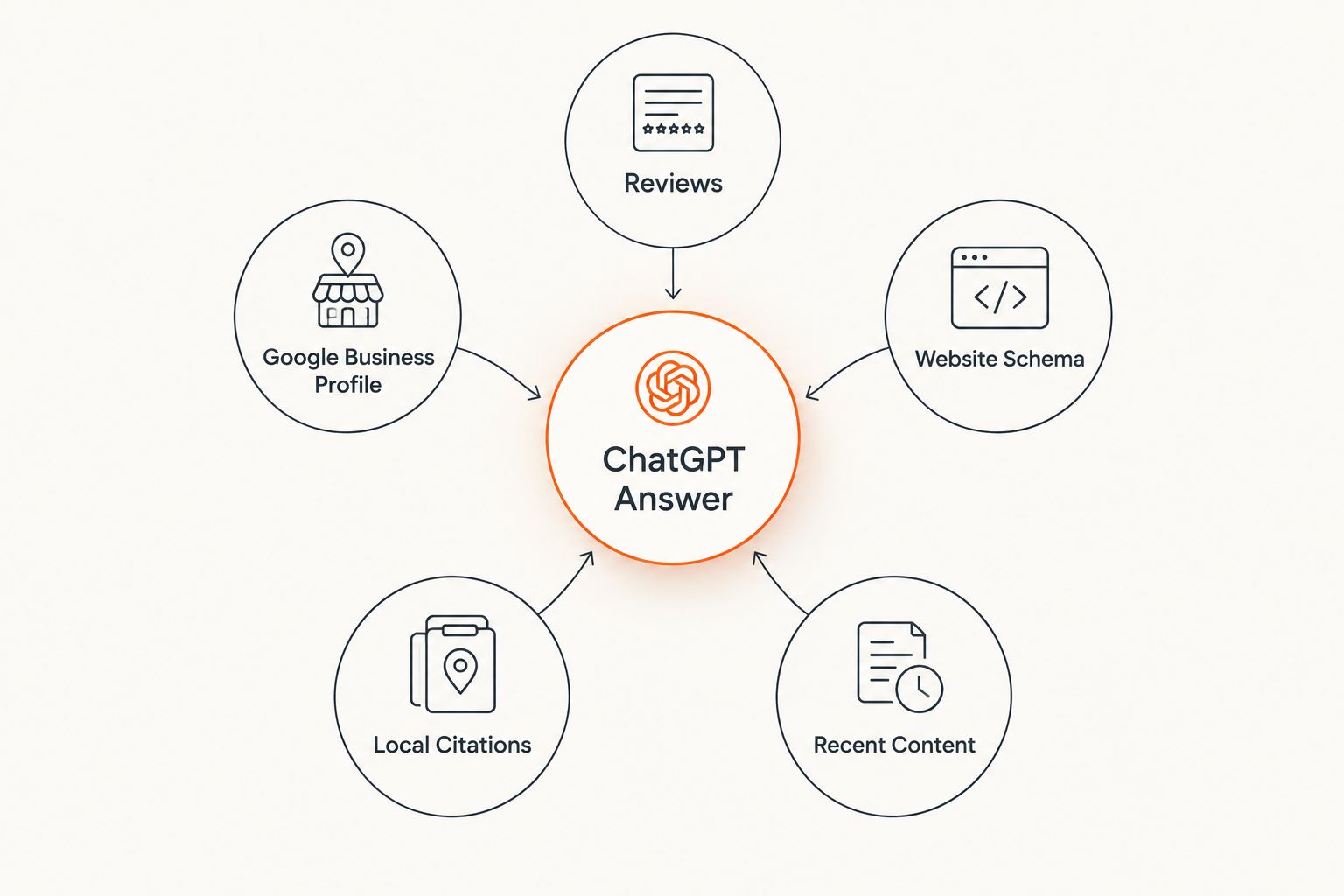
- Getting cited in ChatGPT answers today depends on the same signals AI models pull from: reviews, structured data, and consistent local citations.
- Roxfire tracks brand visibility in ChatGPT the same way it tracks rankings and CPL — as a measurable input, not a guess.
Why ChatGPT visibility matters for home service businesses
Homeowners already ask ChatGPT things like "who's a reliable roofer near me" or "how much should a mini-split installation cost" before they ever open Google. A contractor with zero presence in that answer doesn't get a shot at the job — there's no ad slot to buy your way into yet, and no retargeting pixel to catch the visitor after.
That's a different problem than paid search. Google Ads and Meta Ads let a HVAC or plumbing company force visibility with budget. ChatGPT visibility in 2026 is earned through the same trust signals search engines have valued for years — reviews, citations, structured data — just filtered through a different model. Companies that treat this as "wait for the ad platform to launch" will be several steps behind the ones building citation and review depth now.
You can check your brand's current visibility in ChatGPT before doing anything else — most home service owners have never asked ChatGPT to recommend a company in their own category and are surprised by what comes back.
Audit how ChatGPT currently talks about your business
Start by asking ChatGPT direct, homeowner-style questions in your service area and your category — "best roofing company in Fort Lauderdale," "emergency plumber near me," "HVAC company with good reviews in South Florida." Log what comes back.
- Ask 8-10 variations of the questions a homeowner would actually type
- Note whether your business name appears at all, and whether it's accurate
- Check if competitors show up more consistently than you do
- Screenshot results monthly to track movement over 2026
- Flag any wrong phone numbers, service areas, or pricing claims ChatGPT surfaces
Fix the data ChatGPT is actually pulling from
ChatGPT's web-connected answers lean on the same crawlable data Google uses: your Google Business Profile, your website's schema markup, and third-party directories. If that data is thin or inconsistent, there's nothing for the model to cite.
- Confirm your NAP (name, address, phone) matches across your site, GBP, and directories
- Add or update LocalBusiness and Service schema on your core service pages
- List services with plain-language names homeowners actually search, not internal jargon
- Fix duplicate or abandoned GBP listings that dilute your primary one
- Optimize your Google Business Profile the same way you'd optimize it for a local pack ranking — it's dual-purpose in 2026
Build review volume and recency, not just review count
AI models weight recent, detailed reviews more heavily than a big number from three years ago. A company with 40 reviews from 2026 reads as more current and trustworthy than one with 300 reviews last updated in 2022.
- Ask for a review within 24 hours of job completion, while satisfaction is fresh
- Prioritize Google reviews first, then category-relevant platforms
- Respond to every review, positive or negative, within a few days
- Aim for at least one new review a week per active technician or crew
- Encourage mentions of the specific service performed, not just "great job"
Publish content that answers the exact questions homeowners ask AI
ChatGPT synthesizes answers from pages that directly address a question in plain language. A blog post titled "Signs Your AC Compressor Is Failing" gets pulled into an answer far more easily than a generic "About Us" page.
- Write pages structured as direct question-and-answer, not narrative marketing copy
- Cover pricing ranges, timelines, and common failure points homeowners actually ask about
- Keep answers to 2-3 sentences before expanding — that's the chunk size models tend to lift
- Update seasonal content (hurricane prep, AC tune-ups) before the season hits, not after
Add AI-assisted lead capture so visibility converts into booked jobs
Getting mentioned by ChatGPT is only half the job — the homeowner still has to land on your site and take an action. This is where an AI chatbot for lead capture earns its place: it answers the same follow-up questions ChatGPT triggered, then books the call before the visitor bounces.
- Route after-hours chats straight into your CRM, not a generic inbox
- Pre-qualify by service type and urgency before a human ever picks up
- Trigger a text-back within minutes for any chat that doesn't convert live
- Keep chatbot answers consistent with what your website and GBP already say
Set a test budget for when ChatGPT ads actually launch
OpenAI has piloted sponsored product and shopping-style placements since 2025, and broader advertising formats are widely expected to expand through 2026. Nobody outside OpenAI has confirmed a launch date for local service categories, so treat this as prep, not a live channel.
- Set aside a small test budget separate from your Google Ads and Meta Ads spend
- Assign one person to monitor OpenAI's advertiser announcements
- Plan a 30-day test window the first quarter a self-serve option opens to your category
- Don't pull budget from channels that already book jobs to fund a channel that doesn't exist yet
Track attribution before you need it
When ChatGPT-driven traffic starts showing up in your analytics, you want to already know how to trace it back to a booked job, not scramble to set it up after the fact.
- Tag landing pages that could plausibly be cited by AI answers
- Set up call tracking so every inbound call gets a source, not just paid ones
- Segment referral traffic in analytics for AI-assistant sources specifically
- Review monthly which pages get cited most and double down on that content format
Get your ChatGPT visibility checked
See what ChatGPT says about your business before a competitor buys the answer.
Comparing channels for 2026
| Channel | Best For | 2026 Status | Key Limitation |
|---|---|---|---|
| Google Ads | Immediate, high-intent local leads | Fully live, self-serve | Cost-per-click rising in competitive metros |
| Meta Ads | Brand awareness, remarketing | Fully live, self-serve | Weaker for urgent, high-intent searches |
| Local Services Ads | Pay-per-lead, Google Guaranteed badge | Fully live, category-gated | Limited to approved trades and regions |
| ChatGPT (AI visibility) | Long-term brand mention and trust | Earned only — no ad buy available | No reporting dashboard, no guaranteed placement |
| ChatGPT ads (future) | Early adopters willing to test | In limited testing, not category-specific | No confirmed rollout date for home services |
Verdict: Google Ads and Local Services Ads still book the jobs in 2026 — ChatGPT visibility is the channel you build now so you're not starting from zero when paid placement arrives.
Common mistakes home service businesses make with ChatGPT
- Waiting for a self-serve ad platform that isn't live. Companies pause all AI-related effort until they can "buy ads," losing months of citation-building time.
- Ignoring stale Google Business Profile data. A phone number that's been wrong for a year gets repeated wrong by ChatGPT too.
- Treating ChatGPT and traditional SEO as separate projects. The same schema, review, and content work feeds both.
- Assuming more reviews always wins. A stagnant review count from two years ago reads as inactive, not trustworthy.
- Skipping attribution setup. Businesses that wait until AI-referral traffic is significant to start tracking it lose the ability to prove it worked.
“If ChatGPT can't find your reviews or your service pages, it can't recommend you — no ad budget fixes that.”
FAQ
What are ChatGPT ads for home service businesses in 2026?
There is no self-serve ChatGPT ad platform built for home service categories in 2026. OpenAI has tested sponsored shopping and product placements, but HVAC, roofing, and plumbing companies cannot buy keyword-targeted ads inside ChatGPT the way they can with Google Ads or Meta Ads.
Can HVAC or roofing companies advertise directly inside ChatGPT right now?
Not directly. There's no campaign manager, no CPL bidding, and no category access for local services as of 2026. The only way to appear in a ChatGPT answer today is through organic signals like reviews, schema, and citations.
How do you get a home service business mentioned in ChatGPT answers?
Keep your Google Business Profile accurate, add structured data to service pages, build recent reviews, and publish content that directly answers homeowner questions. These are the same signals that improve local search rankings.
Is ChatGPT visibility the same as SEO?
They overlap heavily but aren't identical. SEO targets ranking positions on a search results page; ChatGPT visibility is about whether your business gets named inside a synthesized answer, which depends more on structured, current, and trustworthy data.
Does Roxfire manage ChatGPT ad campaigns?
Roxfire manages Google Ads, Meta Ads, and local SEO for home service businesses, and tracks ChatGPT brand visibility as part of that work. There is no ChatGPT ad platform to manage yet as of 2026.
Should HVAC companies wait for ChatGPT ads or focus on Google Ads now?
Focus on Google Ads, Local Services Ads, and local SEO now — those book jobs in 2026. Treat ChatGPT visibility work as a parallel investment, not a replacement for channels that already convert.
How do reviews affect ChatGPT recommendations?
Recent, detailed reviews signal current trustworthiness more than a high total count. A business with steady weekly reviews in 2026 reads as more active and reliable than one with a large but stale review count.
What's the difference between AI Overviews ads and ChatGPT ads?
AI Overviews ads run inside Google's search results and are already live in 2026. ChatGPT ads refer to OpenAI's own platform, which remains in limited testing with no confirmed local-service rollout.
One last thing
The home service companies gaining ground in ChatGPT answers right now aren't buying anything — they're the ones with clean Google Business Profiles, weekly reviews, and service pages written like answers instead of brochures. That's a 2026 head start no ad budget can buy back once ChatGPT ads for home services actually launch.