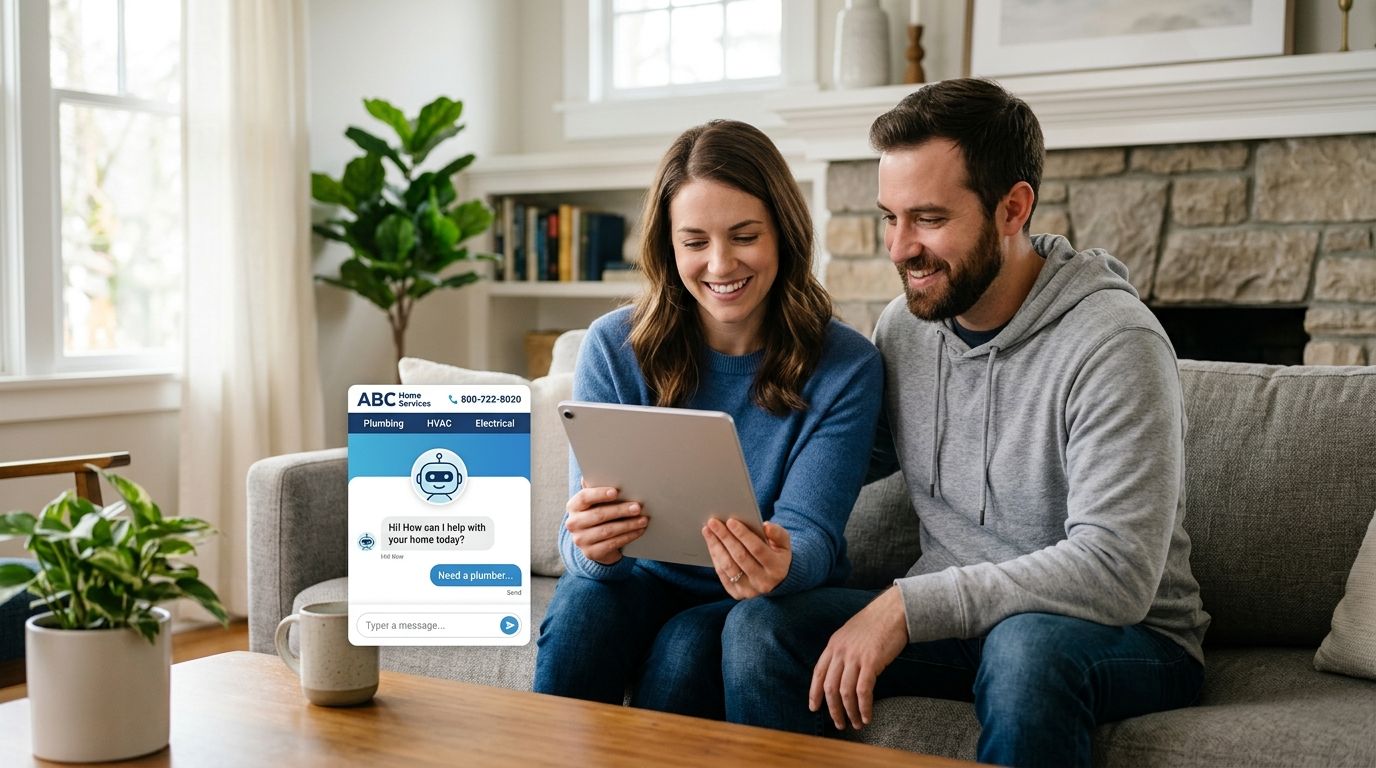
AI chatbot lead capture for home service websites means a chat widget that answers, qualifies, and books incoming visitors around the clock, before an HVAC emergency, roof leak, or flooded basement call goes to a competitor. For HVAC, roofing, cleaning, and restoration companies in South Florida, the need is sharper than most industries: storms, heat waves, and burst pipes don't wait for 9-to-5, and the first business to respond usually books the job.
- AI chatbot for home service websites captures after-hours HVAC, roofing, and restoration leads before a competitor answers first.
- Best pick: a chatbot wired into speed-to-lead routing and your CRM, not a standalone widget bolted onto the homepage.
- Skip any chatbot that can't triage an emergency (gas leak vs. routine tune-up) - it loses bookings, not just leads.
- Roxfire pairs AI chat capture with call tracking and CRM automation so chats convert into booked jobs, not just transcripts.
Why this matters for HVAC, roofing, and restoration companies
A homeowner searching for AC repair at 11 PM on a Saturday isn't going to wait until Monday. If your site has no chat, no after-hours number, and a contact form that sends to an inbox nobody checks until morning, that lead calls the next name on the search results page. A chatbot doesn't fix a bad close rate, but it stops the leak of leads that never make it into your pipeline at all.
This is the same speed-to-lead problem Roxfire tackles with paid search and CRM work in 2026 - chatbots are one more channel where response time decides who books the job. If your contractor website's conversion rate is already weak, a chatbot compounds the problem instead of fixing it, because it just adds another leaky step to a page visitors are already abandoning.
A chatbot that collects a name and phone number without a callback plan is just a fancier contact form.
“A chatbot that collects a name and phone number without a callback plan is just a fancier contact form.”
Set up AI chatbot lead capture: the step-by-step
Audit your current after-hours lead loss
Before adding a chatbot, find out how many leads you're already losing between close of business and the next morning. Most HVAC, roofing, and restoration companies underestimate this number until they check.
- Pull call logs and flag every call that came in after 6 PM or on a weekend
- Check how many of those calls went to voicemail versus a live answer
- Review form submissions timestamped overnight and see how fast they got a callback
- Note which service lines (emergency vs. routine) generate the most off-hours traffic
- Compare your after-hours volume against your close rate on those leads today
Write your chatbot's qualifying questions
A generic "How can we help you?" script wastes the first 30 seconds of a conversation. Home service chatbots need trade-specific triage questions up front.
- Ask for property type (residential or commercial) before anything else
- Separate emergency language ("no AC", "water everywhere", "roof leaking") from routine requests
- Capture service address to confirm you actually cover the zip code
- Ask preferred contact method - phone, text, or email - not just "leave your number"
- Include a same-day availability question so the bot can set expectations honestly
Connect the chatbot to speed-to-lead routing
A chatbot that just emails a transcript to a shared inbox is slower than a phone call. The bot needs to trigger an immediate notification to whoever is on call.
- Route emergency-flagged chats to a text alert, not just email
- Set a maximum response-time target for staff in minutes, not hours, on flagged leads
- Pair the chatbot with call tracking for home service marketing campaigns so you can see whether chat leads convert to calls or bookings
- Log every chat-to-call handoff in your CRM, not a spreadsheet
- Review missed-response reports weekly, not quarterly
Feed the chatbot your service area and emergency triage rules
A bot that books a job outside your service radius, or promises same-day service you can't deliver, damages trust before a technician ever shows up.
- Hard-code your service zip codes so the bot declines out-of-area requests politely
- Build a decision tree for true emergencies (gas smell, active flooding, no heat) versus routine maintenance
- Set business hours logic so after-hours chats get an honest next-available answer, not a fake promise
- Add seasonal rules - hurricane season storm response looks different from a slow August week
- Include a fallback for questions the bot can't answer that routes straight to a human
Wire the bot into your CRM and SMS follow-up
A chatbot lead that sits in a chat platform's own dashboard, disconnected from your CRM, gets forgotten. The bot's job ends when the lead is booked or handed off cleanly.
- Push every completed chat into your CRM as a new lead record automatically
- Trigger an SMS confirmation the moment a chat lead submits contact info
- Tag chat-sourced leads separately from Google Ads or Meta Ads leads for attribution
- Set an automated follow-up sequence for chats that go cold before booking
- Sync appointment bookings from the chatbot directly to your dispatch calendar
Test the handoff from bot to human
Most chatbot failures happen at the handoff, not the greeting. A homeowner who gets passed to a human and has to repeat everything they already typed will hang up.
- Confirm the human agent sees the full chat transcript before calling back
- Time how long it actually takes staff to follow up after a bot flags an emergency
- Run a mystery-shop test yourself, outside business hours, on a busy weekend
- Check that the bot doesn't loop a frustrated visitor back to the same script twice
- Fix any step where the bot asks a question already answered earlier in the chat
Measure cost per lead and close rate monthly
A chatbot is a lead source like any other - it needs the same CPL and close-rate scrutiny you'd apply to Google Ads or Meta Ads in 2026.
- Track chat-sourced leads against booked jobs, not just chats started
- Compare cost per booked job across chat, phone, and form leads
- Flag any month where chat volume rises but close rate drops - that's usually a script problem
- Revisit your qualifying questions every quarter as service mix changes
- Report chatbot performance in the same dashboard as your other lead sources, not separately
Comparison: chatbot options for home service websites
| Option | Best for | Key limitation |
|---|---|---|
| Generic live-chat widget, no AI routing | Companies testing whether chat gets used at all | No triage logic; every chat still needs a human to sort emergency from routine |
| Website builder's built-in chat | Very small operations with low after-hours volume | Rarely connects to a CRM or dispatch system without manual work |
| Field-service platform chat add-on | Companies already running scheduling through that platform | Triage rules are generic across trades, not tuned to HVAC, roofing, or restoration specifics |
| Custom AI chatbot tied to CRM and speed-to-lead routing | Multi-crew HVAC, roofing, and restoration companies fielding after-hours emergencies | Requires setup time and ongoing script updates as service lines change |
A chatbot that isn't connected to your CRM and speed-to-lead routing is worse than no chatbot - it creates the appearance of responsiveness without the follow-through.
Get your after-hours leads audited
See how many calls and chats you lose after 6 PM before you buy a chatbot.
Common mistakes home service companies make with chatbots
- Turning on a chatbot and burying the phone number. Homeowners searching for a roof leak at midnight still want the option to call; a chat-only site loses the callers who want to talk to a person.
- Using one script for every trade line. A restoration company fielding "water in my basement right now" needs different triage than a cleaning company fielding a quote request - one generic script serves neither well.
- No bilingual path in South Florida markets. Miami-Dade and Broward traffic includes a large share of Spanish-language searchers; a chatbot that only replies in English drops those leads at the first message.
- Treating the chatbot as a set-and-forget tool. Scripts written in January 2026 don't account for hurricane-season spikes from June through November; triage rules need seasonal review.
- No handoff protocol for after-hours emergencies. If the bot flags a gas leak or active flooding chat and nobody gets an SMS alert until the next morning, the chatbot has made response time worse, not better.
FAQ
What's the best AI chatbot for home service websites in 2026?
The best option in 2026 is whichever chatbot connects directly to your CRM and speed-to-lead routing, not the one with the most features. A standalone widget that can't hand off an emergency chat to a human fast loses the lead anyway.
Is a chatbot better than a phone number for HVAC leads?
No - a chatbot should sit alongside your phone number, not replace it. Homeowners with a no-AC emergency still want to talk to someone; the chatbot exists to catch the visitors who won't call at all.
How much does an AI chatbot cost for a contractor website?
Cost varies by platform and whether it's bundled into an existing CRM or marketing stack, so check current provider pricing directly rather than relying on a flat estimate. The bigger cost factor is the setup time needed to build trade-specific triage questions.
Can a chatbot replace call tracking?
No. Call tracking measures phone-sourced leads; a chatbot captures a separate channel. Running both together shows which source actually converts to booked jobs, not just which one generates more contacts.
Do chatbots work for emergency restoration companies?
Yes, when the bot is built with emergency triage logic for flooding, active leaks, and storm damage, and routes those chats to an immediate SMS alert. Without that routing, a restoration chatbot just adds delay to a time-sensitive call.
Should a roofing company use a chatbot or Local Service Ads?
They are not competing tools - Local Service Ads brings the traffic, and a chatbot captures visitors who land on the site but don't call. Roofing companies running both in 2026 typically use chat to catch after-hours and weekend traffic.
How do chatbots handle Spanish-speaking leads in South Florida?
Only if the bot is built with a bilingual script from the start. A chatbot that defaults to English-only in Miami-Dade or Broward County will lose a large share of local search traffic before the first question is answered.
One last thing
The chatbot itself is the easy part - most platforms can be live on a home service website within a day. The part that actually moves close rate is the triage script and the handoff speed, and both need review every season, not just at setup. A bot running the same script in hurricane season 2026 that it ran in a quiet April is a bot that's already out of date.