
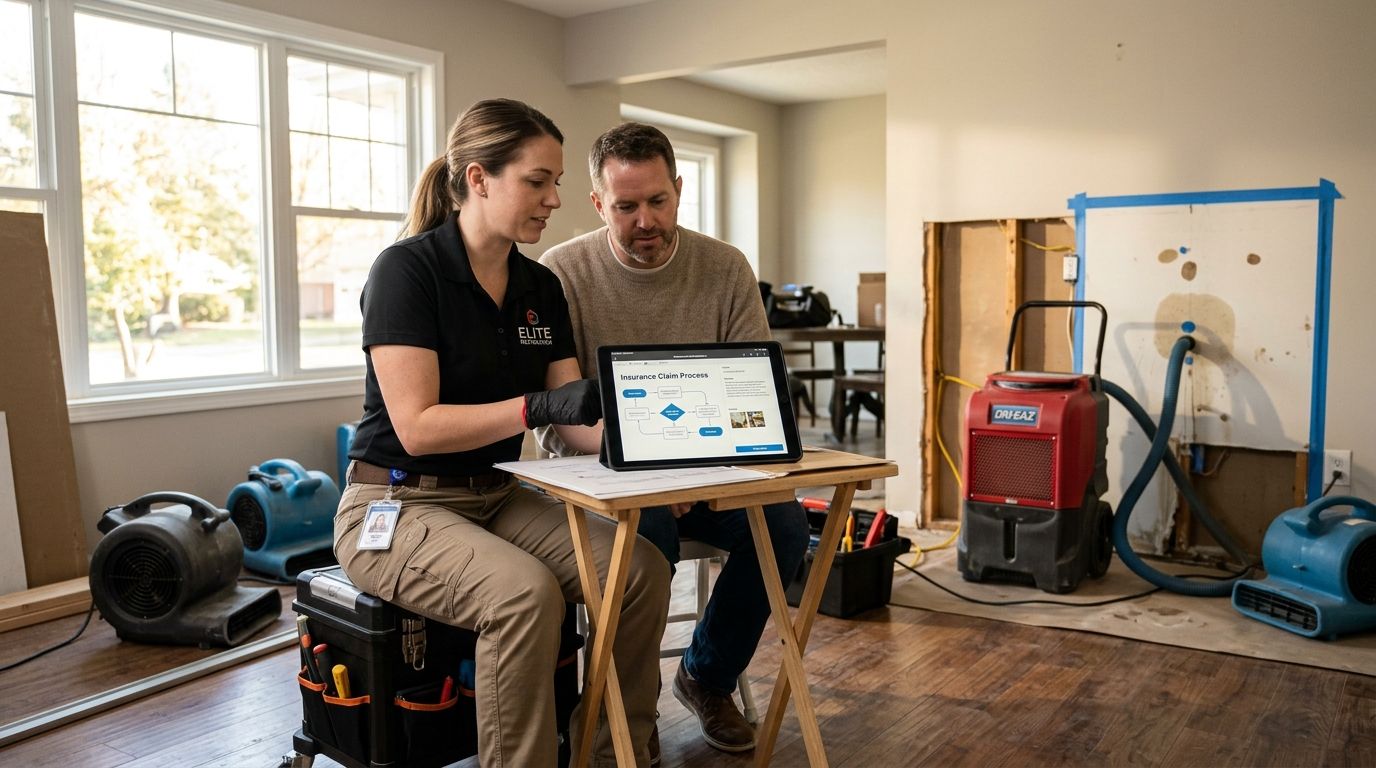
Insurance claim marketing for restoration companies is the practice of generating and converting leads for water, fire, mold, and storm damage jobs that route through an insurance claim rather than a straight cash sale. The buyer isn't just a homeowner — it's a homeowner working with an adjuster on a timeline, which changes the keywords, the landing page copy, and the speed-to-lead math entirely.
- Insurance claim marketing restoration jobs convert faster when landing pages address the claim process, not just the damage type.
- Speed-to-lead under 5 minutes matters more here than in cash-pay trades because homeowners call 3-4 restoration companies at once post-storm.
- Google Ads spend should flex 2-3x during named storm events, then drop back for baseline mold and water-damage demand.
- Reviews mentioning insurance experience, direct billing, and adjuster communication close better than generic 5-star reviews.
- Local SEO for storm damage and water damage insurance claim terms carries different intent than restoration company alone.
Why insurance claim marketing matters for restoration companies
Restoration is a two-buyer sale. The homeowner picks the company, but the insurance carrier approves the scope and the payout, and that split changes every part of the marketing funnel. A restoration marketing strategy built for Fort Lauderdale companies has to account for storm-driven demand spikes that don't exist in most other trades.
The timing problem is structural: demand is either flat (routine pipe leaks, slow mold jobs) or it spikes hard in the 72 hours after a named storm. A restoration company running the same flat monthly ad budget in June and September in South Florida is either wasting spend in the slow months or getting outbid in the fast ones. Insurance claim marketing for restoration companies has to be built around that volatility, not against it.
Homeowners filing a claim also search differently than a cash-pay customer. They type "does insurance cover water damage from a pipe burst" and "is mold remediation covered by insurance" — claim-specific queries that a generic "restoration company near me" page never answers. Miss that intent in 2026 and a competitor's page answers it first.
The build: six steps that produce claim-stage leads
Update your landing pages for claim-stage intent
A page built for a cash-pay water damage job and one built for an insurance claim should not read the same. The claim-stage visitor wants proof you've dealt with adjusters before they hand over their address.
- Add a section explaining your insurance billing process if you handle it directly
- Name the claim types you work in (water, fire, mold, storm) as separate headers, not one paragraph
- Include a short FAQ on what the claim process looks like, without giving legal advice
- Show the timeline from first call to mitigation start — adjusters and homeowners both want speed
- Put a phone number and a form above the fold; claim-stage leads call more than they fill forms
Set up speed-to-lead for storm surges
When a named storm hits, a homeowner with standing water calls the first three companies that show up, then books whoever answers first. Every minute of delay costs bookings during a surge.
- Set up call tracking on every campaign so you know which source produced the call, not just the form fill
- Route after-hours storm calls to a live answering service, not voicemail
- Text back within 60 seconds on any missed call, with a booking link
- Staff extra phone coverage for the 48-72 hours after a storm makes landfall
- Review call recordings weekly during storm season to catch dropped or mishandled calls
The manual version is a shared spreadsheet and a rotating on-call schedule. It works until call volume triples. A CRM with automated routing and text-back absorbs the surge without adding headcount, which is where most restoration companies land after their first bad season.
Run paid search built around storm timing, not a flat budget
Google Ads for restoration is a different game in a normal week versus the week after a hurricane. Flat bidding all year either overspends in slow months or underbids during the surge, when cost-per-click rises because every competitor is chasing the same keywords.
- Build a Google Ads plan for restoration companies after storm season with a separate budget tier for named-storm windows
- Bid on claim-specific terms alongside the core damage terms
- Pause low-intent competitor-brand terms during surge windows to protect budget for high-intent damage searches
- Lean on call-focused ad groups in the first 72 hours post-storm, when phone response beats a form
- Set geo-targeting tight to the actual impact zone, not the whole metro
Strengthen local SEO for claim-driven search terms
Organic traffic doesn't spike as fast as paid during a storm, but it keeps producing leads in the slow months when ad costs would otherwise eat margin. A local SEO plan for restoration companies should target both damage-type and claim-type searches.
- Build separate pages for water damage, fire damage, mold remediation, and storm damage — not one combined services page
- Optimize the Google Business Profile with photos from real jobs, not stock images
- Target claim-phrased long-tail terms alongside the higher-volume near-me terms
- Get listed on the directories insurance agents and adjusters actually reference
- Keep name, address, and phone consistent across every listing; inconsistency hurts emergency-service rankings fast
Generate reviews that speak to the insurance experience
A generic 5-star review helps rankings but does little to reassure someone mid-claim. A review that mentions billing, fast estimate turnaround, or smooth adjuster coordination closes better than five reviews that just say "great service."
- Ask for reviews after the insurance portion of the job wraps, not only after mitigation
- Prompt customers with a question about how the insurance side of the process went
- Respond to every review, positive or negative, within a few days
- Follow a structured process for generating 5-star reviews instead of asking inconsistently
- Feature two or three insurance-specific reviews directly on claim-stage landing pages
Track ROI by claim type, not just cost-per-lead
Cost-per-lead alone hides the real economics in restoration. A lead that turns into a large fire restoration job with an approved scope is worth far more than five cheap leads that never book. Restoration companies that watch only CPL over-invest in cheap, low-value channels.
- Tag every lead by claim type (water, fire, mold, storm) in the CRM at intake
- Track close rate and average job value by lead source, not just volume
- Review paid, organic, and referral ROI monthly during storm season and quarterly the rest of 2026
- Shift channel budget based on booked-job value, not raw lead count
Get a restoration plan for claim-stage leads
See how Roxfire structures ads, local SEO, and speed-to-lead for restoration companies.
Channel comparison for restoration lead generation
| Option | Best for | Key limitation |
|---|---|---|
| Google Ads | Fast lead volume during storm surges | Cost-per-click rises hardest exactly when demand peaks |
| Local SEO | Steady baseline leads in the slow months | Takes months to rank; can't respond to a sudden storm |
| Meta Ads | Building awareness before storm season starts | Lower intent than search; needs a nurture sequence behind it |
| Review and reputation work | Converting claim-stage visitors comparing 3+ companies | Requires ongoing operational discipline, not a one-time push |
| Answering service plus text-back | Capturing surge calls outside business hours | Adds monthly cost that feels wasted in quiet months |
Verdict: Roxfire is the right fit for a South Florida restoration company that wants storm-season Google Ads and claim-stage local SEO run together instead of as separate line items.
“A restoration lead that never gets a callback in the first five minutes after a storm is a lead you paid for and gave to a competitor.”
Common mistakes restoration companies make with insurance claim marketing
- Running one flat ad budget all year instead of a surge tier for named-storm windows, which leaves them outbid exactly when demand peaks.
- Sending claim-stage traffic to a generic services page that never mentions the insurance process or timelines — the first thing that buyer looks for.
- Ignoring speed-to-lead during surges because normal-week response times feel fine until three competitors answer inside five minutes.
- Treating cost-per-lead as the only metric, starving the channels that produce fewer but far more valuable insurance-approved jobs.
- Skipping claim-specific review prompts, ending up with a profile full of generic praise instead of the billing-and-adjuster detail that reassures a homeowner mid-claim.
FAQ
What is insurance claim marketing for restoration companies?
It is marketing built for homeowners filing an insurance claim for water, fire, mold, or storm damage rather than paying out of pocket. It needs claim-stage landing page content, faster speed-to-lead, and ad budgets that flex with storm activity.
How much should a restoration company spend on Google Ads during storm season?
Scale 2-3x above your baseline budget during the 72 hours after a named storm, then return to normal once demand settles. A flat budget either overspends in quiet months or gets outbid during surges.
Do restoration companies need separate pages for insurance claims and cash-pay jobs?
Yes. Claim-stage visitors search claim-phrased terms and want process and timeline information that a generic cash-pay page skips entirely.
What is the fastest way to increase restoration leads after a storm?
Set up call tracking and text-back automation so no call goes unanswered during the surge, then raise Google Ads budget on damage and claim keywords inside the actual impact zone.
Is local SEO or paid search better for restoration companies?
Paid search responds faster to sudden storm demand, while local SEO builds steadier baseline leads between storms. Most restoration companies in 2026 run both at the same time.
How do reviews affect insurance claim marketing?
Reviews mentioning billing, adjuster coordination, or fast estimate turnaround reassure claim-stage homeowners more than generic praise. They are often the tiebreaker when someone is comparing several companies.
Why does speed-to-lead matter more for restoration than other trades?
After a storm, homeowners with active water or fire damage call several companies within minutes of each other and book whoever answers or texts back first, often inside five minutes.
Should restoration companies track ROI by lead source or claim type?
Both, but claim type is the one most companies miss. A single large fire restoration job can outweigh a dozen cheap leads, so close rate and job value by source beats cost-per-lead alone.
One last thing
The restoration companies that hold up best through a bad 2026 storm season aren't the ones with the lowest cost-per-lead. They're the ones whose CRM was already tagging leads by claim type before the storm hit, so on day three of the surge they knew which channel was producing large fire jobs and which was producing calls that never book. Build that tagging in the slow months, not during the surge.


