

Independent contractor marketing is the mix of local SEO, paid search, and reputation tactics a solo or small-crew trade business uses to win jobs against national franchise brands with far bigger ad budgets. The goal isn't matching franchise ad spend dollar for dollar — it's converting a smaller, sharper audience faster than a call center can.
- Independent contractor marketing wins on response speed and hyper-local targeting, not ad-spend parity with franchises.
- Google Business Profile and Local Service Ads let a single-truck contractor outrank a franchise in a tight service radius.
- Reviews tied to one name beat franchise reviews diluted across dozens of trucks and technicians.
- Cost per booked job, not cost per lead, is the number that decides whether a channel is working in 2026.
Why independent contractor marketing matters against franchise brands
Franchise brands buy advertising across dozens of local markets simultaneously, which pushes brand recognition and paid search visibility higher than a single-location contractor can match on budget alone. That's the gap independent contractors compete inside every day in 2026.
But franchise structure creates real weaknesses. A homeowner calling a franchise's national dispatch line reaches a call center, not the person actually doing the work. Reviews get spread across dozens of trucks instead of concentrated under one name people remember. Independent contractor marketing exploits that gap — trading ad-spend parity for speed, specificity, and reviews tied to a face.
The approach looks different from franchise marketing for home service brands precisely because the constraints are different: smaller budget, tighter service radius, and an owner who can pick up the phone.
Claim your Google Business Profile before the franchise does
The map pack is the first battleground, and it's free to fight on.
- Verify the primary category matches the exact service, not a broad trade category
- List every service performed as a separate service line, not one paragraph
- Set the service area to the zip codes actually worked, not a county-wide guess
- Upload job photos weekly — franchises rarely update local profiles this often
- Respond to every review, good or bad, within 48 hours
Run Local Service Ads in a radius the franchise can't out-bid
Google's Local Service Ads run on a pay-per-lead model with a background check and license verification badge — something a franchise's national brand can't fake at the local level.
- Set the service radius tight enough that budget concentrates instead of spreading thin
- Complete license and insurance verification before launch; incomplete profiles get buried
- Respond to every LSA lead within minutes — ranking in the widget depends partly on responsiveness
- Dispute unqualified leads inside the 30-day window instead of eating the cost
- Layer Local Service Ads setup on top of an organic Google Business Profile instead of relying on paid alone
An agency-run Local Service Ads account moves faster on optimization and dispute filing than most owner-operators have time for, which is where a service like Roxfire's paid search management enters as the faster path — not a prerequisite.
Build a review engine the franchise brand can't match
A franchise splits five-star reviews across every technician on the roster. An independent contractor concentrates every review under one name and one truck.
- Text a review request within 24 hours of job completion, while the work is still visible
- Ask for a specific detail in the review (the service performed, not just "great job")
- Route unhappy customers to a private feedback form before they post publicly
- Respond to every review publicly, even the five-star ones, to show an active operator
- Follow a system like generating 5-star reviews for home service businesses instead of asking inconsistently
Rewrite your website around specificity, not scale
Franchise sites are built for every market at once, which makes them generic by design. An independent contractor's site should read like it was built for one neighborhood.
- Name the exact towns and zip codes served on the homepage, not "serving the greater area"
- Show the owner's face and name, not a stock crew photo
- List licensing and insurance details a franchise call center won't volunteer
- Put the phone number in the header on every page, not buried in a contact form
Post video proof of the work instead of stock photos
Homeowners scroll past franchise stock photography without registering it. A 30-second clip of an actual job on an actual truck gets watched.
- Film the before-and-after of one job per week, unedited is fine
- Post to Google Business Profile, not just social feeds — it shows up in local search
- Keep the owner's voice in the clip; narration builds more trust than text captions
- Reuse the same clips as Local Service Ads creative when the format allows video
The same logic that has regional agencies like Pittsburgh video production companies pitching service businesses on before-and-after reels applies here: raw, specific footage beats polished, generic footage every time a homeowner is comparing a name they know against a franchise they don't.
Track cost per booked job, not cost per lead
A cheap lead that never becomes a booked job is worse than an expensive one that closes. Franchises optimize for lead volume because their call centers can absorb waste; an independent contractor can't.
- Set up call tracking on every ad channel so booked jobs, not raw calls, get attributed
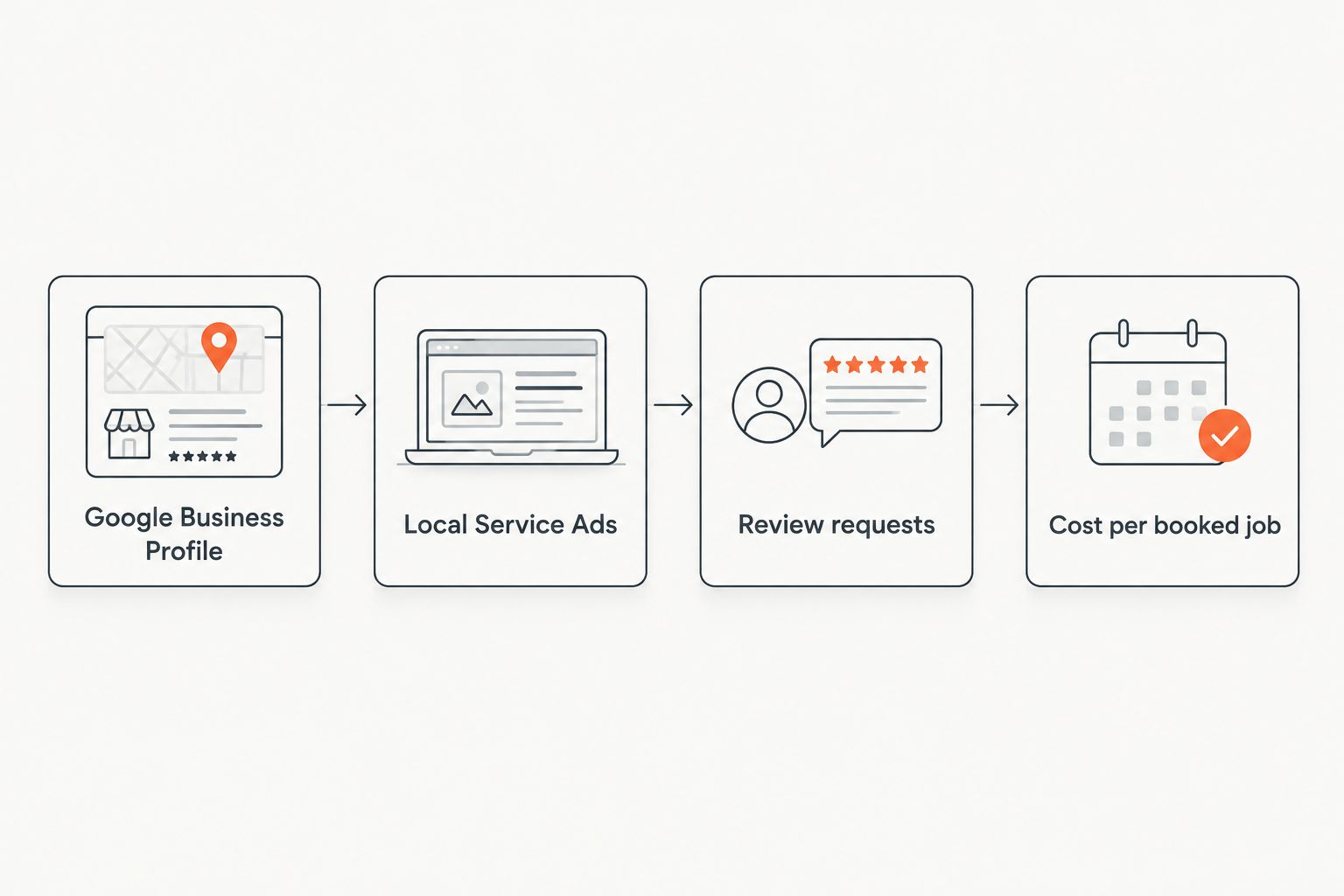
- Compare cost per booked job across Google Business Profile, Local Service Ads, and any paid social
- Cut the channel with the worst cost per booked job every quarter, not every year
- Recalculate after every price change — a financing offer changes close rate math
Get a marketing plan built for you
Roxfire runs Google Ads, SEO, and review systems for independent contractors.
Comparing your options
An independent contractor doesn't need to outspend a franchise — the contractor needs to out-execute on the channels a franchise structurally can't personalize.
| Option | Best For | Key Limitation | Verdict |
|---|---|---|---|
| DIY Google Business Profile + review requests | Contractors with an hour a week to manage listings | Visibility builds slowly without paid support | Start here, free |
| Self-managed Local Service Ads | Contractors ready to pay per qualified lead in one radius | Requires license verification and constant bid management | Solid, time-intensive |
| Franchise corporate co-op advertising | Franchisees receiving brand-funded national spend | Not available to independent contractors at all | Not applicable |
| Full-service agency management (Roxfire) | Contractors who want Ads, SEO, and reviews run and reported on monthly | Still requires budget and a monthly ROI check | Buy if the budget supports it |
Common mistakes independent contractors make competing against franchises
- Matching franchise financing offers instead of leading with response speed. A contractor can't match a national financing program, but can beat a call-center callback time by hours.
- Leaving the Google Business Profile service area vague. A county-wide radius dilutes ranking in the exact zip codes that matter most.
- No systematic review request after every job. Reviews requested inconsistently arrive inconsistently, and franchises out-volume a slow trickle.
- Copying franchise ad copy. "24/7 emergency service, nationwide trust" reads generic from a one-truck operation; a name and a face reads credible.
- Chasing every lead instead of qualifying for booked-job value. A cheap, unqualified lead costs more in wasted callbacks than a pricier, pre-qualified one.
FAQ
What is independent contractor marketing?
Independent contractor marketing is the combination of local SEO, Google Business Profile optimization, paid search, and review generation a solo or small-crew trade business uses to compete for local jobs, often against franchise brands with larger ad budgets.
How do independent contractors compete with franchise ad budgets?
By narrowing the service radius on paid ads, concentrating reviews under one recognizable name, and responding to leads faster than a franchise call center can. Budget parity isn't required; execution speed is.
Is Google Local Service Ads worth it for a solo contractor?
Yes for most trades, because the pay-per-lead model with a verified license badge favors a legitimate small operator over a generic franchise listing in a tight service area.
How many reviews does an independent contractor need to compete with a franchise?
There's no fixed number, but review velocity matters more than total count — a contractor adding new reviews every week signals an active business the way a franchise's static, spread-out review count doesn't.
Should independent contractors match franchise pricing or financing offers?
No. Matching a national financing program isn't usually realistic for a small operation; competing on response speed, specificity, and local trust converts better than price matching alone.
What marketing budget should an independent contractor set in 2026?
Budget should scale with service radius and job value rather than mirror franchise national spend; a starting point is setting a monthly cap and tracking cost per booked job before increasing it.
Do independent contractors need a website if they rank on Google Business Profile?
Yes. A Google Business Profile drives visibility, but a website converts that visibility into a booked job by showing licensing, service area detail, and photos a profile alone can't fully display.
How fast should an independent contractor respond to a lead?
As close to immediately as possible. Local Service Ads ranking and homeowner conversion both drop the longer a call or message sits unanswered, and a franchise call center is rarely faster.
One last thing
The highest-leverage move for an independent contractor in 2026 isn't outspending the franchise on ads — it's picking one service radius and refusing to dilute it, then posting proof of work under one name every single week. A franchise call center can outspend that. It can't replicate it.