

Multi-location plumbing marketing is the practice of running Google Ads, local SEO, and review management as separate campaigns per service area instead of one blended account, because a plumber in Fort Lauderdale and a plumber in Boca Raton are competing in two different maps, two different price ranges, and two different sets of reviews. The goal isn't more leads company-wide — it's more booked jobs per location, tracked back to the specific market that produced them.
- Multi location plumbing marketing fails when every branch shares one Google Business Profile, one landing page, or one blended CPL number.
- Location-specific landing pages and call tracking are the two fixes that move the needle fastest in 2026.
- Roxfire treats each plumbing location as its own account, with its own cost per booked job, not a shared average.
- A generic national agency optimizes for total leads; a location-aware operator optimizes for jobs booked per branch.
Why multi-location plumbing marketing matters for growing companies
A single-location plumber can get away with one Google Business Profile, one phone number, and gut-feel budget decisions. A company running four, six, or twelve branches can't — because Google's map results are hyper-local, and a searcher in Pembroke Pines never sees your Miami reviews, your Miami rank, or your Miami phone number.
Every additional location is a separate local search battle. If Roxfire manages campaigns for one plumbing brand with multiple branches, the account isn't one big budget split evenly — it's a set of smaller, location-specific accounts that happen to share a logo. Treat it any other way in 2026 and the budget quietly subsidizes the location that's easiest to rank, while the newer branch starves.
The operators who get this right stop asking "how many leads did we get this month" and start asking "what did each location's booked job cost." That single shift in reporting changes almost every decision that follows.
The step-by-step plan
Audit lead flow location by location
Before changing anything, pull a location-by-location breakdown of leads, booked jobs, and cost per booked job — not a company-wide average. Averages hide the branch that's bleeding budget.
- Separate Google Ads conversion data by location extension or campaign, not by account total
- Pull Google Business Profile insights per listing — calls, direction requests, website clicks
- Cross-reference lead volume against dispatched jobs in your CRM or field service software
- Flag any location where cost per lead looks fine but cost per booked job is high — that's a close-rate problem, not an ad problem
- Check whether phone numbers are unique per location or shared, which breaks attribution entirely
Standardize your Google Business Profiles across every location
Each plumbing location needs its own Google Business Profile, its own service area settings, and its own review stream. Google's local map results — the 3-pack most searchers act on — reward proximity and profile completeness location by location, not brand-wide authority.
- Verify a separate GBP for every physical or registered service address, not one profile with multiple service areas bolted on
- Match business name, categories, and service list exactly across locations, varying only the address and phone number
- Upload location-specific photos: trucks, technicians, and branded uniforms at that branch, not stock imagery
- Set accurate service-area radii per location so ads and organic listings don't overlap and cannibalize each other
- Respond to every review under the correct location profile, using the reviewer's name and the actual service performed
Build location-specific landing pages
Sending every city's traffic to one generic "our services" page is the single most common reason multi-location plumbing marketing underperforms. A searcher in Boca Raton wants to see a Boca Raton phone number, Boca Raton reviews, and language that matches their neighborhood, not a corporate homepage.
Doing this manually means a template with swapped city names, local reviews, and a unique phone number per page — doable in-house with a developer and some discipline. Once you're running paid traffic to a dozen pages, though, testing conversion rate improvements page by page without a dedicated system gets slow, which is where a team that already runs franchise marketing for home service brands earns its budget: the page structure, tracking, and testing cadence are already built.
- Give each location its own URL, its own title tag, and its own local schema markup
- Feature that location's actual reviews, not a company-wide aggregate score
- Use a unique tracked phone number per landing page for call attribution
- Include drive time or service radius language specific to that market
- Test one variable at a time — headline, form length, phone placement — per location, not across all pages at once
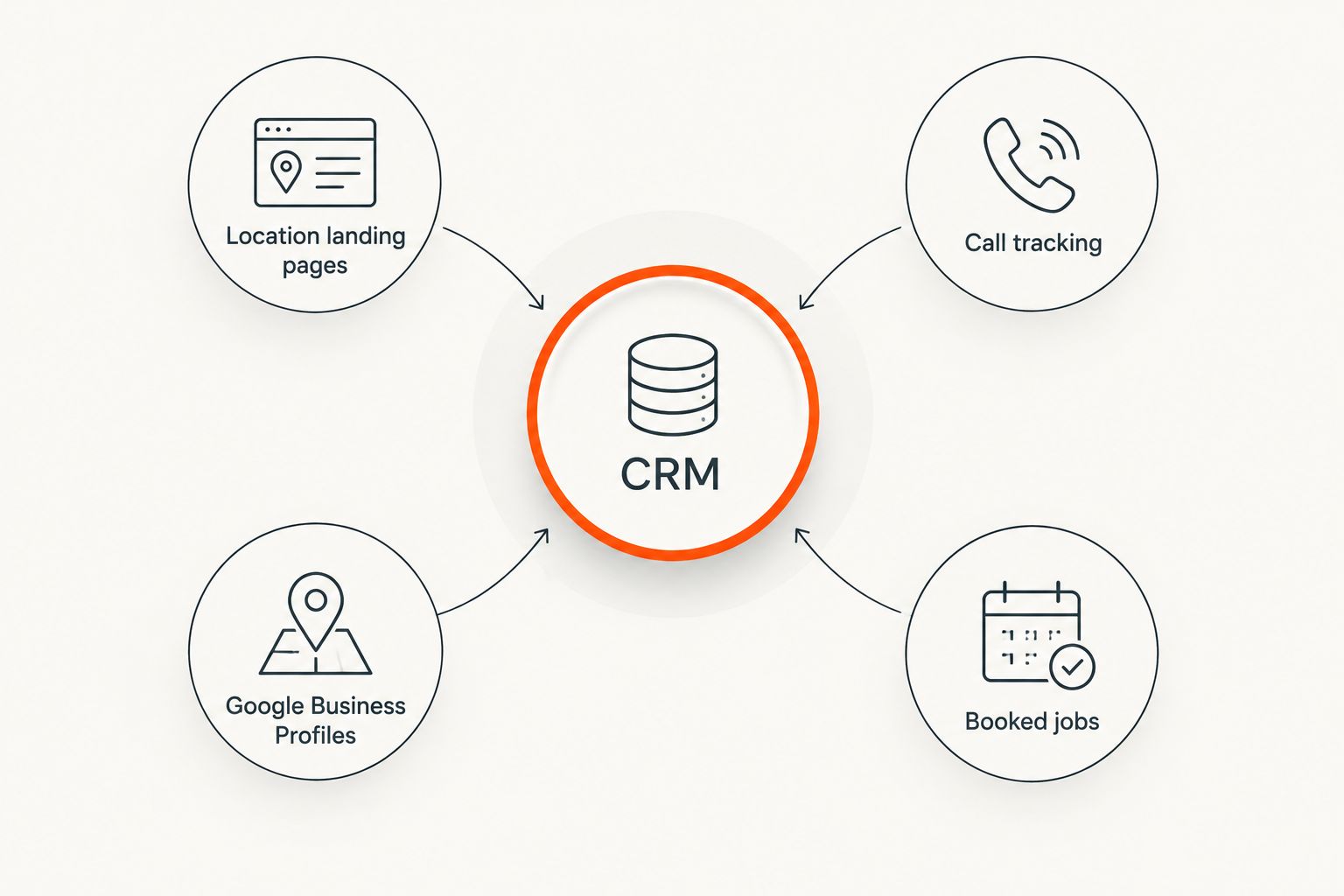
Centralize call tracking and CRM attribution
If two locations share a phone number, or your CRM doesn't tag which location's ad a lead came through, no amount of ad spend optimization will tell you what's actually working. Fixing attribution comes before fixing ad spend, not after.
- Assign a dedicated tracked phone number to every location's ads, GBP, and landing page
- Route calls into a CRM that logs source, location, and outcome (booked, no-show, price shopper)
- Set up call tracking for home service marketing campaigns before increasing any location's budget, not after
- Tag every lead with a location ID at intake so reporting doesn't require manual sorting later
- Review call recordings monthly for the locations with the worst lead-to-booked-job ratio — it's usually a speed-to-lead or scripting problem, not a traffic problem
Run location-level Google Ads instead of one blended campaign
One shared Google Ads account with location extensions feels efficient but hides which branch is actually profitable. Structure campaigns so budget, bids, and negative keywords can move independently per location.
- Build separate campaigns (or at minimum separate ad groups) per service area, not one campaign with radius targeting for the whole region
- Set bid adjustments by location based on close rate, not just click volume
- Exclude neighboring locations' service areas from each other's targeting to stop internal cannibalization
- Layer in Google Ads management for plumbing companies best practices — dayparting around emergency call windows, call-only extensions for after-hours leads
- Pause or reallocate budget from any location where cost per booked job has run above the rest for 60+ days
Fix review generation location by location
Review count and recency are location-specific ranking and conversion signals. A location with 12 reviews from 2023 loses to a competitor with 40 reviews from the last 90 days, even with a better overall brand reputation.
- Send review requests immediately after job completion, tied to the technician and the correct location
- Set a location-level target — for example, 8 to 10 new reviews per month per branch — so no location goes stale
- Respond to negative reviews within 24 to 48 hours, from the correct location profile
- Train dispatch and technicians on the exact ask, since the request that works face-to-face rarely works by generic text blast
- Audit review velocity quarterly per location, not just company-wide star rating
Measure cost per booked job, not blended CPL
A blended cost-per-lead number across six locations tells you almost nothing about where to spend the next dollar. Say one branch's CPL is $65 but only a third of those leads book, while another branch's CPL is $95 with a two-thirds close rate — the second branch is the better investment, and a blended average would never surface that.
- Report cost per booked job per location monthly, not quarterly
- Compare close rate by lead source (organic, paid, referral) within each location, not company-wide
- Reallocate budget toward the location and channel combination with the lowest cost per booked job, not the lowest CPL
- Use ROI tracking for home service Google Ads to tie ad spend directly to revenue per location, not just lead count
“If corporate can't tell you which location booked the job, the ad spend is guessing.”
Comparing your options
| Option | Best for | Key limitation |
|---|---|---|
| In-house marketing coordinator | Companies with 2-3 locations and simple reporting needs | Rarely has bandwidth to build location-specific pages and manage per-branch ad accounts |
| Generic national marketing agency | Brands that just need volume and don't need per-location attribution | Reports blended metrics; can't tell you which branch is underperforming |
| Freelance SEO or PPC contractor | Single-location or budget-constrained operations | Usually specializes in one channel, not the full attribution loop across locations |
| Roxfire (performance marketing agency) | Multi-location plumbing brands that need per-branch cost-per-booked-job reporting | Requires clean CRM and call tracking data to show its full value |
Verdict: multi-location plumbing companies that report by branch, not by company average, consistently spot which locations deserve more budget months before a blended report would ever show it.
Get a location-by-location marketing review
See cost per booked job for every branch, not a company average.
Common mistakes multi-location plumbing companies make
- Sharing one Google Business Profile across locations — Google eventually suppresses or merges duplicate-address profiles, killing local visibility for the newer branch.
- Sending every city's paid traffic to the homepage — a searcher who sees a generic page instead of their own city's reviews and phone number bounces before calling.
- Reporting company-wide CPL instead of per-location cost per booked job — this hides the exact branch draining the budget every single month.
- Letting locations compete against each other in the same Google Ads campaign — overlapping service-area targeting means two branches bid each other up for the same search.
- Skipping call tracking until after a budget increase — without location-tagged call data, there's no way to prove the increase paid off.
FAQ
What is multi-location plumbing marketing?
Multi location plumbing marketing runs Google Ads, local SEO, and review generation as separate efforts per branch instead of one blended campaign, since each location competes in its own local search results in 2026.
How many Google Business Profiles does a multi-location plumbing company need?
One verified Google Business Profile per physical or registered service address. Sharing a single profile across locations risks Google merging or suppressing listings.
Should each plumbing location have its own landing page?
Yes. A location-specific landing page with a local phone number and local reviews converts better than a generic homepage, and it's required for accurate call tracking by location.
What's the difference between cost per lead and cost per booked job?
Cost per lead measures ad efficiency; cost per booked job measures actual revenue impact per location, since close rates vary widely branch to branch.
Is Roxfire better than a national marketing agency for multi-location plumbers?
Roxfire is best for plumbing brands that need per-branch reporting on cost per booked job. A national agency that only reports blended metrics can't show which location needs more or less budget.
How often should multi-location plumbers review location-level ad performance?
Monthly at minimum. Waiting a full quarter lets an underperforming location burn budget for 90 days before anyone catches it.
Can one Google Ads account manage multiple plumbing locations?
Yes, but structure it with separate campaigns or ad groups per location and location-specific negative keywords, not one blended campaign with radius targeting.
How many reviews should each plumbing location target per month?
A reasonable target is 8 to 10 new reviews per month per branch to keep review velocity and recency competitive in local search results.
One last thing
The branch that looks like your worst performer on a company-wide CPL report is sometimes your best one once you split out cost per booked job — and the reverse is just as common. Pull that split before making any budget decision in 2026, not after.