
YouTube Ads for home service businesses means running video campaigns on YouTube's ad inventory (in-stream, in-feed, and Shorts) with the goal of turning homeowners scrolling video into booked jobs, not just brand awareness. Home service companies compete for high-ticket, high-consideration decisions — a roof replacement, an HVAC install, a restoration job — where a homeowner needs to trust you before they call, and that's a different job than a search ad has to do.
TL;DR
- YouTube ads home services campaigns work best for high-consideration jobs (roofing, HVAC replacement, remodeling) that need trust before a call.
- Skippable in-stream ads need a hook in the first 5 seconds or the click-to-skip button ends the campaign.
- Budget by cost-per-lead and booked-job rate, not cost-per-view — CPL is the number that matters in 2026.
- Video marketing for contractor websites and YouTube Ads work together: the ad earns the click, the site closes the lead.
- Track every view back to a call or form fill or you're guessing at what's working.
Why YouTube Ads matters for home service businesses
YouTube's own reported reach puts logged-in monthly users past 2 billion — that's more reach than any single home service niche will ever need, but it also means most of that inventory is irrelevant to a roofing company in Fort Lauderdale unless targeting is tight. The value for home service businesses isn't the audience size, it's the format: video builds trust faster than a text search ad can, and trust is the bottleneck for jobs over a few thousand dollars.
A homeowner searching "HVAC replacement near me" already decided to buy. A homeowner scrolling YouTube hasn't decided anything yet — YouTube Ads home services campaigns work upstream of search, warming up the homeowner before they ever type a query. That's why the format fits roofing, restoration, remodeling, and HVAC replacement better than one-call, low-ticket services like locksmiths or junk removal, where the search intent is already there and the video step just adds cost.
Paired with video marketing for contractor websites, the same footage that runs as a YouTube ad becomes the trust-building content on the landing page the ad sends traffic to. One shoot, two jobs.
Pick the right YouTube ad format for the job
YouTube gives you several formats, and picking the wrong one for a home service budget wastes spend fast.
- Skippable in-stream — runs before/during other videos, viewer can skip after 5 seconds, you pay only on view or click. Best default for most home service budgets in 2026.
- In-feed video ads — show up in YouTube search results and the homepage feed, work like a thumbnail-driven listing. Good for retargeting people who already searched your service.
- Non-skippable in-stream — 15 seconds, forced view, higher cost per impression. Rarely worth it for a local service business unless brand awareness is the actual goal.
- Shorts ads — vertical, 60 seconds or less, competes with TikTok-style content. Fits fast-turn services (cleaning, lawn care, pressure washing) better than big-ticket remodeling.
- Bumper ads — 6 seconds, unskippable, cheap per impression. Works only as a supporting layer to reinforce a brand name after the main ad already ran.
Build creative that works with the sound off
Most YouTube viewers scroll with audio muted or half-attention on the screen, so a home service ad that depends on narration to land its message loses most of its audience in the first 5 seconds.
- Put the service and the city name on screen in text within the first 3 seconds
- Lead with the visual proof — the truck, the crew, the before/after — not a logo animation
- Caption every line of dialogue, don't rely on spoken audio alone
- Show the phone number or a clear call-to-action on screen at the 5-second mark and again at the end
- Cut the intro — no 3-second logo bumper before the actual pitch starts
Layer in-market and custom-intent audiences
YouTube's targeting only pays off when it's layered, not left at the default "anyone in this zip code."
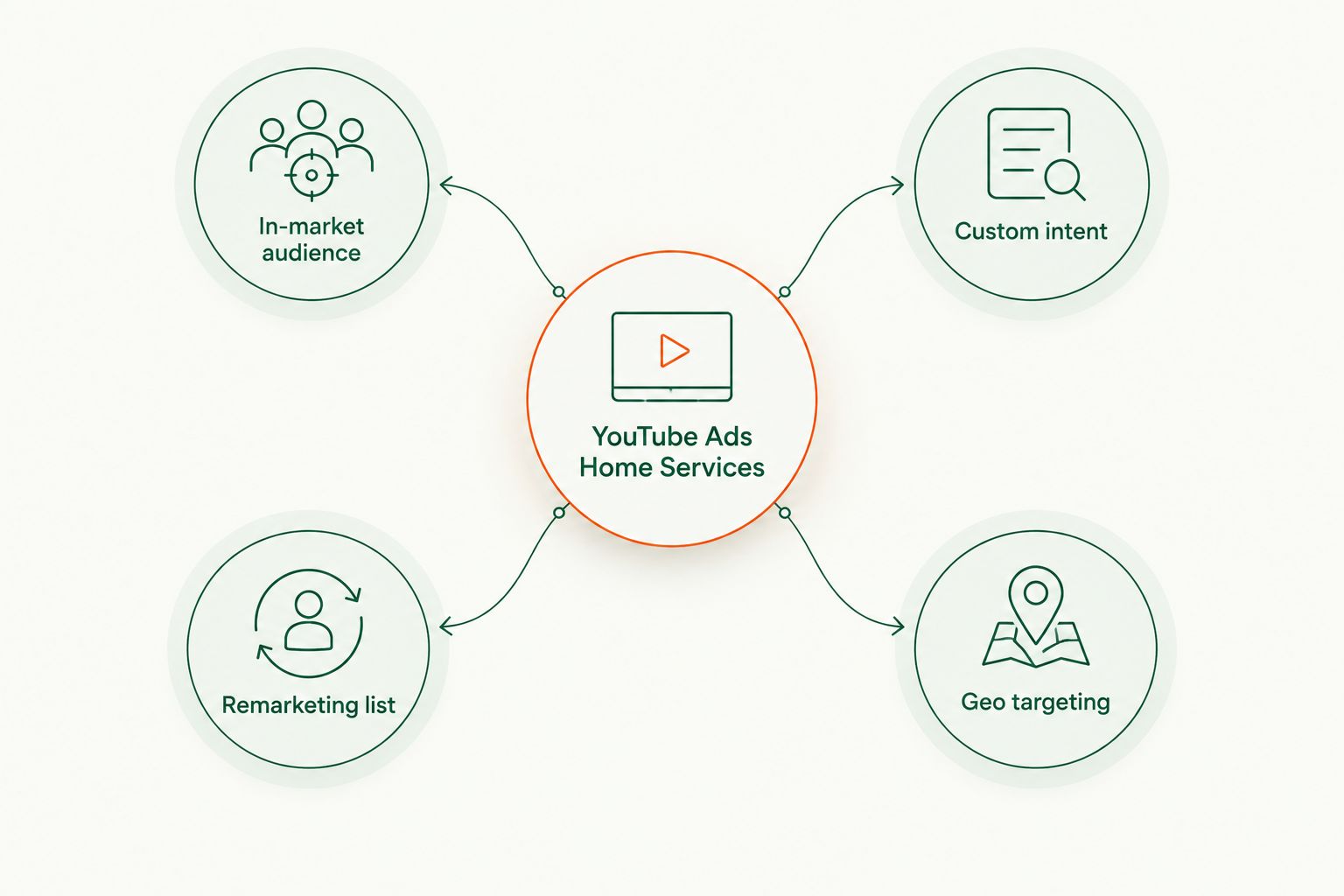
- Start with in-market audiences for home improvement, home services, or the specific category YouTube offers (roofing, HVAC, etc.)
- Add a custom intent audience built from search terms like "roof leak repair" or "AC not cooling"
- Layer a remarketing list from website visitors who didn't convert
- Exclude past customers if the job type isn't a repeat service within 12 months
- Test a lookalike/similar audience built from your existing customer list where the platform supports it
Narrow targeting to your actual service area
A national or state-wide radius wastes budget on homeowners you can't service.
- Set geo-targeting to the exact counties or zip codes you dispatch crews to
- Exclude cities outside your service radius even if they're technically close
- Adjust bids up for zip codes with higher home values if the job is high-ticket (roof replacement, whole-home generators)
- Layer in seasonal geo-adjustments — storm-prone counties before hurricane season, for example
Set a budget by cost-per-lead, not cost-per-view
Cost-per-view looks good on a report and means nothing to a business owner counting booked jobs. Budget YouTube Ads home services campaigns the same way you'd budget Google Ads: against cost-per-lead and close rate, not vanity view counts.
- Set a target CPL based on your average job value and close rate, not an arbitrary daily spend
- Run a 2-4 week test window before judging performance — video campaigns need volume to optimize
- Compare CPL against your other channels (search, Meta, Nextdoor) monthly, not weekly
- Cut the audience segments with the highest CPL after the test window, not before
Track every view back to a booked job
A YouTube ad that gets views and clicks but no call tracking is a black box. Home service businesses need attribution that connects the ad to the phone ringing, not just to a landing page visit.
- Use call tracking numbers unique to the YouTube campaign, separate from search or Meta
- Tag form fills with UTM parameters that flag the source as YouTube
- Pull weekly reports on cost-per-booked-job, not just cost-per-lead
- Cross-reference view-through conversions against your CRM's job close data
Getting this step wrong is the single biggest reason home service owners write off YouTube Ads as "didn't work" when the real problem was never measuring what worked. How to track ROI from Google Ads for home service companies covers the same attribution setup, and it applies directly to video campaigns.
Refresh creative every 30-45 days
Video ad fatigue hits faster than search ad fatigue because the same audience sees the same 15-30 second spot repeatedly in a shorter window.
- Swap the hook (first 5 seconds) even if the rest of the video stays the same
- Rotate seasonal messaging — storm prep, AC tune-ups before summer, holiday lighting install
- Test a testimonial-led version against a crew/truck-led version
- Pull performance data before rotating, not on a fixed calendar
“If your video doesn't work with the sound off, it doesn't work.”
Platform comparison for home service businesses
| Platform | Best for | Key limitation |
|---|---|---|
| YouTube Ads | High-consideration jobs — roofing, HVAC replacement, remodeling — that need trust before a call | Needs actual video creative; skippable formats live or die on the first 5 seconds |
| TikTok Ads for home service businesses | Fast-turn services and younger homeowner segments — cleaning, junk removal, lawn care | Smaller reach among homeowners over 55 versus YouTube |
| Nextdoor Advertising for home service businesses | Hyperlocal trust plays — storm damage response, neighborhood-specific promotions | Limited targeting scale outside dense metro zip codes |
| Google Search Ads | Bottom-funnel homeowners already searching and ready to book | Builds no brand awareness before the search happens |
YouTube Ads home services campaigns win on trust-building for big-ticket jobs; search ads still win on bottom-funnel intent — most home service marketing budgets in 2026 need both, not one instead of the other.
Common mistakes home service businesses make with YouTube Ads
- Running the same script as a TV commercial — YouTube viewers skip after 5 seconds; a 30-second brand-awareness spot built for TV loses most of the audience before the pitch starts.
- Targeting an entire metro area instead of a service radius — spend gets wasted on homeowners a crew can't reach, inflating CPL for no reason.
- Judging performance after 3-4 days — video campaigns need volume to optimize; pulling the plug in week one kills data the algorithm needed to learn from.
- Skipping call tracking on the video campaign specifically — without a dedicated tracking number, YouTube-driven calls get credited to "direct" or "organic," and the campaign looks like it failed when it didn't.
- Using stock footage instead of the actual crew and trucks — homeowners hiring for a $15,000 roof job want to see the real business, not a generic stock actor in a hard hat.
Get a YouTube Ads plan built for your market
Targeting, creative direction, and call tracking set up for your service area.
FAQ
What's the best YouTube ad format for home service businesses?
Skippable in-stream ads are the best default for most home service budgets in 2026 because you only pay on views or clicks past the 5-second skip point. Shorts ads fit fast-turn services like cleaning or lawn care better than big-ticket remodeling.
How much should a home service company budget for YouTube Ads in 2026?
Budget against a target cost-per-lead based on your average job value and close rate, not a fixed daily spend. Run at least a 2-4 week test window before judging whether the CPL is competitive against search or Meta.
Is YouTube Ads better than TikTok Ads for home service businesses?
YouTube Ads reaches a broader age range and fits high-consideration jobs like roofing and HVAC replacement better. TikTok Ads for home service businesses tends to work better for younger homeowners and fast-turn services like junk removal or cleaning.
Do YouTube Ads work for emergency services like restoration and plumbing?
Emergency services convert better on search ads because the homeowner already has an active problem and is typing a query. YouTube Ads home services campaigns fit the planning phase better — storm prep, maintenance plans, replacement jobs a homeowner is weighing over weeks.
How long before YouTube Ads start generating booked jobs?
Video campaigns typically need a 2-4 week test window to gather enough data for the algorithm to optimize targeting. Judging a campaign inside the first week usually kills it before it had a chance to work.
What's the difference between YouTube Ads and Google Search Ads for contractors?
Search ads capture homeowners who already decided to buy and are typing the query. YouTube Ads build trust with homeowners earlier in the decision, before they've started searching.
Can a small home service business run YouTube Ads without a video production budget?
Yes, but the creative bar is lower risk than most owners assume — a phone-shot video of the actual crew and trucks with clear on-screen text often outperforms a polished stock-footage spot. The footage can double as content for the website's video marketing.
How do you track YouTube Ads leads back to a phone call?
Use a call tracking number unique to the YouTube campaign, separate from search and Meta, and tag form fills with campaign-specific UTM parameters. Without that separation, YouTube-driven calls get misattributed to direct or organic traffic.
One last thing
Most home service owners who try YouTube Ads once and quit made one mistake: they judged a video campaign on the same week-one timeline as a search campaign. Video needs more impressions before the algorithm has enough signal to optimize targeting — pulling the budget in week one is the single most common way to waste the spend that was just starting to work.


