
Display advertising for home service businesses means running banner, video, and native ads across websites, apps, and YouTube to homeowners who aren't actively searching yet, with the goal of getting your name recognized before an AC dies, a roof leaks, or a pipe bursts. Unlike search ads, display doesn't chase intent — it builds it, so the metrics and the creative rules are different from anything you're running on Google Search right now.
- Display advertising home services campaigns work best for retargeting site visitors and building brand recall, not for generating same-day calls.
- Google Display Network and YouTube reach the widest audience; Nextdoor and Meta reach the most local, trust-based audience.
- Click-through rates on display are naturally low industry-wide — judge these campaigns on cost per lead and booked jobs, not clicks.
- Skip a landing page built for display traffic and most of this budget disappears into impressions nobody remembers.
Why display advertising matters for home service businesses
Most HVAC, roofing, and restoration companies pour their entire budget into search ads and Local Service Ads, chasing homeowners at the exact moment they type "AC repair near me." That's the right first move, but it ignores everyone who isn't searching yet — the homeowner whose unit is 11 years old and hasn't failed, the one who just closed on a house and hasn't picked a lawn service, the family that will need a new roof after next hurricane season.
Display fills that gap. It's the channel that keeps your name in front of a homeowner for the six months between "I should probably get this looked at" and "I need someone today." Roxfire runs display as a supporting channel to search and Local Service Ads for South Florida service businesses, not as a replacement for either — the mix matters more than any single platform.
What makes this segment different from a typical B2C brand running display: purchase cycles are irregular and often emergency-driven, service areas are geographically bounded, and a single job can be worth thousands of dollars — which changes how much cost per lead you can tolerate compared to an ecommerce advertiser.
Build a display strategy that fits your service business
Define your service area and audience segments before you touch creative
Display platforms let you target by geography, homeowner status, income band, and even property age — none of that matters if you haven't decided who you're targeting first.
- Map your actual service radius, not your city name — zip codes, not metro areas
- Segment homeowners vs. renters where the platform allows it (roofing, HVAC, and window companies should exclude renters entirely)
- Layer in property age data for categories tied to equipment lifespan — AC units, water heaters, roofs
- Exclude commercial-only zip codes if you're strictly residential
- Build a separate segment for past customers for maintenance or replacement upsell campaigns
Build display creative that doesn't blend into the page
A banner that looks like a stock ad gets ignored. The click-through rate on the average display ad is already low across every industry — generic creative pushes it lower.
- Use real photos of trucks, crews, or completed jobs instead of stock imagery
- Put the service area name directly in the creative ("Serving Broward County since [year you started]" type framing)
- Test static banners against short video cuts — video marketing for contractor websites works for YouTube in-stream just as well as it does on-site
- Rotate seasonal messaging — hurricane prep in June, AC tune-ups in April, not the same static all year
- Keep one clear call to action per ad — "Get a free inspection" beats three competing offers stacked on one banner
Set your budget before the platform sets it for you
Display is cheap per impression and expensive per real conversion if nobody's watching the account. Start with a number you can defend, then adjust based on what the account actually returns.
- Decide your target cost per lead before launch, not after the first invoice
- Cap daily spend per platform so one channel doesn't eat the whole month
- Set a minimum 30-day test window — display needs volume to optimize, it doesn't convert like search on day one
- Reference a documented marketing budget for a home service business framework instead of guessing a percentage of revenue
- Hold 10-15% of the display budget in reserve for creative refreshes once the first set fatigues
Choose your display network based on what you're actually trying to do
Google Display Network gives you scale. Meta gives you targeting precision. Nextdoor gives you a neighborhood-trust angle that search and Meta can't replicate. None of them is universally "best" — the right pick depends on the job type and the service area size.
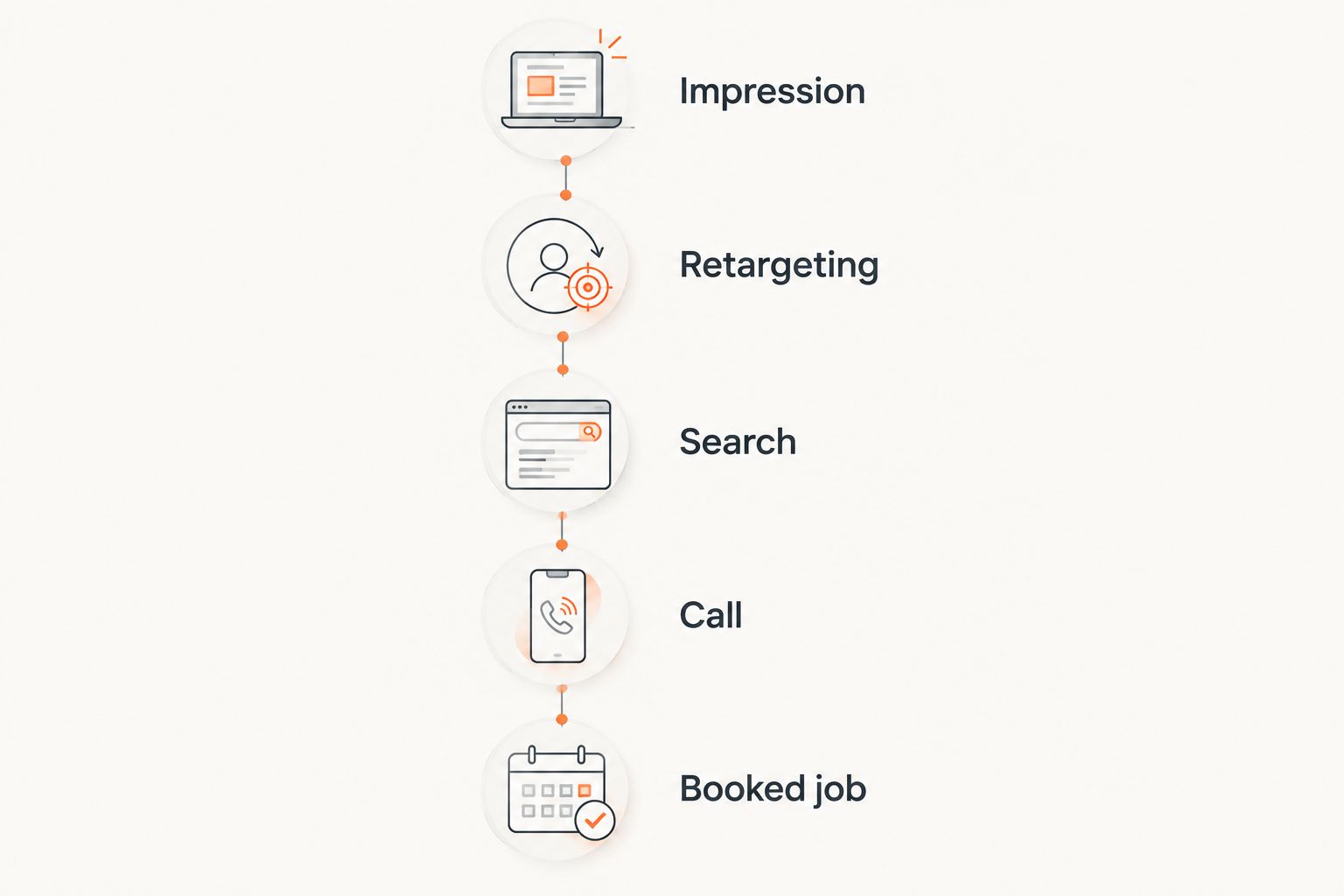
Measure the leads, not the impressions
Impressions and reach are vanity numbers for a home service business. The only numbers that matter are cost per lead, cost per booked job, and how those compare to your search and Local Service Ads channels.
- Set up call tracking before launch so display-sourced calls don't get credited to organic or direct
- Use a dedicated landing page per campaign, not your homepage — display traffic converts worse on a generic page
- Pull a full ROI report from Google Ads style breakdown monthly, applied to display spend the same way
- Track view-through conversions separately from click-through — display often assists a search conversion days later
- Compare cost per booked job across channels monthly, not cost per click
Layer retargeting onto every display campaign you run
Cold display traffic converts at a fraction of the rate of retargeted traffic. If you're not retargeting site visitors who didn't convert, you're leaving the cheapest leads in the account on the table.
- Retarget anyone who visited a service page but didn't fill out a form within 14 days
- Exclude anyone who already converted to avoid wasting spend on existing leads
- Use a shorter retargeting window (7-10 days) for emergency categories like restoration and plumbing
- Serve a different creative on retarget than on the cold campaign — a review or guarantee message works better here than a broad awareness message
Avoid wasting spend on the wrong season
South Florida service demand swings hard by season — hurricane prep in summer, HVAC breakdowns in peak heat, roofing after storm season. Running flat display spend year-round ignores that pattern.
- Increase display budget 4-6 weeks ahead of known seasonal spikes, not during them
- Pull back generic brand-awareness spend during off-season months and shift it to retargeting
- Build separate seasonal ad sets so performance data doesn't get muddied across a full year
Comparison: display channels for home service businesses
| Channel | Best for | Key limitation |
|---|---|---|
| Google Display Network | Retargeting site visitors and broad brand recall across millions of sites | Click-through rates are low industry-wide; easy to burn budget on placements that never convert |
| YouTube in-stream/video | Showing a job in motion — storm cleanup, mold removal, roof tear-off | Needs real video creative, not a repurposed TV commercial |
| Meta (Facebook/Instagram) | Hyper-local geo-targeting by zip code and homeowner status | Creative fatigues fast in small service areas |
| Nextdoor advertising | Neighborhood-level trust and referral-style visibility | Smaller reach than GDN or Meta — better as a supplement, not a primary channel |
| Programmatic/DSP | Multi-location or franchise brands running display at scale across many markets | Usually needs a media buying partner and more spend to get useful reporting |
Verdict: for a single-location home service business in 2026, Google Display Network paired with retargeting and a Nextdoor supplement covers most of what display can realistically deliver — programmatic only makes sense once you're running multiple locations.
Get a display and budget plan built for your area
Roxfire builds display campaigns around your actual service radius and season.
Common mistakes home service businesses make with display
- Sending display traffic to the homepage. A homeowner who saw a roofing banner should land on a roofing page, not a general services list.
- Judging display by click-through rate alone. Display CTR is naturally low across every industry — cost per booked job is the number that matters.
- Running the same creative for 12 months. Ad fatigue sets in fast in a bounded service area where the same households see the ad repeatedly.
- Skipping call tracking. Without it, display-sourced calls get misattributed to organic or brand search, and the campaign looks like it's failing when it isn't.
- Ignoring seasonality. Flat year-round spend on a category that spikes seasonally (HVAC, roofing, restoration) wastes budget in the slow months and underfunds the busy ones.
FAQ
Does display advertising work for home service businesses in 2026?
Yes, as a supporting channel to search and Local Service Ads — display builds recognition before a homeowner searches, it doesn't replace the channels that capture active demand.
What's the best display network for a local HVAC or roofing company?
Google Display Network paired with retargeting covers the broadest reach for most single-location home service businesses; Nextdoor adds a neighborhood-trust layer on top.
Is display advertising better than Google Ads search for home service leads?
No — search ads capture homeowners already looking for a contractor, while display builds awareness for homeowners who haven't started looking yet. Most companies need both.
How much should a home service business spend on display advertising?
Start with a defined cost-per-lead target and a 30-day test budget rather than a fixed percentage of revenue; display needs volume before it optimizes.
Should HVAC or roofing companies retarget display visitors?
Yes — retargeted display traffic converts at a meaningfully higher rate than cold display traffic, and excluding recent converters keeps the retargeting pool efficient.
Does display advertising help with seasonal home service demand like hurricane prep?
Yes, when budget increases 4-6 weeks ahead of the season rather than during it — display needs lead time to build recognition before demand spikes.
Can a home service business track ROI from display ads?
Yes, with call tracking and a dedicated landing page per campaign — without both, display-sourced leads get miscredited to other channels.
One last thing
The home service companies that get the most out of display in 2026 aren't the ones with the biggest budget — they're the ones who stopped judging the channel by click-through rate and started judging it by booked jobs 30-60 days out, because that's how long display actually takes to show up in a search conversion.
“Display ads sell awareness, not appointments -- measure them that way or the account looks broken when it isn't.”