

New homeowner marketing for home service businesses means targeting buyers in the first 90 days after closing, before they've picked an HVAC company, a roofer, or a cleaning crew, with the goal of becoming their default vendor for the next decade of maintenance, repairs, and replacements. New homeowners act on urgency, not brand loyalty — a failed 4-point inspection item or a dying AC unit turns into a same-week call, and whoever answers first usually keeps the account through the next roof, water heater, and remodel.
- New homeowner marketing home services works best when realtor and title company referrals feed the pipeline before the first service call.
- Geofenced ads and Nextdoor targeting around recently sold homes beat citywide campaigns for HVAC, roofing, and restoration leads.
- SMS and direct mail sent within 30 days of closing catch buyers before they've chosen a default vendor.
- 5-star review requests tied to the new-homeowner experience convert better than generic review asks.
Why new homeowner marketing matters for home service businesses
A new homeowner in South Florida is almost guaranteed to touch a home service business within the first year. Insurance carriers often require a 4-point inspection and a wind mitigation report to lock in coverage, and both routinely surface roofing, electrical, and HVAC issues the buyer didn't know existed. That puts a home service purchase decision in front of someone who has zero vendor history and zero brand preference.
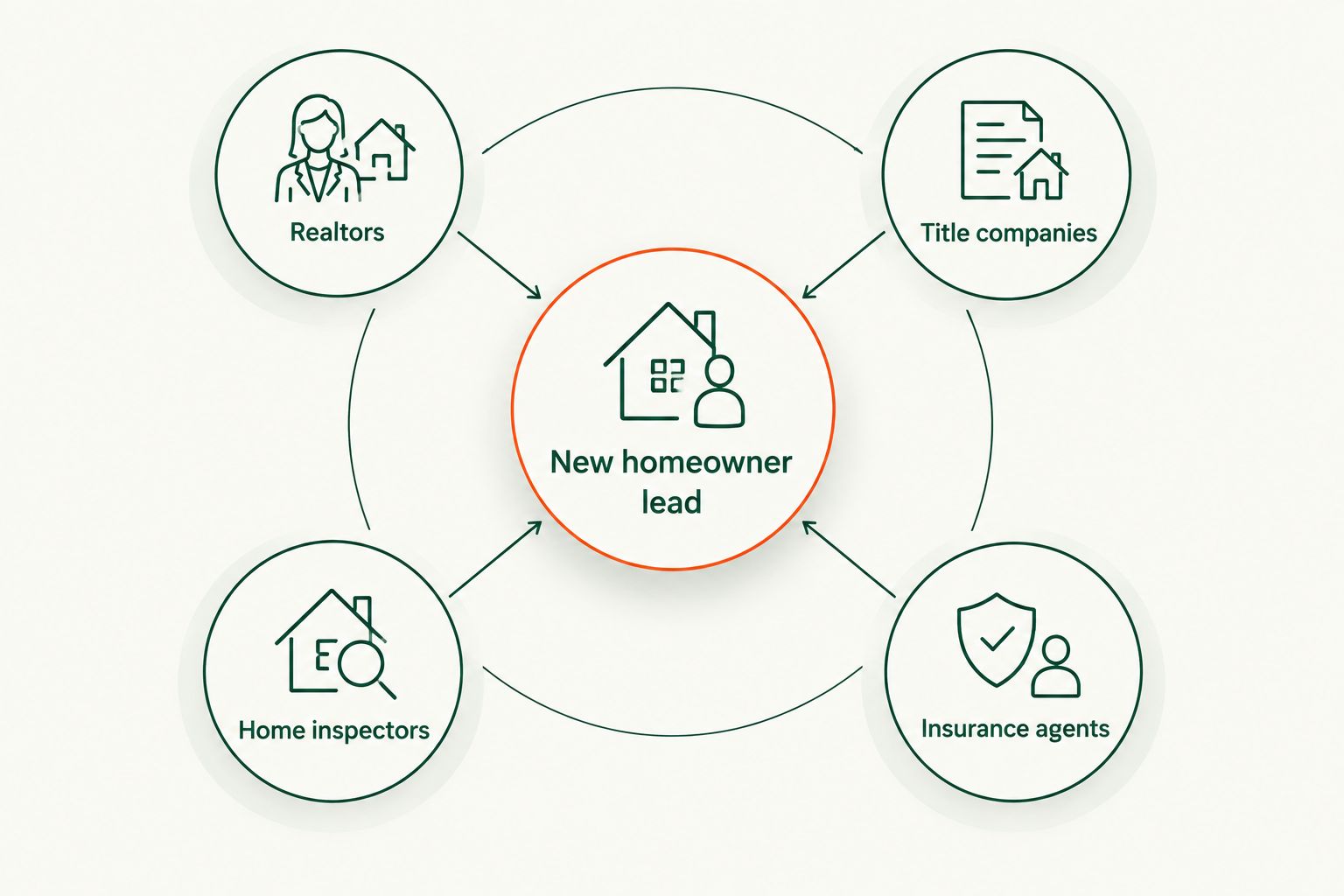
That's the opening. Every realtor, title company, and home inspector working a closing in a Roxfire service market already has that homeowner's contact information before you do. The companies that win new-homeowner marketing home services aren't the ones with the biggest ad budget — they're the ones who show up at the moment the homeowner starts asking "who do I even call for this?"
How to market to new homeowners in 2026
Build referral partnerships with realtors, title companies, and inspectors
A closing touches four or five parties before the buyer gets keys. Each one is a distribution channel if the relationship exists before the deal closes.
- Reach out to top-producing realtors in your target zip codes, not the whole MLS roster
- Join preferred vendor lists at title companies that close a high volume of residential deals
- Build referral agreements with home inspectors who run 4-point inspections
- Partner with insurance agents who require wind mitigation reports before binding a policy
- Track referral source in the CRM starting with the first inbound call, not after the job books
Roxfire builds these realtor referral partnerships into lead-gen programs for HVAC, roofing, and restoration clients across South Florida because the referral source data tells you which relationships are actually producing booked jobs versus which ones just feel good on paper.
Target search and ad intent tied to the closing timeline
New homeowners don't search "best HVAC company near me" the way a five-year resident does. They search for what the inspection report told them to fix.
- Build landing pages around phrases like "AC inspection after buying a house" or "what does a 4-point inspection check"
- Run Google Ads against new-homeowner and warranty-expiration phrases, not just generic service keywords
- Add an FAQ block answering inspection-driven repair questions on service pages
- Layer neighborhood and subdivision names from recent closings into ad copy and headlines
- Bid separately on "just moved" and "new construction" intent instead of blending it into broad match
Optimize Google Business Profile for post-move searches
A homeowner who just closed searches on their phone standing in the driveway. Your Google Business Profile is what shows up.
- Add Q&A entries that answer "just moved in, what do I need to check" scenarios directly
- Keep service area boundaries current as new subdivisions and developments come online
- Post seasonal reminders — hurricane prep, AC tune-ups — timed to local closing surges
- Request and upload photos from recent jobs in newer subdivisions specifically
Run geofenced and Nextdoor ads around recently sold homes
Citywide ad spend wastes money on homeowners who already have a vendor. Geofencing puts the budget where the decision is still open.
- Geofence a one-mile radius around active closings pulled from public record or MLS feeds
- Sponsor Nextdoor advertising in neighborhood groups covering new-construction zones
- Build Facebook and Instagram custom audiences around recent movers
- Rotate creative between AC, roofing, and cleaning offers depending on season and inspection type
Send SMS and direct mail within 30 days of closing
The window to reach a homeowner before they pick a default vendor is short. Miss it and a competitor's magnet is already on the fridge.
- Pull closing-date data from title partners or public record data providers
- Send a welcome message within the first two weeks of the closing date
- Time a second touch to seasonal maintenance — AC filter change, gutter check
- Keep the message service-specific rather than a blanket discount blast
Roxfire runs SMS marketing campaigns timed off closing data for HVAC and restoration clients because a message that arrives two weeks post-close reads as helpful, not spammy.
Collect reviews that speak to the new-homeowner experience
A review that says "great service" doesn't move another new buyer. A review that says "we had no idea who to call after buying our first house and they walked us through everything" does.
- Ask for a review immediately after the first service call, while the "just moved in" context is fresh
- Prompt reviewers to mention what worried them as new owners before the job was done
- Feature these reviews on realtor-facing landing pages, not just the homepage
- Monitor review volume against closing volume in the same zip codes to spot gaps
“A new homeowner without an HVAC contractor is a warm lead until day 31, then a competitor's customer.”
Channel comparison for new homeowner marketing
| Option | Best for | Key limitation |
|---|---|---|
| Realtor & title referral partnerships | Steady, trust-based inbound leads | Takes months to build volume before results show |
| Geofenced & Nextdoor ads | Fast visibility in specific new-construction zones | Needs current closing data or targeting goes stale |
| Google Ads on new-homeowner intent | Capturing homeowners searching right after an inspection | Competes with home warranty companies and marketplaces |
| SMS & direct mail post-closing | Direct reach before a vendor is chosen | Requires a compliant, timely closing-date data source |
| Google Business Profile optimization | Owning "near me" searches in growing zip codes | Slow to move without consistent review volume |
Build a new-homeowner lead pipeline
Roxfire runs realtor referral, geofenced ad, and review programs for South Florida home service brands.
Common mistakes home service businesses make with new homeowner marketing
- Treating outreach as a one-time postcard instead of an ongoing referral pipeline with realtors and title companies.
- Blasting ads citywide instead of geofencing recently sold zones, which burns budget on homeowners who already have a vendor.
- Asking for a generic review instead of one that mentions the new-homeowner situation, losing the exact social proof that converts other new buyers.
- Ignoring the insurance trigger point — missing outreach timed to 4-point inspection and wind mitigation renewal windows when repairs get scheduled anyway.
- Skipping the CRM referral field, so nobody can tell which realtor or which Nextdoor zone is actually producing booked jobs versus noise.
FAQ
What's the best way to market home services to new homeowners in 2026?
Realtor and title company referral partnerships paired with geofenced ads around recently sold homes perform best in 2026 because they reach the buyer before a vendor is chosen. SMS outreach timed to the closing date adds a second, direct touch.
How do you find new homeowners to market to?
Public record closing data, MLS feeds, and title company partnerships identify recent buyers by address and closing date. Realtors and home inspectors working a market also generate direct referral leads before a public record even updates.
Is Nextdoor advertising worth it for new homeowner leads?
Nextdoor advertising works well when it's geofenced to neighborhoods with recent closings or new construction. Sponsoring a whole city's Nextdoor feed without geofencing wastes budget on homeowners who already have a vendor.
Do realtor referral partnerships actually generate leads for HVAC and roofing companies?
Yes, but they take months to build volume — a realtor needs to trust the vendor before making a referral part of their routine. Once established, referral partnerships produce steadier, higher-trust leads than cold ads.
What triggers a new homeowner's first HVAC or roofing call?
A 4-point inspection or wind mitigation report flagging an issue is the most common trigger in Florida, followed by an AC system failing in the buyer's first summer in the house. Both create urgency within weeks of closing.
How fast should a home service company reach out to a new homeowner?
Within 30 days of the closing date, before the homeowner has picked a default vendor for maintenance and repairs. Outreach that arrives after the first repair is already booked with a competitor is too late.
Is Google Ads or SEO better for reaching people who just moved?
Google Ads reaches homeowners with immediate intent right after an inspection surprise, while SEO and Google Business Profile optimization build a durable local presence that pays off over years. Home service businesses that run both outperform ones that pick just one.
One last thing
The fastest signal in new-homeowner marketing home services isn't the ad creative — it's the closing date. A geofenced campaign that goes live the same week a deal closes consistently outperforms one built around zip code averages, because the homeowner is standing in an empty house thinking about exactly what needs fixing. Build the referral and data pipeline first; the ad spend just fills the gaps the referrals don't cover.