

New contractor marketing is the process of building visibility, trust, and lead flow for a home service business in its first 6-12 months, before a track record of reviews and referrals exists to carry the phone. A newly licensed HVAC, roofing, or plumbing contractor faces a different problem than an established company: zero review history, no branded search volume, and a budget that has to prove itself fast or the business runs out of runway.
- New contractor marketing starts with Google Business Profile and licensing proof, not paid ads.
- Set a 90-day budget before touching Google Ads or Local Service Ads in 2026 - guessing burns cash fast.
- Reviews from your first 10-15 jobs matter more than any ad spend for a brand-new license.
- Call tracking from day one tells you which channel actually produces booked jobs, not just clicks.
- Competing on price against franchise brands is a losing game for a new contractor - compete on speed and specialization instead.
Why new contractor marketing matters for newly licensed contractors
A contractor who just pulled a license has none of the assets that make marketing cheap later: no review count, no repeat-customer base, no branded search traffic. Every dollar spent in month one either builds one of those assets or it doesn't, and there's no cushion to absorb wasted spend the way an established company can.
Home service buyers in 2026 check reviews and licensing before they call, especially for anything involving safety or code work like HVAC, roofing, and electrical. A brand-new Roxfire client with zero reviews is starting from a trust deficit that has to be closed before ad spend produces a reasonable cost per booked job. That's the real difference between marketing for a 10-year-old company and marketing for a business that got its license this quarter.
Claim and complete your Google Business Profile before you spend a dollar on ads
Google Business Profile is free, and for a brand-new contractor it's the highest-leverage move available before any paid channel makes sense. A profile with a category, service area, and photos filled out ranks in the local map pack faster than a bare-bones listing, and it's the first thing a homeowner checks against your license number.
- Select the primary category that matches your license exactly (e.g., "HVAC contractor," not "Air conditioning store")
- List your license number in the business description
- Add service area zip codes instead of a storefront address if you work from a truck
- Upload at least 10 photos of completed work, even from apprentice or side jobs
- Turn on messaging and Q&A so early inquiries don't go to voicemail
Build a website that proves you're licensed and insured before it tries to sell
A one-page site with a phone number and a stock photo doesn't convert in 2026 - homeowners scroll for licensing, insurance, and service area before they'll fill out a form. This step comes before any paid traffic, because sending clicks to a weak page just raises cost per lead without fixing the real problem.
- State your license number and insurance status above the fold
- List exact services offered, not a vague "we do it all"
- Add a click-to-call button that works on mobile without extra taps
- Include a service area map or list of cities/zip codes covered
- Post a form that asks for the job type first, not name and email first
Set a first-90-day marketing budget you can actually defend
Most new contractors either spend nothing and wait for word of mouth, or overspend on ads with no plan to measure results. A defined 90-day budget with a target cost-per-lead ceiling forces discipline before the checking account decides for you. The budget framework for a home service business that Roxfire uses with new licensees starts small and scales only after a channel proves it produces booked jobs, not just leads.
- Set a hard monthly ceiling before opening any ad account
- Reserve a portion of the budget for review generation, not just ads
- Track cost per booked job, not cost per click, from week one
- Kill any channel that hasn't produced a booked job within 30 days at 2x your target CPL
- Revisit the number every 30 days instead of setting it once for the year
Get your first reviews before the phone starts ringing hard
A contractor with zero reviews loses to a competitor with 40, even at a better price. New contractor marketing has to front-load review generation because paid traffic to a zero-review profile converts at a fraction of the rate of a profile with social proof.
- Ask every early customer, including friends and family jobs, for a review within 24 hours of completion
- Send the review link by text, not email - text response rates run far higher
- Respond to every review, positive or negative, within a few days
- Use a QR code on invoices or trucks that links straight to the review form
Launch Local Service Ads or Google Ads once the budget and reviews are in place
Once a Google Business Profile is complete and the first reviews are live, paid search becomes worth the spend. Local Service Ads put a licensed, background-checked contractor at the very top of the results page, above standard Google Ads, and charge per lead rather than per click - a better fit for a new contractor with a tight budget in 2026.
- Complete the Google Guarantee background check before launching, since it can take days to approve
- Start with two or three high-intent service categories, not every service you're licensed for
- Set a weekly lead cap so early spend doesn't outrun your crew's capacity to answer calls
- Pair Local Service Ads with a small standard Google Ads budget for services LSA doesn't cover well
Track every lead's source so you know what's actually working
A new contractor without call tracking is guessing which dollar produced which job. Setting up call tracking for a home service marketing campaign from day one means every decision after month one is based on real numbers instead of gut feel.
- Use dynamic number insertion so each channel gets its own tracked number
- Record calls to check whether the office is actually converting the leads coming in
- Tag every lead by source in a spreadsheet or CRM before month two
- Review the source breakdown every two weeks during the first 90 days
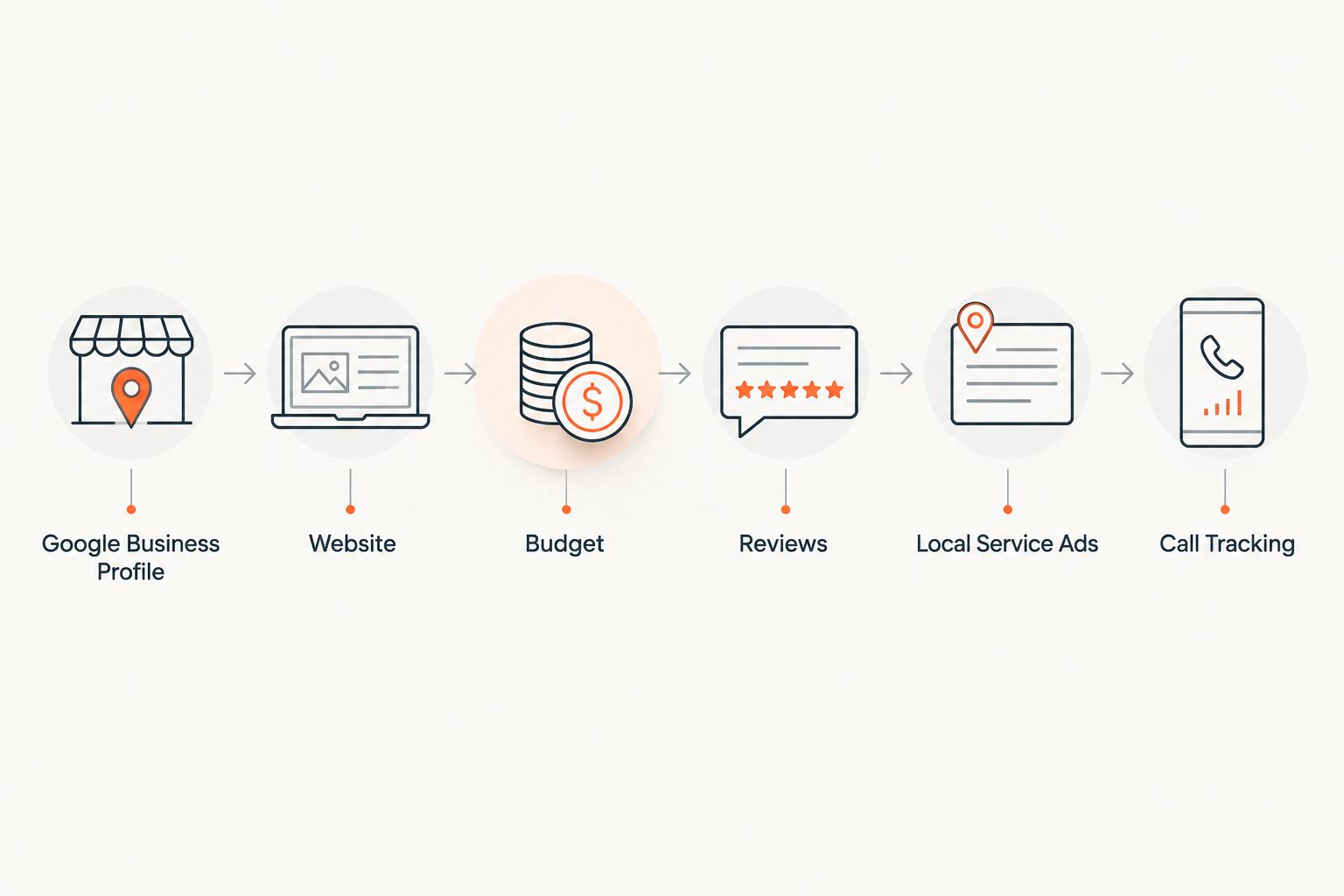
Marketing options for a newly licensed contractor
| Option | Best for | Key limitation |
|---|---|---|
| Google Business Profile + reviews | Every new contractor, day one | Takes weeks to build enough reviews to move the needle |
| Local Service Ads | Contractors ready to pay per lead, not per click | Requires Google Guarantee approval and a completed profile |
| Standard Google Ads | Services not well covered by Local Service Ads | Costs more per lead until quality score and reviews build up |
| Lead marketplaces (Angi, HomeAdvisor-type sites) | Filling early capacity gaps fast | Shared leads and no control over lead exclusivity |
| Full-service agency management | Owners who need to stay on the tools, not on marketing | Requires enough budget to make management fees worth it |
A newly licensed contractor with no reviews and a tight budget should start with Google Business Profile and review generation before spending a cent on paid ads. That's the single sentence version of new contractor marketing in 2026.
Get a marketing plan for your first year
Roxfire builds the launch sequence for newly licensed home service contractors.
Common mistakes newly licensed contractors make
- Competing on price against franchise brands instead of leaning on faster response times and owner-operator service - a new license rarely wins a race to the bottom on price. The playbook for independent contractors competing against franchise brands covers the positioning shift that actually works.
- Spending the entire first-month budget on ads with no tracking, then having no idea which channel produced the three jobs that closed.
- Skipping the license number and insurance status on the website, which quietly kills conversion rate on every paid click sent to the page.
- Buying leads from marketplaces exclusively and never building an owned asset like a Google Business Profile with real reviews attached to the license.
- Setting the ad budget once and never revisiting it for 90 days, even after cost per lead comes in double the target.
FAQ
What's the best marketing channel for a newly licensed contractor in 2026?
Google Business Profile optimization plus early review generation is the best starting point for a newly licensed contractor in 2026, since it's free and builds the trust signals paid ads need to convert. Local Service Ads become worth the spend once the profile and first reviews are live.
How much should a new contractor budget for marketing in the first 90 days?
There's no fixed number that fits every trade or market, so a new contractor should set a hard monthly ceiling and track cost per booked job against it rather than guessing a percentage of revenue that doesn't exist yet. Adjust the number every 30 days based on what the tracking shows.
Is Local Service Ads better than Google Ads for a new contractor?
Local Service Ads charges per lead instead of per click and places licensed, background-checked contractors above standard search ads, which fits a new contractor's tight budget better in most cases. Standard Google Ads still fills gaps in services or areas Local Service Ads doesn't cover well.
How many reviews does a new contractor need before running ads?
There's no magic number, but a profile with zero reviews converts far worse than one with even 10-15 reviews, so getting the first batch in before scaling ad spend protects cost per lead. Ask every early customer for a review within 24 hours of job completion.
Should a new contractor buy leads from Angi or HomeAdvisor-type marketplaces?
Lead marketplaces can fill early capacity gaps fast, but the leads are typically shared with competitors and don't build an owned asset like a Google Business Profile with reviews tied to your license. Treat them as a short-term filler, not a long-term strategy.
How does a new contractor compete against franchise brands in the same market?
A new contractor competes on faster response times, direct owner access, and specialization in specific services rather than trying to match a franchise's ad budget or price. Positioning around speed and personal service converts better than a price war a new business can't sustain.
When should a new contractor set up call tracking?
Call tracking should be set up before the first ad dollar is spent, not after, since it's the only way to know which channel produced which booked job. Dynamic number insertion assigns a separate tracked number to each channel from day one.
One last thing
The contractors who struggle most in year one aren't the ones with small budgets - they're the ones who never wrote down a target cost per booked job before spending. New contractor marketing works when the sequence is right: profile, website, reviews, then paid traffic, not the reverse. Skip a step and every dollar after it costs more than it should.